Tag Archives: historical fiction

#BookReview ‘The House Across the Street’ by @LesleyPearse #historical #mystery

This is the first book I have read by Lesley Pearse. The House Across the Street is a slow build as Pearse takes time to build the characters and the Sixties setting. This is a difficult book to describe: part-mystery, part-romance, part-thriller. Lesley Pearse.The house of the title is in Bexhill-on-Sea. Twenty-three year old Katy Speed is fascinated by Gloria, her fashionable neighbour, who owns a dress shop in town. Katy is also fascinated by some odd comings and goings; a black car arrives, bringing women and sometimes children to the house. Katy’s mother Hilda disapproves of Gloria, thinking there may be something illegal going on. Then one night Gloria’s house burns down and Katy’s father Albert is arrested for murder. It is at this point that the story really takes off.
The 1965 setting is well portrayed. It is a time of social change. Katy and her friend Jilly dream of escaping boring Bexhill to live and work in London. Hilda is something of a mystery; moody, cold, traditional. Mother and daughter mirror the changing times and sexual freedoms of the time. The backbone of the story is domestic violence and the lack of help available for victims in the Sixties.The House Across the Street is a novel sympathetic to the Sixties, showing the transition after World War Two as the older generation shaped by their war experiences clash with their children who want to grab their new freedoms. Pearse contrasts the awkward marriage of Hilda and Albert, and Katy’s new friendship with a barrister at her new job, to demonstrate the changing lives of women. Katy has more opportunities than her mother, but the laws protecting women remain inadequate. At the heart of the novel lays brutality but also kindness and a sense of justice.
The second half of the book flew by as Pearse expertly handles the increasing intrigue.

Here’s my review of YOU’LL NEVER SEE ME AGAIN, also by Lesley Pearse.

If you like this, try:-
‘The Beekeeper’s Daughter’ by Santa Montefiore
‘Beside Myself’ by Ann Morgan
Good Me Bad Me’ by Ali Land

And if you’d like to tweet a link to THIS post, here’s my suggested tweet:
#BookReview THE HOUSE ACROSS THE STREET by @LesleyPearse https://wp.me/p5gEM4-3yv via @Sandra Danby

#BookReview ‘Amy Snow’ by @AuthorTracyRees #historical

When eight-year old Aurelia Vennaway runs outside to play in the snow on a January day in 1831, she finds a baby, blue, abandoned and barely alive. She takes the baby home and, despite opposition from her parents, demands they keep the baby. Aurelia really is that precocious. She names the baby Amy. Amy Snow by Tracy Rees is about two lost girls, each lost in different ways who through their friendship find strength to face the lot given to them by life at a time when women had few individual rights. Tracy ReesThis is the story of a secret, well-hidden and unveiled by a series of letters. The two girls grow up together. Aurelia lives a privileged life and Amy stays on in the large house, first as a servant and then companion to her friend. She is treated harshly by Aurelia’s parents, but is looked after by Cook and under-gardener Robin. The two girls support each other as they grow up. Amy gains an education and learns how to be a lady, but when Aurelia faints, a weak heart is diagnosed. When Aurelia dies in her early twenties, Amy is thrown out of the house where she was discovered in the snow. ‘Staying here where you were not welcome. Schemer! Vagabond! Baseborn!’ shouts Lord Vennaway.
But Aurelia has not abandoned Amy. In a package entrusted to the keeping of the local schoolteacher and given to her after the funeral, Any finds money, a green silk stole and a letter. It is the first of many. In a recreation of the treasure trails she invented for her young friend when they were children, Amy must now follow Aurelia’s trail of clues. The subterfuge is necessary, Aurelia insists in her first letter, but does not explain why. So Amy travels to London and looks for a mysterious bookshop, trying to second-guess Aurelia’s clues, unsure where the path will lead, knowing only she must find the next letter. What is the secret Aurelia is protecting and why can’t she confide in Amy while she is alive? Each letter apologises for giving no answers. The trail takes Amy from London to Twickenham, Bath and York. The nature of the secret becomes obvious well before Amy realizes it, but this doesn’t stop the urge to read to the end.
There is some lovely description of the houses and the fashions of the time, and I particularly liked Ariadne Riverthorpe who was much more than she seemed. In contrast the family in Twickenham, the Wisters, are idealised. As the story progressed, the letter device came to see rather false. Also, given the title of the book, I expected the main narrative to be about Amy’s origins so when these are briefly explained at the end, it seems like a bit of an afterthought.
CLICK HERE TO READ MORE ABOUT THIS BOOK

Click the title below to read my reviews of other novels by Tracy Rees:-
DARLING BLUE
THE ELOPEMENT
THE HOUSE AT SILVERMOOR
THE ROSE GARDEN

If you like this, try:-
‘After Leaving Mr Mackenzie’ by Jean Rhys
‘Angel’ by Elizabeth Taylor
‘The Distant Hours’ by Kate Morton

And if you’d like to tweet a link to THIS post, here’s my suggested tweet:
#BookReview AMY SNOW by @AuthorTracyRees http://wp.me/p5gEM4-2TL via @SandraDanby

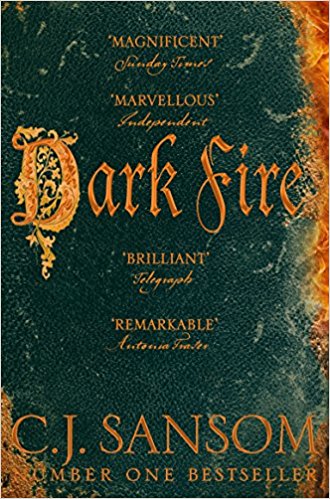
#BookReview ‘Dark Fire’ by CJ Sansom #Tudor #detective

Dark Fire by CJ Sansom is a story of political intrigue, whodunit and a Tudor weapon of mass destruction. Second in the series about Tudor lawyer Matthew Shardlake, Dark Fire combines two criminal mysteries; the appearance and subsequent disappearance of the alchemical formula to make an ancient terrifying weapon, and the impending trial and expected sentencing of a young woman to death by pressing. CJ SansomDespite a tenuous connection between the two cases, and a somewhat meandering pace at times, I enjoyed this book for its further development of Shardlake, first seen in Dissolution. It is 1540, King Henry VIII wishes to anul his marriage to Anne of Cleves, recommended to him by Thomas Cromwell, and marry instead the teenager Catherine Howard. At the beginning of the book Cromwell’s relationship with Henry is weakening and this imposes time pressure on both the novel and on Shardlake. As the novel opens, the lawyer is defending Elizabeth Wentworth, a teenage girl accused by her family of killing her cousin by pushing him down a well. She languishes in the Hole in the cellars of Newgate Prison and refuses to speak. Shardlake, though convinced of her innocence, despairs of being able to help her.
The alchemical formula for Greek Fire, the legendary substance with which the Byzantines destroyed the Arab navies, has been lost for centuries but is discovered in the library of a closed monastery in London by a government official. Cromwell decides to present it to the king as a demonstration of his fealty. He charges Shardlake with finding the Greek Fire within two weeks; to ease this he instructs the postponement of Elizabeth’s case for two weeks. As in Dissolution, Shardlake is once again living every minute under threat of Cromwell’s demands and bad temper. When Shardlake tracks down the official and his alchemist brother, he is too late; both men are dead and the formula is missing. So starts a chase across London.
As always with Sansom, the historical setting is convincingly written with vivid descriptions of the lives of rich and poor, the divisions between them and the melting pot that is the City and its surroundings in Tudor London. As this is the second book of the series, the community around Shardlake is becoming clearer and we see a small group of people who are different. Shardlake with his hunched back; Brother Guy, Moor and apothecary, who is stared at on the streets because of the colour of his skin; Jack Barak, Cromwell’s assistant who is sent to work with Shardlake, is threatened because of his Jewish heritage. Shardlake seems a modern interpretation of a sixteenth century lawyer; he has enlightened views of both race and the role of women, and is becoming disillusioned with religion. These loyalties and views potentially cause trouble for him, adding to the vulnerability that makes him appealing.
A pleasure to read, I am hooked on this series.
CLICK HERE TO READ MORE ABOUT THIS BOOK AT AMAZON

And here are my reviews of other novels by CJ Sansom:-
DOMINION
DISSOLUTION #1SHARDLAKE
SOVEREIGN #3SHARDLAKE
REVELATION #4SHARDLAKE
HEARTSTONE #5SHARDLAKE
LAMENTATION #6SHARDLAKE

If you like this, try:-
The Western Wind’ by Samantha Harvey
The Wicked Cometh’ by Laura Carlin
The French Lesson’ by Hallie Rubenhold

And if you’d like to tweet a link to THIS post, here’s my suggested tweet:
#BookReview DARK FIRE by CJ Sansom https://wp.me/p5gEM4-3Ne via @SandraDanby

#BookReview ‘The Rich Pay Late’ by Simon Raven #historical

It is the eve of the Suez crisis in the Fifties. Written in the Sixties with the benefit of hindsight of this political crisis, The Rich Pay Late by Simon Raven has a modern tone applicable to today’s culture. Greed, disloyalty, snobbishness are common. First of the ten novels in Raven’s ‘Alms for Oblivion’ series, in which a Dickensian cast of characters overlap with each other’s lives, each book is a self-contained story from the end of the Second World War to 1973.Simon RavenThe Rich Pay Late opens as Donald Salinger and Jude Holbrook, co-owners of an advertising agency, discuss the purchase of a financial magazine, Strix. Jude is ambitious but without money, Donald has the cash but is cautious. And so starts the combined theme of gambling/business/love in which everyone is for himself and taking calculated risks is a way of life. Structurally, it is an ensemble story rather than concentrating on one central character; Raven introduces characters with short glimpses, some of one paragraph, of people who start off separate from Donald and Jude until their entwined lives are revealed. Not one character is superfluous.
This is a short novel of 250 pages, but intense. Slow, rich, satirical, it portrays a depressing and bleak take on human nature. The blurred story builds and builds as the appalling characters become real; at times a little dry, I persevered and am pleased I did as the pace of the final third was quicker.
The narrative centres around the sale of Strix and subsequently on a political scandal about Strix’s new board member, Peter Morrison MP. When the magazine’s owner receives the offer to buy his company, Morrison’s vote takes on additional importance. But is he a benefit or a liability?
A tale of politics, media, love affairs and betrayal between a network of upper and upper-middle class men and women with names like Vanessa, Somerset and Jude. In places, the dark humour reminds me of Nancy Mitford’s later novels. There is some discussion amongst reviewers about the correct order in which to read the series, I’m sticking with Raven’s order. Written fourth, he placed this first in his series.

And here’s my review of the next book in the same series:-
FRIENDS IN LOW PLACES #2ALMSFOROBLIVION

If you like this, try:-
Freya’ by Anthony Quinn
Wigs on the Green’ by Nancy Mitford
Hangover Square’ by Patrick Hamilton

And if you’d like to tweet a link to THIS post, here’s my suggested tweet:
#BookReview THE RICH PAY LATE by Simon Raven via @SandraDanby https://wp.me/p5gEM4-3SY

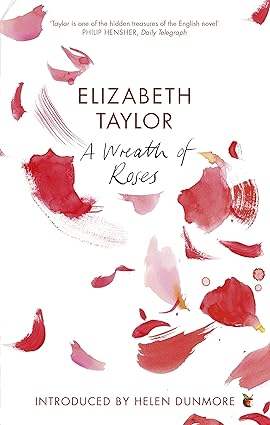
#BookReview ‘A Wreath of Roses’ by Elizabeth Taylor #historical

There are some novels that you want to start read again as soon as you’ve finished it. To appreciate the finer details, unravel sub-text, and simply to admire. A Wreath of Roses by Elizabeth Taylor had that effect on me. Elizabeth Taylor

It is described in reviews as ‘her darkest novel’. What fascinated me was the inter-play between the three key female characters, how they see each other, and themselves, how they behave individually and together. Multiple contradictions complicated by self-delusions and self-awareness. I don’t mean to seem cryptic. The story is simple, as is often the way with Taylor.
In that period after the Second World war when life begins to look normal, the undercurrents of the war experience are everywhere. Camilla and Liz are staying with Frances, Liz’s former governess, for their annual summer holiday. It is a habit forged by years with happy memories of podding peas and sharing stories. Except this year is different. Liz is now married and has brought her baby, Harry. Frances, an artist, is now painting dark tortured pictures rather than feminine florals and portraits. And Camilla has a shocking experience on her journey to stay with Frances; she witnesses a suicide at a train station that makes her melancholy, lonely and inadequate. She looks at herself in the dressing table mirror, ‘Her flesh was golden as an apricot; her hair, in contrast, looked tarnished and harshly bright.’
Taylor inserts three male characters as wedges into the cosiness of the three women. Camilla resents Arthur, Liz’s husband, for taking her friend away. Richard Elton, who with Camilla is there when the suicide happens, is staying at a pub in the village. Camilla feels sorry for him and at the same time attracted to him and will not listen to Liz’s instinctive uneasiness about him. Morland Beddoes is a collector of Frances’ work, he arrives in the village and stays at the same pub as Elton; he too feels uneasy about the man’s motivations. A friendly sort who finds himself the recipient of peoples’ woes, ‘Morland Beddoes was not in the last self-infatuated. He loved himself only as much as self-respect required, and the reason why he saw himself so clearly was that he looked not often, but suddenly, so catching himself unawares.’
This is a dark novel, but not in today’s meaning of psychological thriller. It is a study of ageing, friendship, the power of sexual tension, and it is sublimely written.

Read my reviews of other books by Elizabeth Taylor:-
A VIEW OF THE HARBOUR
ANGEL
AT MRS LIPPINCOTE’S
IN A SUMMER SEASON
THE SLEEPING BEAUTY

If you like this, try:-
‘All My Puny Sorrows’ by Miriam Toews
We Are Water’ by Wally Lamb
All the Birds, Singing’ by Evie Wyld

And if you’d like to tweet a link to THIS post, here’s my suggested tweet:
#BookReview A WREATH OF ROSES by Elizabeth Taylor https://wp.me/p5gEM4-3uV via @SandraDanby

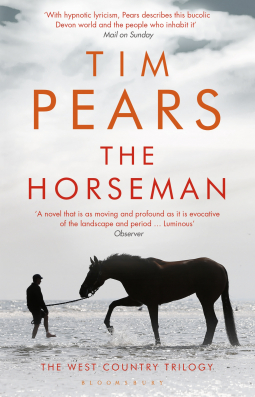
#BookReview ‘The Horseman’ by Tim Pears #historical #Devon

The Horseman by Tim Pears is an account of the slow, meandering life on an estate farm in rural Devon. It is 1911 when, for modern readers, the sinking of the Titanic is not far away and the Great War looms. Two children, born into very different worlds, grow up not far apart; both have a strong love of horses. This novel is billed as a coming-of-age tale but it is also a description of rural farming methods. Tim Pears Told in a month-by-month format, the seasons unfold in a remote Devon valley where the passing of time is marked by the weather and the tasks undertaken on the farm. There is a long list of characters and at the beginning I confused who was who, but gradually they settled into their roles. Leopold Sercombe is the youngest son of the master carter working on the tenant farm of a large estate. He longs to escape school every day to run home and help his father with the horses; these are working animals, cart horses and cobs, they are almost characters. We are there as Noble gives birth; as Leo’s father shares one of the secrets of his trade, the use of dried tansy to give his horses a glossy coat; and the day Leo is given a chance to break Noble’s unnamed colt. “The boy watched the colt, his young lean muscular beauty in motion, then turned and walked towards the fence. There was but one spectator there, sitting on the top pole, feet resting on the lower, a youth in a Homburg hat, shirt, breeches, and riding boots of a sort worn by the master and his kind.” Lottie, daughter of the master, the owner of the estate, challenges the way Leo is handling the colt. And so begins their shared love of horses.
This is a 4* book for me. Why not 5*? Because the relationship between the two children takes a long time to start happening and then ends explosively which seems out of kilter with the spirit and pace of the story; because the slow, slow pace of the story and the passages of overly detailed description at times felt like sections for a ‘how to use farm machinery book’. But Leo is an entrancing character; his gentle authority with horses, his silences and thoughtful behaviour, make it essential to read The Wanderers, second in the trilogy.

Here’s my review of RUN TO THE WESTERN SHORE, also by Tim Pears.

If you like this, try:-
Barkskins’ by Annie Proulx
Anderby Wold’ by Winifred Holtby
Housekeeping’ by Marilynne Robinson

And if you’d like to tweet a link to THIS post, here’s my suggested tweet:
#BookReview THE HORSEMAN by Tim Pears https://wp.me/p5gEM4-3QE via @SandraDanby

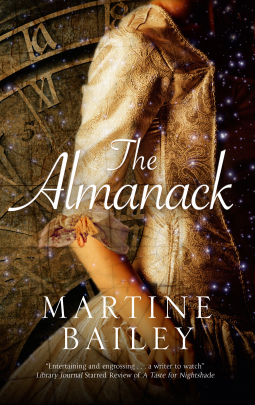
#BookReview ‘The Almanack’ by @MartineBailey #historical #mystery

In 1751, eleven days were lost as Britain aligned with the Gregorian calendar and this is the year in which Martine Bailey sets her third novel, The Almanack. An original mixture of historical mystery, detective novel and romance, it has time as its theme throughout. The passing of time and the fixedness of the past, the slippery unpredictability of the future, and the way our choices made today can impact on the time to come. Martine BaileyTabitha Hart is travelling north from London, home to a village near Chester, summoned by a plea from her mother. On route she is robbed and arrives at Netherlea in shredded clothing to find her mother recently drowned. Tabitha left Netherlea in disgrace and her return is not welcomed by village gossips and officials but she refuses to ignore worries about the nature of her mother’s death. Consulting her mother’s Vox Stellarum, the Chester almanack, she discovers handwritten notes outlining her fears of someone called ‘D’. A childhood friend now village constable, widower Joshua Saxton, offers solid, reliable support as Tabitha struggles to stay in the village, caring for Bess, the baby daughter she left behind with her mother. It is clear Joshua is fond of Tabitha but she does not return his affections; awkwardness complicated when she meets Nat Starling, lodger at Eglantine Hall, a writer of ‘penny oracles, horoscopes and dream lore.’ Tabitha starts to make connections between her mother’s suspicions and the predictions in the printed almanac, written by De Angelo. Could this be the ‘D’ who threatened her mother? But there are many people in the village with the initial ‘D’. Who can she trust?
Almanacks, or printed yearbooks, not only contained a calendar, festival dates, seasonal notes, sunrise and sunset times, planetary alignments, historical facts and other country lore but also riddles, predictions and horoscopes. Exactly the sort of thing hack Nat Starling writes to scratch a living. The theme of time breathes in every chapter, together with the lost eleven days in 1751 that confused the established seasonal calendar. Although the past cannot be changed, memories of the past may vary between people and written records can be amended to tell a different version of the truth. Lies told in the past may in the future be deemed historical fact. And so Starling thinks on the river of time: ‘If he was standing here in the now, then to the left, downriver, the past was disappearing away into the night. Time past could never be changed: what was done was done. If only the past did not stay fixed like dead flies in amber. If only he could live his life again.’
A thoroughly enjoyable historical mystery, there is so much detail in this book it will repay reading. I did not fully engage with the riddles – one precedes each chapter – based on original riddles, with the answers written at the back of the book. Bailey manages the twists and turns of the plot, efficiently hiding the identity of ‘D’ until I finally guessed correctly just before the end. This is Bailey’s third novel and another brilliant read, evidence of her mastery of her period and intricate plotting.

And here are my reviews of other novels by Martine Bailey:-
THE PROPHET #2TABITHAHART
AN APPETITE FOR VIOLETS
THE PENNY HEART

If you like this, try this:-
‘The Cursed Wife’ by Pamela Hartshorne
Orphans of the Carnival’ by Carol Birch
Dark Aemilia’ by Sally O’Reilly

And if you’d like to tweet a link to THIS post, here’s my suggested tweet:
#BookReview THE ALMANACK by @MartineBailey https://wp.me/p5gEM4-3QV via @SandraDanby

#BookReview ‘Blackberry and Wild Rose’ by Sonia Velton @Soniavelton #historical #Huguenot

Blackberry and Wild Rose, the debut novel of Sonia Velton, is entrancing. So many novels are hyped prior to publication but disappoint on reading. This does not. Carefully imagined and cleverly plotted, it kept me reading until the end. It reminded me of Tracy Chevalier’s early novels in which the reader is immersed in a historical world down to the smallest detail. Sonia VeltonBlackberry and Wild Rose tells the story of two women in eighteenth century Spitalfields, London, where the houses are full of weavers and looms clatter every hour of daylight, set alongside the everyday noise, bustle and smells of market stalls, shops, inns and bawdy houses. In 1768, Sara Kemp arrives in Spitalfields from the country, sent away from home by her mother for something she does not understand. Obviously alone and lost, she is taken up by Mrs Swann and put to work in her brothel. Esther Thorel is an Englishwoman married to a Huguenot master of silk. Dissatisfied with her life with a husband obsessed by his business, Esther paints naturalistic flowers which she longs to see reproduced in silk. Dismissed by her husband, instead she fulfils the role expected by her husband and does good works with other Huguenot wives. When the paths of the two women cross one day outside the Wig and Feathers tavern, the lives of many people change. Sara, trying to escape Mrs Swann, must pay an unaffordable sum of money for her freedom. Esther pays the debt and employs her as maidservant in her household. Esther’s husband Elias is unaware of Sara’s background. Both women are blind to each other’s plight. Esther sees Sara as a charitable case, simply helped; Sara despises Esther’s inability to see the truth in front of her nose. It is apparent that there is one set of rules for men, another for women. Though so different, Sara and Esther are essentially trapped by their sex and by their roles, and dependent on the prosperity of the Thorel silk business.
Eighteenth century silk weaving was a highly competitive business, threatened by the import of light, cheap printed cottons imported by the East India Company. As the margins of the masters, including Thorel, are cut, the wages of their journeymen weavers are cut too. The weavers gather together in ‘combinations’, early trade unions, to press their case. Some are militant, issuing ultimatums. Some are violent. As this instability threatens the Thorel livelihood, Esther and Sara individually set off on paths which lead them into a conflict which ends in death. Both must make decisions; to tell the truth and suffer, or to lie and survive.
The woman are credible, contradictory, selfish, generous, often peevish and unlikeable. They are not modern women, with the morals and expectations of modern life, placed into a historical setting. Although both are independent and often wilful, they are eighteenth century women and so may not be to the taste of some readers. The men are similarly selfish, ambitious, deceitful and nasty – with one or two exceptions – and utterly believable. These are not stereotypes, there are characters which redeem faith in human nature, but this is not a novel in which the role of women is enhanced from the factual truth of the time. The story ends with a trial at which the judge says, ‘I understand that all this is difficult for you – a servant and a woman – to understand…’ But the men in this story underestimate the women at their peril.
The story of Esther, silk designer, is loosely based on the real Anna Maria Garthwaite, whose patterns and silks can be seen in London’s Victoria & Albert Museum. The title of the novel is one of Esther’s designs. Excellent.

If you like this, try:-
The Cursed Wife’ by Pamela Hartshorne
The Mermaid and Mrs Hancock’ by Imogen Gowar Hermes
The Penny Heart’ by Martine Bailey

And if you’d like to tweet a link to THIS post, here’s my suggested tweet:
#BookReview BLACKBERRY AND WILD ROSE by Sonia Velton @Soniavelton https://wp.me/p5gEM4-3Q4 via @SandraDanby

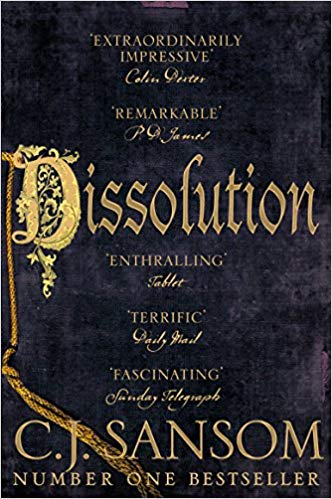
#BookReview ‘Dissolution’ by CJ Sansom #Tudor #detective

Oh my goodness why have I taken so long to read the Shardlake series by CJ Sansom? I was absolutely gripped by Dissolution, first in this Tudor series of mysteries featuring Matthew Shardlake, commissioner for Thomas Cromwell. And now I want to read all the others. CJ SansomIt is 1537. Henry VIII is king and supreme head of the Church of England. A year has passed since Anne Boleyn was beheaded and her successor as queen, Jane Seymour, has just died following childbirth. Cromwell’s team of investigators, or commissioners, are reviewing every monastery across the land. The dissolution of these institutions is expected as Catholic worship is reformed and anglicised. Lawyer Shardlake is sent by Cromwell to the monastery of Scarnsea on the Sussex coast where the investigating commissioner Robin Singleton has been murdered. Cromwell wants a quick solution to the murder so he can tell the king the problem and solution at the same time, and so puts pressure on Shardlake to find the murderer within days.
Shardlake is a great central character; a hunchback, as a boy he turned to his studies when sports and girls seemed impossible. ‘My disability had come upon me when I was three, I began to stoop forward and to the right, and no brace could correct it. By the age of five I was a true hunchback, as I have remained to this day.’ At Scarnsea, Shardlake needs all his bravery and perseverance to unravel Singleton’s murder. There is only one person he can trust, his servant Mark Poer. Everyone else is a suspect. Sansom twists a variety of motives to make every person at Scarnsea a potential murderer and as the story is told totally from Shardlake’s viewpoint, we must consider each piece of new evidence with him. Everyone at the monastery knows their way of life is threatened and some monks fear the changes. But there have been sexual misdeeds in the past, drinking, gambling and, Shardlake comes to suspect, financial fraud too.
When the snow falls, Scarnsea is cut off from the outside world. Shardlake’s investigation is systematic, interviewing monks, examining correspondence, visiting the crime scene, checking financial records, considering potential scenarios. There is a creepiness about the monastery which made me shiver as Shardlake shivered, and not not just from the extreme cold. Threat is ever present, made gloomier by the adjacent marshes.
Dissolution is a terrific book. The historical setting and details are authentic; Shardlake is a compelling protagonist, caught as he is between light and shade, between what he wants to do and what he knows he should do; and the murderer is not obvious.
CLICK HERE TO READ MORE ABOUT THIS BOOK AT AMAZON

And here are my reviews of other novels by CJ Sansom:-
DOMINION
DARK FIRE #2SHARDLAKE
SOVEREIGN #3SHARDLAKE
REVELATION #4SHARDLAKE
HEARTSTONE #5SHARDLAKE
LAMENTATION #6SHARDLAKE

If you like this, try:-
‘The Last Hours’ by Minette Walters
‘The Witchfinder’s Sister’ by Beth Underdown
The Ashes of London’ by Andrew Taylor

And if you’d like to tweet a link to THIS post, here’s my suggested tweet:
#BookReview DISSOLUTION by CJ Sansom https://wp.me/p5gEM4-3zp via @SandraDanby

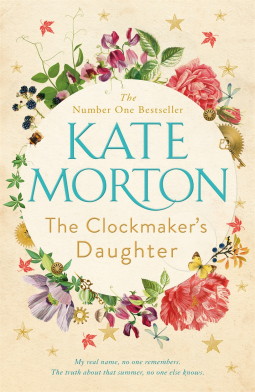
#BookReview ‘The Clockmaker’s Daughter’ by Kate Morton #historical #romance

Kate Morton is strongest when writing about houses, houses with history, atmospheric, beautiful, brooding houses. Birchwood Manor in The Clockmaker’s Daughter is haunted by what happened there. A death, a theft, a drowning. The truth is a complicated tale of twists and turns, Morton gives us numerous characters from slices of history from a Pre-Raphaelite group of artists to National Trust-like ownership today. Kate Morton
The mystery starts from page one, the Prologue, told in the voice of an unknown woman remembering her arrival at Birchwood Manor with Edward. When the rest of the house party leave, ‘I had no choice; I stayed behind.’ Is she a ghost? Cut straight to today and archivist Elodie who unpacks an old leather satchel finds inside a photograph of a woman and an intriguing sketchbook. Leafing through the pages she stops dead, seeing a drawing of a house she knows though she has never been there. It featured in a bedtime story told by her mother. Is it a real place? Does it have magical powers as local tales suggest? ‘It is a strange house, built to be purposely confusing. Staircases that turn at unusual angles, all knees and elbows and uneven treads; windows that do not line up no matter how one squints at them; floorboards and wall panels with clever concealments.’
The mysteries of the drawing, the house, the girl in the photograph and a missing blue diamond are told in multiple viewpoints from 1862 to today. Four big mysteries to unravel means complicated threads woven between the years and the characters and I was tempted to keep notes of who said what and lost track of the year, a couple of times. At the end, I was left with a couple of outstanding questions but nothing to spoil my enjoyment of the book. I found the title rather misleading as Birdie the clockmaker’s daughter, though being one of the key characters, is not the only essential component. The house though is at the centre of everything.
We follow the story of Elodie, whose mother died when she was six and who is about to be married. Of Birdie, who lost her mother when she was four and was left with a baby farmer and trained as a pickpocket. Of Ada Lovegrove who is essentially abandoned by her parents who bring her from India and dump her at Birchwood House, now a school for young ladies. Of Leonard Gilbert, survivor of the Great War, who comes to Birchwood to write a biography of the Pre-Raphaelite artist Edward Radcliffe. Of Jack Rolands who is living now at Birchwood and seems to be searching for something. Of Lucy Radcliffe, Edward’s little sister, and my favourite character. Lucy, a curious little girl, encouraged by her brother to improve her mind by reading, was ‘learning fast that she knew a lot less about her own motivations than she did about the way the internal combustion engine worked.’
Piece by piece, Elodie unravels the true story. The story switches quickly between narrators which can be disorientating and it is only towards the end that some links fit into the bigger picture which makes it a little frustrating. Morton does not write short novels, this is 592 pages, and at times I wanted to cut superfluous detail to get to the meat of the story. A beautiful cover, though.

And here’s my review of another novel by Kate Morton:-
THE DISTANT HOURS

If you like this, try
‘The Man Who Disappeared’ by Clare Morrall
‘The Silent Companions’ by Laura Purcell
‘The Ballroom’ by Anna Hope

And if you’d like to tweet a link to THIS post, here’s my suggested tweet:
#BookReview THE CLOCKMAKER’S DAUGHTER by Kate Morton https://wp.me/p5gEM4-3yi via @SandraDanby