
Summer 1939. Germany has invaded Czechoslovakia. Jews desperate to flee Nazi persecution queue outside embassies in Berlin in the hope of getting a visa, while sending their children on Kindertransport to Britain. In the UK, the IRA’s bombing campaign continues. Scientists in Europe and America are researching atomic fission, and also at the Cavendish Laboratory in Cambridge. It is a vulnerable, combustible time. This is the setting for Nucleus by Rory Clements, second in his trilogy of history professor and amateur spy, Tom Wilde. 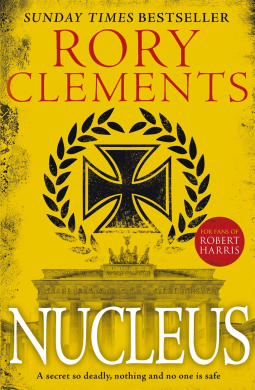 In the first book in the series, Corpus, Tom Wilde was more amateur detective than spy. In Nucleus, the stakes are higher, war is imminent, spies are everywhere and so are traitors. The problem is, they look like friends. Asked by none other than the US president Franklin D Roosevelt to be a ‘clear and unbiased voice’ for him on research at the Cavendish, Wilde is drawn into a world of American millionaires, a Hollywood actress, champagne, tennis parties and horseracing. And then one of the Cavendish physicists, a withdrawn, complicated genius due to move to the USA to work with Oppenheimer, is found drowned in the River Cam. Was he killed because he had unlocked the answer to converting atomic fission into a bomb capable of destroying a city?
Meanwhile, Wilde’s girlfriend and neighbour, Lydia Morris, goes to Berlin on a mercy mission to search for the disappeared eight-year old son of Jewish scientist, Eva Haas, now in England. Could Albert have been kidnapped by the Gestapo to put pressure on his mother? And who is the mysterious German, Baumgarten, who helps Eva and her uncle, physicist Arnold Lindberg, escape to Austria. Tom Wilde, a specialist on Francis Walsingham, spymaster to Queen Elizabeth I, is an interesting protagonist; at times reckless but capable of analysis and leaps of faith.
Corpus was a slow read, at times lightly plotted, but Nucleus an emotional rollercoaster that continues until the last page. Clements avidly recreates the atmosphere of Britain on the brink of war; a summer where parties abound, people approach life with a reckless abandonment, where fear and paranoia combine with a ‘let’s get on with it’ attitude. I enjoyed Corpus but Nucleus is better. The plot twists and turns with all disparate elements connected together by the end. This is a compelling read which I devoured on a plane, sitting up to read it while others slept around me.
Click the title to read my reviews of the other books in the Tom Wilde series:-
CORPUS #1TOMWILDE
NEMESIS #3TOMWILDE
HITLER’S SECRET #4TOMWILDE
A PRINCE AND A SPY #5TOMWILDE
THE MAN IN THE BUNKER #6TOMWILDE
THE ENGLISH FUHRER #7TOMWILDE
And from the Sebastian Wolff series:-
MUNICH WOLF #1SEBASTIANWOLFF
If you like this, try:-
‘The Farm’ by Tom Rob Smith
‘Last Light’ by Alex Scarrow
‘Dominion’ by CJ Sansom
And if you’d like to tweet a link to THIS post, here’s my suggested tweet:
#BookReview NUCLEUS by Rory Clements https://wp.me/p5gEM4-3iZ via @SandraDanby

 Directed by Alfred Hitchcock, Rebecca won 11 Oscar nominations and won two – for Best Picture and Cinematogrophy. Watch the trailer here.
 Various television adaptations include the 1979 BBC production [above] starring Jeremy Brett as Maxim, Joanna David as the second Mrs de Winter, and Anna Massey as Mrs Danvers. Watch the first episode here.


 “When I feel I haven’t had a book grab me in a while, or if I’m in a reading slump, I turn to this book, which is normally about once a year or more if I need it. One thing that draws me back to the book is the emotions in the book and how they have changed as I grew. What I take from the book and how I relate to the characters has changed over the years, it is a brand new book every time I read it. When I first read it I identified with Mark, the main character, but as now that I have my own family I identify with his mum and his lawyer.
 Bronagh seems to have it all; her own flat, a fantastic new job as a party planner and a blossoming romance with long-term friend, Max. Little does she know that someone is plotting to take everything away from her.
 What is a ‘Porridge & Cream’ book? It’s the book you turn to when you need a familiar read, when you are tired, ill, or out-of-sorts, where you know the story and love it. Where reading it is like slipping on your oldest, scruffiest slippers after walking for miles. Where does the name ‘Porridge & Cream’ come from? Cat Deerborn is a character in Susan Hill’s ‘Simon Serrailler’ detective series. Cat is a hard-worked GP, a widow with two children and she struggles from day-to-day. One night, after a particularly difficult day, she needs something familiar to read. From her bookshelf she selects
  “I first read it when I was about fifteen. I have always loved westerns, but this is probably the best western I have ever read. I bought it because I like the author’s style and stories. He is above all a great storyteller. I bought it in the winter and thoroughly enjoyed it. It has a great sense of ‘place’ with writing truly evocative of a cold, frozen climate. I read it every winter and never tire of it. It would in reality be strange to read it in the summer.
 The plot: “King Mabry, an aging gunfighter and cattleman, is travelling to Cheyenne across frozen wastes and is being hunted for what he knows and the gold he is carrying. Thwarting his pursuer, he comes across a troupe of players (being led astray by outlaws), he is attracted to one of troupe and returning to help against his better judgement, tracks them and tries to help. Wounded, he is aided by one of the troupe who escapes. Travelling together they fight Indians, the weather and finally the outlaws in a tense action filled showdown. It is a perfect story of relationships, growth of spirit, survival and romance.”
 Rupert Brett is back and it is 1995, with the property markets raging and the Sub-Prime madness just beginning. The Irish Sea, a shipment of drugs is intercepted, the IRA lose the cocaine and their most feared enforcer, Tir Brennan, is captured. Deauville, a wealthy French aristocrat has a terrible accident with far reaching consequences. Bogota, the head of the old drug cartels is dead and Ballesteros is now running new routes to the US and beyond. The events are all linked and somehow drugs are being smuggled with impunity across the globe. With a source originating in Palm Beach, US, Rupert Brett is again asked to go undercover, with SAS Sergeant Chris Adams as protection. They must find out how the drugs are being smuggled into the corporate world of property, polo and high finance. The answers run deeper than either could imagine and a dangerous former nemesis returns, throwing their lives into turmoil.


 “I don’t read it often, probably once every five or six years, the last time about three years ago. I remember being surprised at how dated some of the dialogue came across, but it was written in the early ‘70s! Even so, I still enjoyed it. There are no particular circumstances that prompt me to read it, but, unusually for me, once in a while I like to go back to it: I know I’m going to love it, and I’ve usually forgotten enough to be surprised. I have bought this book as a present more than any other.
 Martin Gates left the village fifteen years ago because he didn’t belong any more. Now he’s back, and looking for answers. The problem is, no one wants to hear his questions. Well, maybe Tanya McLean, but she has an ulterior motive and her husband won’t like it. In the meantime, a horrific accident leaves a farm worker fighting for his life; a brutal killing triggers a police investigation; and even the locals are falling out amongst themselves. Is Martin’s arrival more than a coincidence? Do the villagers really want reminding of the past? And why are ravens gathering in Sherwood Forest?
 SANDRA DANBY'S BOOK REVIEWS