Tag Archives: women’s fiction

#BookReview ‘The Elopement’ by @AuthorTracyRees #historical

When society beauty Rowena Blythe elopes with an unsuitable artist’s assistant, the repercussions ripple throughout the household and the local community. The Elopement, like other novels by Tracy Rees, is packed with social comment. She shows that while society in 1897 was lived under strict class differences, people were more similar than they realised. Tracy ReesRees tells the story of three women who live in close proximity to each other in Highgate, North London. Housemaid Pansy Tilney works six days a week at Garrowgate Hall, home to the Blythe family and run with a rod of iron by the mistress, Maud Blythe. Rowena, the only daughter of the house, is intended for a suitable marriage if only Maud can find a suitable husband that Rowena will deem to accept. Rowena and her best friend Verity love nothing more than to gossip, especially about those they see as unfashionable, plain, weak or boring. One of their targets is single mother Olive Westfallan. The Westfallen family lives at the opposite side of Hampstead Heath to the Blythes. There is history between the two families as the patriarchs – Rowena and Olive’s fathers – fell out long ago. Olive, who is as rich if not richer than Rowena, pays no notice to gossip about her unusual circumstances. As a single unmarried woman, she adopted a daughter Clover and gave home to a ward, Angeline. She is a working mother, as head of her own charitable foundation she helps less fortunate people take a step up in life, through education, employment or financial aid. There are not two people more different than Rowena and Olive.
Rees brings the three women together in the most unusual of circumstances. Each is facing a life-changing decision and each is prevaricating. Rowena must choose a husband. Pansy must leave Garrowgate Hall and find new employment as the man she loves holds a secret unfulfilled passion for Rowena. Olive must consider whether to accept a marriage proposal from a man she likes, perhaps loves, but isn’t sure if she loves him enough or whether his attitude to life fits hers. These are dilemmas of the time, England on the cusp of the twentieth-century saw the cause of women evolving rapidly. Rees presents opportunities to her three characters, each must be brave in making their decision.
A novel about the solidarity, and also bitchiness, of women. Not all are as they seem. Some get what they want, others don’t know what they want. As the constraints of society’s expectations are loosened, new chances become available, to rich and poor alike. Rowena, who had it all, falls in love with an unsuitable man – an artist, foreign and poor ­– and pays the price for her impetuous decision.
I’ve loved every Tracy Rees novel I’ve read so far. The Elopement didn’t disappoint. It is in fact a sequel to Rees’s The Rose Garden [see below for a link to my review] but it isn’t necessary to read the first to enjoy The Elopement. Each woman must find a way to break free of the limitations of their sex and find a brighter future. So much more than a historical romance.
CLICK HERE TO READ MORE ABOUT THIS BOOK

Click the title below to read my reviews of other novels by Tracy Rees:-
AMY SNOW
DARLING BLUE
THE HOUSE AT SILVERMOOR
THE ROSE GARDEN

If you like this, try:-
After Leaving Mr Mackenzie’ by Jean Rhys
The Walworth Beauty’ by Michèle Roberts
The Ninth Child’ by Sally Magnusson

And if you’d like to tweet a link to THIS post, here’s my suggested tweet:
THE ELOPEMENT by @AuthorTracyRees #bookreview https://wp.me/p2ZHJe-6p9 via @SandraDanby

COMING SOON… THE NEXT BOOK I REVIEW WILL BE:- William Trevor
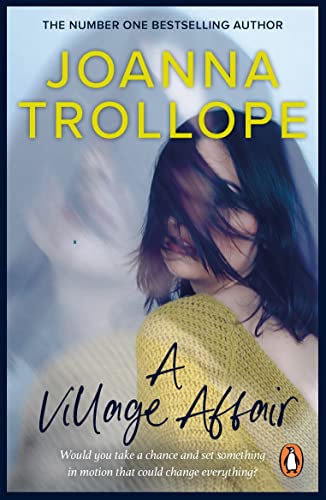
#BookReview ‘A Village Affair’ by Joanna Trollope #familysaga #rereading

The title of this Joanna Trollope novel is so clever. Yes, A Village Affair is about a love affair that takes place in a village. It’s also about a woman’s love for that village, a comfortable middle-class lifestyle and a house, and the reverberations of her subsequent love affair on such a small claustrophobic community. Joanna TrollopeWhen Alice Jordan moves to The Grey House in Pitcombe she knows at last she is living a beautiful life. The house is old and stylish, her husband successful, her three children adorable. She wishes for nothing more and fits comfortably into village routines. So why does it feel as if something is missing. When she falls in love with Clodagh Unwin, daughter of their richest neighbours, the whole village apple cart is upset and Alice’s life is suddenly the opposite of idyllic. ‘Once you had stopped letting things happen and started to make them happen, you couldn’t go back.’
Trollope charts the changes in Alice’s life through the descriptions of her homes. The stifling suburban home where she grew up, her first married home with Martin to the glorious Grey House. It is clear as she bounces from one home and one relationship to another – from smothering mother and silent father, to boring husband Martin, and Cecily, Martin’s cool garden designer mother – that Alice doesn’t know who she is or what she wants. She has fallen in love with a picture postcard image of marriage, but has married the wrong person. When she realises this and becomes open to change, making choices she has never considered before, she then must face the consequences good and bad. Her choices now affect more than just her.
First published in 1990, the story about a gay love affair has dated somewhat awkwardly. The neighbours all have a judgement about the Jordan’s marriage but that is what villages are like, everyone knows everyone else even if they don’t know them well or particularly like them. One village character feels so strongly about what’s happened that she weeps over and over again but ‘couldn’t quite describe what it was that she felts so strongly about.’ Another believes he understands more about poetry than life because, ‘life was often just too peculiar to take in.’
I first read this book thirty years ago and enjoyed again Trollope’s skill at characterization, the small details. Clodagh, in distress, becomes ‘an exotic broken bird with tattered, gorgeous plumage and splintered frail bones showing through.’ Toddler Charlie ‘who had fitted a raspberry on his finger like a thimble and was regarding it with wonder.’
It is possible to feel affronted at the now old-fashioned portrayal of a relationship between two women but this story is really about love full stop. Alice loves Clodagh but also loves her children, her parents and in some way still loves her husband. Love is never simple.
CLICK HERE TO READ MORE ABOUT THIS BOOK AT AMAZON

Here are my reviews of other Trollope novels:-
A PASSIONATE MAN
MUM & DAD
THE CHOIR
THE RECTOR’S WIFE

If you like this, try:-
The Lie of the Land’ by Amanda Craig
The Perfect Affair’ by Claire Dyer
Something to Hide’ by Deborah Moggach

And if you’d like to tweet a link to THIS post, here’s my suggested tweet:
#BookReview A VILLAGE AFFAIR by Joanna Trollope https://wp.me/p2ZHJe-6jI via @SandraDanby

COMING SOON… THE NEXT BOOK I REVIEW WILL BE:- Mick Herron
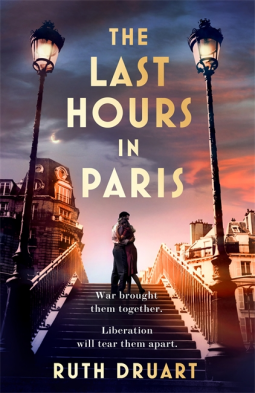
#BookReview ‘The Last Hours in Paris’ by Ruth Druart #WW2

The Last Hours in Paris by Ruth Druart is a different kind of Second World War romance. At times it is a tough read, the hatred is visceral and uncompromising. It feels real. Ruth DruartThis is the story of three people in the last days of occupied Paris and the years following when repercussions continued and the war, though never spoken of, remained tangled in the roots of daily life. Those who fought the Germans, those who stayed behind and lived under German dictatorship. In peacetime everyone must live alongside each other again. The different memories, experiences, losses, are difficult to assimilate.
In Paris 1944 Élise Chevalier a bank clerk by day, secretly helps to smuggle Jewish children from the city. ‘Paris was no longer Paris. It was an occupied city, and even the buildings seemed to be holding their breath, waiting.’ No longer her familiar city, Paris is sinister, threatening, frightening. One day in her favourite bookshop Élise is threatened by two French policemen and is defended by another customer, a German soldier. And so begins the story of Élise and Sébastian Kleinhaus and the terrifying, impossible time in which they live.
In 1963 in rural Brittany, eighteen-year old Joséphine Chevalier uncovers a story about her mother that she could never have imagined. She fears it is impossible to truly know someone. ‘From now on, she’ll always be wondering what part of themselves people are hiding.’
A slow burn to start, Druart takes her time, allowing us to feel connected to the characters as she gradually raises the emotional temperature. The peripheral characters are well drawn, particularly Élise’s younger sister Isabelle, bookshop owner Monsieur le Bolzec and Breton farmer Soizic. Each brings their own experience, judgement and dignity to what is an impossible, unbearable situation for everyone. The definition of family and home, love, protection and separation. ‘Maybe home wasn’t a place at all, but the people you wanted to be with.’
Whatever you may think of what happened in Paris at this time, Druart tells this sensitive story of young people, inexperienced, naive and hopeful, living in a time of such violence and betrayal, of secrets, survival, moralising and vengeance. After surviving the hardships, violence and deprivations of war, how can they adapt to find a new life of possibilities. How can they forgive the secrets and betrayals and move on.
A strongly emotional interpretation of life in occupied Paris that is hardly an obvious setting for a story about love. But this is a love more than romance. It is a love of family, responsibility, truth, sacrifice, forgiveness, of letting go of past hurts and wrongs and looking to the future.
Highly recommended.

Click the title to read my review of WHILE PARIS SLEPT, another World War Two story by Ruth Druart.

If you like this, try:-
Midnight in Europe’ by Alan Furst
The Book of Lies’ by Mark Horlock
After the Bombing’ by Clare Morrall

And if you’d like to tweet a link to THIS post, here’s my suggested tweet:
#BookReview THE LAST HOURS IN PARIS by Ruth Druart https://wp.me/p2ZHJe-5T2 via @SandraDanby

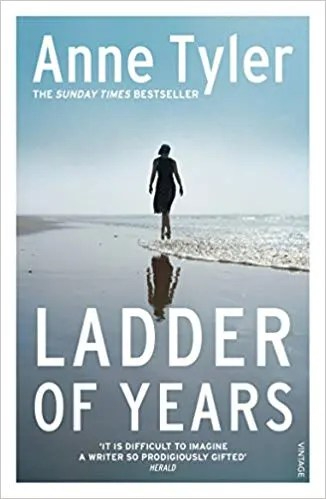
#BookReview ‘Ladder of Years’ by Anne Tyler #contemporary #family

Ladder of Years is another fine character-led drama by Anne Tyler, one of my favourite authors. It is the story of Delia Grinstead who, in a moment of dissatisfaction with her life and relationships, goes for a walk on the beach and keeps on walking. Finding a niche in a small town, with hardly any money and possessions, Delia starts again. And when her family catch up with her and ask her why she left, she cannot find a way to explain. It is twenty-eight years since Ladder of Years was first published. It was chosen by Time magazine as one of the ten best books of 1995. Tyler had already been a Pulitzer Prize finalist in 1986 with The Accidental Tourist and won it in 1989 for Breathing Lessons. All her novels stand the test of time and can be read as if the action takes place today, so accurately is her finger on the portrayal of human emotion.
Adrift from her husband and three almost-adult children in Baltimore and not understanding why, Delia finally tips over the edge while on holiday. She finds herself in Bay Borough, the sort of small town where everyone knows everyone else’s business. She finds a job and a room to rent, buys a couple of secondhand work dresses and a nifty gadget to heat water in a cup so she can make an early morning cup of tea. Delia knows she should let her family know she is safe but is disinclined to do so, feeling she has been taken for granted. Inevitably, one of her sisters arrives on the doorstep. What follows is the story of a woman free for the first time, having married as a teenager and worked all that time as her doctor husband’s receptionist. Free from the expectations of others, she makes a circle of friends on her own terms.
This is a novel about middle-aged stasis and escape, about admitting the truth of one’s own life, choices and possibilities, and that there are no easy answers. Tyler’s characters are always so well-drawn and believable and her observations so wise and true, sometimes uncomfortably so. Here’s an example; ‘Didn’t it often happen, she thought, that aged parents die exactly at the moment when other people (your husband, your adolescent children) have stopped being thrilled to see you coming? But a parent is always thrilled, always dwells so lovingly on your face as you are speaking. One of life’s many ironies.’ Of course, Delia encounters other parent/child combinations in Bay Borough which challenge this theory.
Tyler’s novels deceive; seemingly about small domesticities and passage-of-life-events, they are really about the big, difficult questions we all face as we pass through different phases of life.
Excellent.

Read my reviews of these other books by Anne Tyler:-
A SPOOL OF BLUE THREAD
CLOCK DANCE
FRENCH BRAID
REDHEAD BY THE SIDE OF THE ROAD
VINEGAR GIRL

And read the first paragraphs of:-
DINNER AT THE HOMESICK RESTAURANT 
BACK WHEN WE WERE GROWN UPS

If you like this, try:-
Olive Kitteridge’ by Elizabeth Strout
Mothering Sunday’ by Graham Swift
The Stars are Fire’ by Anita Shreve

And if you’d like to tweet a link to THIS post, here’s my suggested tweet:
#Bookreview LADDER OF YEARS by Anne Tyler https://wp.me/p5gEM4-49S via @SandraDanby

#BookReview ‘Dear Mrs Bird’ by AJ Pearce #WW2 #romance

Sometimes I hear about a book when it is launched but somehow miss the tide. Dear Mrs Bird by AJ Pearce was published in 2018 and two weeks later became a Sunday Times top ten bestseller. In 2019 it was selected for the Richard and Judy Book Club. The first few pages are fresh and engaging, light humour at a time when people when people were living day to day in the Blitz. My only doubt was that I would find the jolly tone too much if it continued for the whole novel. AJ PearceIt is 1941 in London and Emmy Lake applies for a job as a war correspondent and  instead finds herself typing up letters for the problem page of a distinctly faded women’s magazine, Woman’s Friend. The premise is fascinating. The tone is full-on jolly which at times is irritating. The strength of the book for me lies in the second half.
Emmy lives with her friend Bunty on the top floor of Bunty’s grandmother’s house. Both girls have daytime war jobs and volunteer in the evenings. Emmy is frustrated by her boss Mrs Bird’s dismissive rules about letters from emotional young women and starts to reply directly to the women, hiding the letters and posting her replies in secret. When she doesn’t get found out, she becomes bolder, and prints one of her replies in the magazine. Dumped by telegram by her boyfriend, Emmy agrees to go out with Bunty and her boyfriend William and finds herself set up with a blind date. As Emmy’s love life takes a turn for the better, the girls’ friendship is tested as it has never been tested before. Inevitably, Emmy’s letter writing catches up with her in spectacular fashion and she is sent home.
The book is at its best when examining the relationship between Emmy and Bunty, the depth of their loyalty, and what happens when cracks begin to appear. This is a lightweight, cozy war romance which takes a serious tone towards the end. An easy weekend read.

If you like this, try:-
Please Release Me’ by Rhoda Baxter
You’ll Never See Me Again’ by Lesley Pearse
One Step Too Far’ by Tina Seskis

And if you’d like to tweet a link to THIS post, here’s my suggested tweet:
#BookReview DEAR MRS BIRD by AJ Pearce https://wp.me/p5gEM4-49f via @SandraDanby

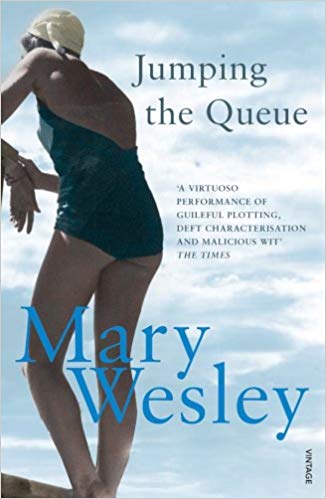
#BookReview ‘Jumping the Queue’ by Mary Wesley #contemporary

Jumping the Queue is a must-read for fans of Mary Wesley’s writing. It is a slim volume about a deadly serious topic. Widow Matilda Poliport prepares to commit suicide. She cleans the house, organises her papers, destroys anything incriminating and gives away her pets. On the day she judges the tide to be favourable, she makes a picnic and takes a bottle of wine to the beach. She plans to wade into the sea and drown. What happens changes the course of Matilda’s death, and life. Mary Wesley This is a quirky mixture of a book with heavy topics which, as you get older, become more familiar and understandable, with dark humour and a touch of forbidden romance. There is also betrayal, all kinds of betrayal actually – between husband and wife, between parents and children, between friends. As Matilda contemplates suicide, she thinks, ‘I am the great betrayer… That is my sin. I am not a sticker. I betray from laziness, fear and lack of interest.’
The story is told from Matilda’s point of view, at times despairing, at times wickedly funny and lusty. It’s hard to believe Jumping the Queue was Mary Wesley’s first adult novel, published in 1983 when she was seventy; its topics are as pertinent today, as then.
Matilda and her husband Tom made a pact, to end it all when they were old and no longer enjoying life. But when Tom dies suddenly in Paris, Matilda is left alone in an isolated West Country house, rarely visited by her four children. The villagers pretty much leave her alone except for her neighbour Mr Jones, who carries a not-so-secret torch for Matilda. But not everything is as it seems. What was Tom really doing in Paris, why don’t the children visit, and does Mr Jones really see UFOs?
When Matilda’s plan at the beach is interrupted by a group of holidaymakers, she retreats to the town to wait. There she meets The Matricide, a man on-the-run, wanted for killing his mother and whose face is in all the newspapers. Matilda is anything but conventional and she doesn’t fear for her safety. The Matricide, whose name is Hugh Warner, checks she understands who he is and that he killed his mother. ‘Of course’, says Matilda. ‘Lots of people long to. You just did it.’
At first glance, this could be a depressing novel about getting older and longing to be out of it. But in fact it is a tale of loyalty, love and trust; just in unexpected places. Thought provoking, sad and uplifting, all at the same

Here’s my review of THE CAMOMILE LAWN, also by Wesley, or read its #FirstPara.

If you like this, try:-
Whistle in the Dark’ by Emma Healey
The Hoarder’ by Jess Kidd
‘The Carer’ by Deborah Moggach

And if you’d like to tweet a link to THIS post, here’s my suggested tweet:
#BookReview JUMPING THE QUEUE by Mary Wesley https://wp.me/p5gEM4-4jF via @SandraDanby

#BookReview ‘In a Summer Season’ by Elizabeth Taylor #classic #love

What a painful, heart-wrenching read is In a Summer Season by Elizabeth Taylor. It is about love – giddying heart-spinning young love, the intensity of teenage crush, the love and companionship of friendship, parental love, second love, age-gap love, tragic love and lust-love. Elizabeth Taylor Widow Kate is seen by friends and family to have married again, unwisely, to a younger man, the charming and feckless Dermot. Kate’s sixteen-year-old daughter Louise hates the way Dermot speaks to her mother, while Kate’s son Tom struggles to make his way in his grandfather’s business and retired teacher Aunt Ethel fears for the new marriage which she believes is founded solely on sex. As Kate adopts new hobbies to fit in with her husband – going to the races, the pub – Dermot feels excluded by the things he doesn’t know, and by Kate’s shared experience with first husband Alan. The household exists in an uneasy alliance. For the first half of the book, this calm is layered with a troubling current eventually brought to the surface by the arrival of Alan’s oldest friend, Charles, and his beautiful daughter Araminta. Tom becomes too caught up in his own calf love for Minty to worry about his mother, Lou falls for the local curate, while Ethel tells all in sensational letters to her friend Gertrude. ‘Ethel had a way of bending her head at closed doors, not listening, as she told herself, but ascertaining.’
None of the characters are endearing. Their paths to the truth, or not, about love – their own love and that of others – their assumptions, misjudgements and blindness, are beset with challenges. Some I forsaw, others I didn’t. Elizabeth Taylor draws a delicately coloured picture of life in a middle-class English family in the Home Counties in the fifties. Times are changing, post-war, particularly the role of women. Kate drifts, used as she was to being the junior partner to her first husband Alan, now she finds herself acting as both mother and lover to her second, younger, husband. Neither are truthful to the other.
More a story of consecutive scenes than a novel with increasing tension, In a Summer Season was published in 1961 and so combines the slower classic style of the older novel, injected with the new sexual tension appropriate to the times. The ending, so long awaited, finally arrived abruptly. My favourite Taylor novel, to date, is A View of the Harbour.
CLICK HERE TO READ MORE ABOUT THIS BOOK AT AMAZON

Read my reviews of other books by Elizabeth Taylor:-
A WREATH OF ROSES
A VIEW OF THE HARBOUR
ANGEL
AT MRS LIPPINCOTE’S
THE SLEEPING BEAUTY

If you like this, try:-
Touch Not the Cat’ by Mary Stewart
My Dear, I Wanted to Tell You’ by Louisa Young
The Confession’ by Jessie Burton

And if you’d like to tweet a link to THIS post, here’s my suggested tweet:
#BookReview IN A SUMMER SEASON by Elizabeth Taylor https://wp.me/p5gEM4-5tQ via @SandraDanby

First Edition ‘The Age of Innocence’ by Edith Wharton #oldbooks #bookcovers

Published in 1920, The Age of Innocence was Edith Wharton’s twelfth novel and the one which would win her the Pulitzer Prize in 1921; the first woman to do so. This [below left] is the American first edition, published by D Appleton.

It is said the first choice of the Pulitzer judges was Main Street by Sinclair Lewis, which was rejected on ‘political grounds’. Wharton’s story first appeared in 1920 in the magazine Pictorial Review, serialised in four parts, then published in book form in the USA by D Appleton.

Edith Wharton

The Age of Innocence – character study by Joshua Reynolds

It is believed the title of the novel was taken from the painting by Joshua Reynolds [above] which was much reproduced in the late 18th century and came to represent the commercial face of childhood.

Edith Wharton

Wordsworth Classics current ed 1994

The current edition by Wordsworth Classics [above] dates from 1994.
BUY THE BOOK

The story
Set in 1870s upper class New York society, The Age of Innocence was set around the time of Wharton’s own birth. She wrote the book had allowed her to find “a momentary escape in going back to my childish memories of a long-vanished America… it was growing more and more evident that the world I had grown up in and been formed by had been destroyed in 1914.”
Gentleman lawyer Newland Archer is due to marry the shy and beautiful May Welland until he encounters May’s cousin. The exotic Countess Ellen Olenska pays no court to society’s fastidious rules and, scandalously, is separated from her husband, a Polish count. To avoid scandal, Ellen is advised to live separately from her husband rather than pursue divorce. Newland tries to forget Ella and marries May but their marriage is loveless. Newland and Ellen meet again and as Newland falls in love with Ellen his behaviour breaks the rules of accepted behaviour. When he finally decides to follow Ellen to Europe, May announces she is pregnant.

Other editions

Films

Edith Wharton

film poster 1993

The 1993 film [above] starring Daniel Day-Lewis as Newland Archer, Michelle Pfeiffer as the Countess Olenska and Winona Ryder as May Welland, was directed by Martin Scorsese. Watch the trailer.
BUY THE DVD

Edith Wharton

film poster 1934

A 1934 film [above] with the same title took inspiration from the Wharton novel but set the action two generations later. Dallas Archer has fallen in love with a married woman, to the displeasure of all his family except his grandfather Newland Archer. And in 1924, a black and white film of The Age of Innocence [below] starred Elliott Dexter as Newland.

Edith Wharton

film poster 1924

If you like old books, check out these:-
It’ by Stephen King 
Ulysses’ by James Joyce
Five on a Treasure Island’ by Enid Blyton

And if you’d like to tweet a link to THIS post, here’s my suggested tweet:
First Edition THE AGE OF INNOCENCE by Edith Wharton #oldbooks #bookcovers https://wp.me/p5gEM4-4aX via @SandraDanby

My Porridge & Cream read… @jane_fenwick60 #books #historical

Today I’m delighted to welcome historical novelist Jane Fenwick.  Her ‘Porridge & Cream’ read is Ross Poldark by Winston Graham.

Ross Poldark was first published in 1946. It’s surprisingly ‘modern’ and fresh even today. I first read it in the 1970s after the saga was made into a TV series. I was intrigued to see how different the two versions were. They were massively different as it turns out, the book being far better.

Jane Fenwick“There are twelve books in all but the first, Ross Poldark, is the one I reread time and time again. I’ve lost count exactly how many times I’ve read it. I go back to it time and time again because it’s like putting on a comfortable pair of old shoes. It always makes me feel better. Also, each time I read it I see something new, some scene which for some reason has new significance, some word choice which adds depth, some character detail I’d missed.

“I’m drawn to this book for two reasons; firstly the main character and secondly the writing style. The central character, Ross Poldark is not a hero, he’s flawed. He makes mistakes but has a conscience and a strong moral compass. Sometimes he is his own worst enemy but you understand his point of view because the reader is witness to not only his actions but his internal dialogue. He’s beautifully drawn.

“Winston Graham was a brilliant writer. The Poldark saga, set in eighteenth/nineteenth century Cornwall, is historically well researched and accurate. As a writer of historical fiction, I find this aspect of his writing very satisfying. WG manages to write unsentimentally about the times but with such warmth and insight that the reader becomes immersed in the story and the lives of the characters. Ross Poldark is the start of the journey and once read it’s impossible not to read the other eleven books in the series. But for me Ross Poldark is my favourite.”
Jane FenwickBUY THE BOOK

Jane’s Bio
Jane Fenwick lives in Settle in Yorkshire, England. She studied education at Sheffield University gaining a B Ed (Hons) in 1989 and going on to teach primary age range children. Jane decided to try her hand at penning a novel rather than writing school reports as she has always been an avid reader, especially enjoying historical and crime fiction. She decided to combine her love of both genres to write her first historical crime novel Never the Twain. Jane has always loved the sea and although she lives in the Yorkshire Dales she is particularly drawn to the North East coast of Yorkshire and Northumberland. This coastline is where she gets her inspiration. As she has always loved history, she finds the research particularly satisfying.

When she isn’t walking on Sandsend beach with her dog Scout, a Patterdale “Terrorist” she is to be found in her favourite coffee shop gazing out to sea and dreaming up her next plot.
Jane is currently writing a historical series again set on the North East coast beginning in 1765. The first two books, My Constant Lady and The Turning Tides were well received. Look out for the third and last in the series Safe Harbour in May 2021.

Jane’s links
Website
Facebook 

Jane’s latest book
Jane FenwickGabriel Reynolds and his stunning red-haired wife Eleanor have settled happily into married life at Westshore… or have they? A woman with a loaded gun, a servant with a grudge, and a buccaneering Irish sea captain seem intent on rocking the boat. When Caroline Hodgeson makes what her ex-fiancé Gabriel sees as an unsuitable match, it sets off a chain of events which will change all their lives. And not for the better.
The Turning Tides, second in the Reynolds seafaring saga, is a tale of jealousy and jeopardy, mistrust and malice. The continuing tale of one man’s love for an unconventional woman.
BUY THE BOOK

What is a ‘Porridge & Cream’ book? It’s the book you turn to when you need a familiar read, when you are tired, ill, or out-of-sorts, where you know the story and love it. Where reading it is like slipping on your oldest, scruffiest slippers after walking for miles. Where does the name ‘Porridge & Cream’ come from? Cat Deerborn is a character in Susan Hill’s ‘Simon Serrailler’ detective series. Cat is a hard-worked GP, a widow with two children and she struggles from day-to-day. One night, after a particularly difficult day, she needs something familiar to read. From her bookshelf she selects ‘Love in A Cold Climate’ by Nancy Mitford. Do you have a favourite read which you return to again and again? If so, please send me a message.
Discover the ‘Porridge & Cream’ books of these authors:-
Sue Johnson’s choice is ‘Jamaica Inn’ by Daphne du Maurier
Sue Moorcroft chooses ‘A Town Like Alice’ by Nevil Shute
Chocolat’ by Joanne Harris is chosen by Kate Frost

And if you’d like to tweet a link to THIS post, here’s my suggested tweet:
Why does @jane_fenwick60 re-read ROSS POLDARK by Winston Graham #books https://wp.me/p5gEM4-58D via @SandraDanby

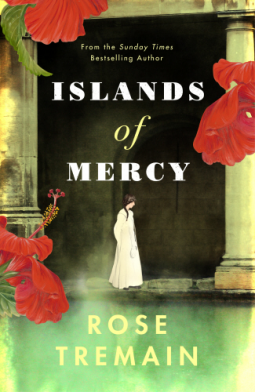
#BookReview ‘Islands of Mercy’ by Rose Tremain #historical

In Bath, England in 1865, such are Jane Adeane’s nursing skills that she is known as the Angel of the Baths. Islands of Mercy by Rose Tremain is about Jane’s destiny to make something of herself, a journey which involves choosing between a tempestuous love affair with another woman and marriage to a respectable doctor. Being the Angel of the Baths is not enough for her and this impacts on the lives of everyone around her. Rose Tremain Islands of Mercy is in fact three stories in one, lightly linked together by the merest connection and fleeting physical meeting. The story starts with Clorinda Morrissey who arrives in Bath from Ireland. ‘She was not beautiful, but she had a smile of great sweetness and a soft voice that could soothe and calm the soul’. By selling a ruby necklace, a family heirloom, Clorinda sets up what becomes a highly popular tea room. It is in this tea room that she first sees Jane Adeane who is taking tea with a man. Jane leaves abruptly and Clorinda is curious why. The man concerned is Doctor Valentine Ross, medical partner of Jane’s father Sir William Adeane and brother of naturalist Edmund Ross, currently pursing butterflies in the Malay Archipelago. In this scene, all three storylines are kickstarted.
The narrative moves back and forth from Bath to London, Dublin and Ireland’s west coast to Borneo. Each place is drawn vividly, Tremain is excellent at settings. In her descriptions of heterosexual and homosexual relationships, she explores the social limitations of the time on the free expression of love for men and women. While Jane can explore her own feelings for another woman only in extreme secrecy and risk of rejection by society, in Borneo a rich ‘rajah’ and his dependent servant live openly. Can Jane make her own way in the world or must she be conventional and marry a man. And can Clorinda’s independence at the tea shop continue or will she come to regret her sale of the ruby necklace. Is money necessary for happiness.
This is an unpredictable read. As Jane’s father Sir William comments, ‘We are overtaken by flashes of lightning and brilliant storms, and we can only submit.’ All the characters act on impulse and not all their decisions make sense, in particular Valentine’s behaviour changes so rapidly he seems a different man.
I was left with mixed feelings. As a Tremain fan dating back to The Colour, I wanted to enjoy this book more than I did. The writing, as always, is of the highest quality but it feels like three novels squeezed into one. I wanted to read more about Clorinda’s story, or concentrate on Jane, rather than go to Borneo which felt like an interruption to the main narrative.
CLICK HERE TO READ MORE ABOUT THIS BOOK AT AMAZON

Read my reviews of these other novels by Rose Tremain:-
LILY
THE GUSTAV SONATA

If you like this, try:-
At Mrs Lippincote’s’ by Elizabeth Taylor
Stanley and Elsie’ by Nicola Upson
Blackberry and Wild Rose’ by Sonia Velton

And if you’d like to tweet a link to THIS post, here’s my suggested tweet:
#BookReview ISLANDS OF MERCY by Rose Tremain https://wp.me/p5gEM4-55D via @SandraDanby