Tag Archives: WW1

#BookReview ‘The Alice Network’ by Kate Quinn @Kate_Quinn #WW1 #WW2

Oh what anticipation, to pick up an unread Kate Quinn book. In The Alice Network, Quinn’s first wartime novel, two strangers are hunting ghosts from the past. A story reaching across both world wars into that other-worldly strange post-war time when music plays, wildflowers bloom and children laugh but the violent truths of war are hidden amongst the weeds. Kate Quinn Southampton 1947. Charlotte St. Clair, a nineteen-year-old American-French girl, arrives with her mother on a boat from America. They are en route to Switzerland where Charlie’s ‘little problem’ will be dealt with and no-one at home need know. But Charlie is desperate to track down her French cousin Rose who has been missing since the end of the war. So she runs away to London to find Evelyn Gardiner, a woman she’s been told may be able to help her. What follows is a road trip to France with Eve and Finn, Eve’s chauffeur and ‘man of all works.’ Eve is a violent drunk. Finn, a taciturn Scot, drives a blue Lagonda and deals with Eve’s nightmares when she waves around a loaded gun. Each one of this unlikely trio is hiding secrets and guilt. If Charlie is to find Rose, Eve must revisit the territory she worked as a wartime spy which means reliving her nightmares. As the trio drive through France, we learn of Eve’s life as a spy in the Great War and why she hates a restaurant owner called René Bordelon.
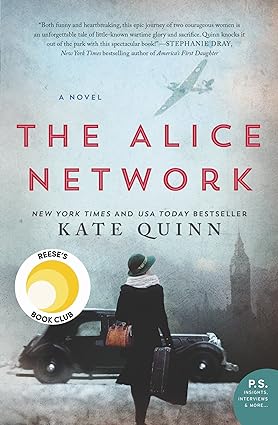
London 1915. Eve, a twenty-two year old orphan, is desperate to do something to help the war effort, something more than typing and filing. Growing up in Lorraine on France’s border with Germany, she is fluent in French, English and German. She is also resourceful, calm, able to lie under pressure and has a stutter that makes people think she is simple-minded. All useful attributes for a spy. After rapid recruitment and training, she arrives in occupied northern France where she meets her new boss. The first piece of advice she receives from Lili, who runs the Alice Network, is, ‘there is no time for fear. It is an indulgence. Turn your ears on and your mind off.’
Excellent. The Alice Network is unputdownable.

Here are my reviews of three other novels by Kate Quinn:-
THE BRIAR CLUB
THE DIAMOND EYE
THE ROSE CODE

If you like this, try:-
‘A Hero in France’ by Alan Furst
‘V2’ by Robert Harris
‘The Ways of the World’ by Robert Goddard #1WIDEWORLD

And if you’d like to tweet a link to THIS post, here’s my suggested tweet:
#BookReview THE ALICE NETWORK by Kate Quinn @Kate_Quinn https://wp.me/p2ZHJe-8Td via @SandraDanby

COMING SOON… THE NEXT BOOK I REVIEW WILL BE:- Toby Clements
#BookReview ‘Precipice’ by Robert Harris @Robert_Harris #WW1 #thriller

A gripping, page-by-page account of the prelude to war interleaved with the secret letters and snatched meetings of a forbidden relationship between the prime minister and a young society woman. I read Precipice by Robert Harris over a weekend, resenting anything that forced me to set the book aside. Robert HarrisThat the man involved is Prime Minister Herbert Asquith, that the story starts in the days preceding the declaration of war against Germany, that the fictional account is based on truth, all adds to the frisson. Harris is a master storyteller used to creating a fictional thriller based on historical fact. It ceased to matter what was true and what was made up, Harris puts us inside the private worlds of Asquith and Lady Venetia Stanley at a time of national danger. We all know how the war begins and ends but I didn’t know the details of the Asquith/Stanley affair or the level of reckless sharing by Asquith of privileged information; using ordinary post, top secret telegrams thrown from car windows. ‘That was a kind of madness.’ Letters were written, sent, received and replied to, with such speed and in such volume as to resemble a frantic exchange of emails or texts between lovers today.
Harris’s genius is to add the fictional character of young policeman Detective Sergeant Paul Deemer, a new recruit at Special Branch, who is charged with looking into the torn remnants of secret Government documents found in the road and handed in by a member of the public. Deemer adds the element of risk that the story needs, a sense of danger as the sergeant uses old-fashioned policing technique – asking questions, following leads, covert surveillance, gathering evidence – in the chase to uncover the truth. Meanwhile, uncannily accurate comments about military matters are appearing in the Daily Mail. From where is the newspaper getting its information? Is the Prime Minister blinded by love? Is he incompetent, perhaps a traitor? Or is someone close to him a spy?
This is a political story about war, about ambition, obsession, showing government tensions at the most pressurised time possible as the country faces tremendous change. I turned to Harris after an unsatisfactory attempt to read another novel, it was like gulping water at a time of extreme thirst.

Read my reviews of these other thrillers, also by Robert Harris:-
AN OFFICER AND A SPY
MUNICH
V2

and try the #FIRSTPARA of THE GHOST, also by Robert Harris

If you like this, try:-
Life Class’ by Pat Barker #LIFECLASS1
‘The Warm Hands of Ghosts’ by Katherine Arden
‘The Lie’ by Helen Dunmore

And if you’d like to tweet a link to THIS post, here’s my suggested tweet:
#BookReview PRECIPICE by Robert Harris @Robert_Harris https://wp.me/p2ZHJe-8ub via @SandraDanby

COMING SOON… THE NEXT BOOK I REVIEW WILL BE:- Michelle Paver

#BookReview ‘The Warm Hands of Ghosts’ by Katherine Arden @arden_katherine #WW1 #mystery

The Warm Hands of Ghosts by Katherine Arden is a historical fantasy about a Great War nurse who returns to the Flanders battlefield to find her brother, believed dead. Part-history, part-ghost story, part-magical realism, part-mystery, there are times when I didn’t know what to believe. Katherine ArdenHaving already served as a nurse in the trenches, Canadian Laura Iven is back at home in Halifax, recovering from the injuries she sustained while nursing. But she isn’t there for long. After the shocking death of her parents in an explosion in Halifax, Laura receives a package from Belgium; her brother Freddie’s uniform and dog tags. The assumption is that he is dead. But Laura receives no official confirmation that he is dead or missing. Disturbed by supernatural possibilities and questions raised at a séance, she decides to return to Belgium to find Freddie.
Laura and Freddie’s stories are told in alternating sections in a timeline that jumped around in a disorientating way; which made me identify with the dislocation and giddiness of Laura’s circumstances. Freddie Iven awakes in No Man’s Land after an explosion and finds himself trapped in mud beneath an overturned pillbox. His only companion is an injured German soldier. Should he kill his enemy. Or can they help each other. If they escape, where should they go. Escaping into the hellish landscape of mud and putrefaction they stay together and wander, lost both emotionally and geographically. Until they meet a fiddler, a man who entertains, who makes the horror of war disappear for a brief time. Is he real, and what is his unspoken motivation? Exhausted, their decision-making puts them in danger. Freddie risks being shot as a deserter, Winter as an enemy.
Laura, now volunteering at a private hospital behind the lines, learns to ride a motorcycle so she can search for Freddie or anyone who remembers him. Troubled by her own trauma, Laura’s nightmares become more vivid. She hears talk of ghosts that move about among living people, and a hotelier who offers soldiers the chance to forget their terrors. Seen once, this man and his hotel can never be found again. Is he real, or another ghost. Laura is a likeable heroine. At times dogged in her determination, unattractively so for the times, and sometimes tin-eared, I was willing her on in her search for Freddie. As the traumas of present-day and past war experiences combine, the ability to differentiate between real life, facts, dreams and superstitions becomes transient.
This is an unusual take on the familiar World War One themes. Powerful, harrowing, it examines the nature of what it takes to fight in a war and kill another human being, when the enemy soldier is really an ordinary man like yourself. Thought-provoking.

Read my reviews of the Winternight trilogy, also by Katherine Arden:-
THE BEAR AND THE NIGHTINGALE #1WINTERNIGHT
THE GIRL IN THE TOWER #2WINTERNIGHT
THE WINTER OF THE WITCH #3WINTERNIGHT

If you like this, try:-
‘Another World’ by Pat Barker
A Long Long Way’ by Sebastian Barry
The Lie’ by Helen Dunmore

And if you’d like to tweet a link to THIS post, here’s my suggested tweet:
#BookReview THE WARM HANDS OF GHOSTS Katherine Arde@arden_katherine https://wp.me/p2ZHJe-7Xy via @SandraDanby

COMING SOON… THE NEXT BOOK I REVIEW WILL BE:- SJ Parris

#BookReview ‘You’ll Never See Me Again’ Lesley Pearse@LesleyPearse #WW1 #romance

When a character in a film says ‘never’ it’s a sign that the impossible thing will definitely happen before the end. Such is the title of the new novel from Lesley Pearse,You’ll Never See Me Again. Lesley PearseIt is 1917 and a storm is thrashing the Devon coast at Hallsands. Betty Wellows is with her shell-shocked husband Martin at his mother’s home, safely up the cliffs. Martin no longer recognises Betty, he is a different man from the fisherman who went to war. Betty is working all hours to support her husband and his mother, putting up with insults, petty grievances, grief for the loss of her husband. As the storm becomes wild and dangerous, Agnes instructs her daughter-in-law to go to her own house beside the beach to rescue her belongings from the flood. Afraid, Betty escapes the older woman’s abuse and runs into the storm. As the waves crash into her home, Betty realises this is her chance to escape Hallsands, Agnes and Martin.
The dramatic opening grabbed my attention and my emotions. Betty is trapped in a life of poverty with a husband who no longer recognises her and a mother-in-law who takes her money and treats her like a skivvy. When she has the chance to escape, Betty takes it. I spent the whole novel chewing over Betty’s dilemma; was she right to run, should she have stayed. Pearse maintains this dilemma throughout the book as Betty goes to Bristol where she changes her name to Mrs Mabel Brook, a widow. You’ll Never See Me Again is the story of how a lone woman in the middle of the Great War is able to strive to improve her lot in life. Mabel suffers setbacks, encounters thieves and frauds, and sheds copious tears. There are moments where her life seems to have reached a settled, easier place; but, of course, more trauma lies ahead.
This is a cleverly plotted book that kept me guessing to the end. Mabel at times is her own worst enemy, and she finds it difficult to accept help. Then she accidentally discovers a talent she never knew she had. When she moves to Dorchester, Dorset, to be a live-in servant/housekeeper for illustrator Miss Clara May, Mabel’s life takes a new turn. Nearby is a prisoner of war camp and one of the inmates, Carsten, looks after Clara’s garden. Carsten and Mabel fall into a state of mutual liking when Spanish flu strikes at the camp; afraid for Carsten’s health, Mabel volunteers as a nurse.
Mabel ran away from Hallsands to be free, but her past travels with her. Finally she must confront her origins in order to move on with her life. Mabel has a strong sense of honesty and justice, which sounds odd given the way she ran away in chapter one. But she is unselfish, never turning away from difficult decisions and transforming herself in a short space of time into a beautiful, assured woman that her neighbours at Hallsands would not recognise.

Here’s my review of THE HOUSE ACROSS THE STREET, also by Lesley Pearse.

If you like this, try:-
One Step Too Far’ by Tina Seskis
Sometimes I Lie’ by Alice Feeney
The Girls’ by Lisa Jewell

And if you’d like to tweet a link to THIS post, here’s my suggested tweet:
#BookReview YOU’LL NEVER SEE ME AGAIN by Lesley Pearse @LesleyPearse https://wp.me/p5gEM4-3ZO via @Sandra Danby

#BookReview ‘Another World’ by Pat Barker #WW1

World War One, a speciality of Pat Barker, is present in every page of this tale of war veteran 101-year old Geordie, living through his final days with his grandson Nick. Woven through Geordie’s story are the threads of Nick’s life, his extended family involving wife, step son and half-siblings. In the modern day there are tensions between siblings, as there were between Geordie and his brother. Pat BarkerPat Barker is an author who does not flinch from showing the human reactions that in real life we prefer to hide: sibling jealousy, sibling hate and underlying it all, selfishness. How these emotions affect this family, from 101-year old Geordie to his great-grandson Jasper, a toddler, is fascinating and often a difficult read.
A sideline from the main story is the life of the family who lived in the house where Nick has just moved with pregnant wife Fran, Fran’s son Gareth, and Fran and Nick’s son Jasper. Also visiting is Miranda, Nick’s daughter. I said the family ties were twisted. Tidying an overgrown rose on the wall of the house, Nick unveils a plaque labelled ‘Fanshawe’. This is the name of the family who lived in this house, Fanshawe made his money from armaments. When parents and children strip wallpaper off the walls, they unveil a portrait of a family. Is it the Fanshawes, or is it them? And so Barker introduces the ghostly strand with uncanny echoes between then and now.
This is a slim volume, read quickly, but not so quickly as to miss the delicacy of Barker’s writing. Here is Nick on his grandfather: ‘Nick feels he’s never known him, not because they’ve been distant from each other – far from it – but because they’ve been too close. It’s like seeing somebody an inch away, so that if you were asked to describe them you could probably manage to recall nothing more distinctive than the size of the pores in their nose.’
A slim volume with such acute observations about human nature, Another World makes you feel uncomfortable and ask questions of yourself. I read every novel Barker writes. Her ‘Regeneration’ trilogy, including the 1995 Booker Prize-winning The Ghost Road, is a must.

For my reviews of other Pat Barker novels, click the title below:-
BLOW YOUR HOUSE DOWN
DOUBLE VISION
LIFE CLASS #1LIFECLASS
TOBY’S ROOM #2LIFECLASS
NOONDAY #3LIFECLASS
THE SILENCE OF THE GIRLS #1WOMENOFTROY
THE WOMEN OF TROY #2WOMENOFTROY
THE VOYAGE HOME #3WOMENOFTROY
UNION STREET

If you like this, try:-
‘The Lie’ by Helen Dunmore
‘Wake’ by Anna Hope
‘A Long Long Way’ by Sebastian Barry

And if you’d like to share this post, try:
#BookReview ANOTHER WORLD by Pat Barker http://wp.me/p5gEM4-1NY by @SandraDanby

#BookReview ‘Toby’s Room’ by Pat Barker #WW1 #historical

As the second book of a trilogy by Pat Barker, Toby’s Room can be read also as a standalone novel. The Toby of the title is the brother art student Elinor Brooke, whose story is told in Life Class. This story starts further back in time with a secret shared by the siblings, something not hinted at in the first book. In fact this whole book is about secrets, things hidden for shame, war too horrible to talk about, fear and emotions to be ashamed of, and things simply not spoken. Society was very different then, pragmatism coloured everyday lives, people did what they had to and tried to forget the bad things. Pat BarkerToby is reported ‘Missing, Believed Killed’, a parcel of his belongings is returned. Elinor believes the true story is being hidden and enlists fellow art student Paul Tarrant – who returned from Ypres injured and is now an official war artist – to help. She believes another war artist, Kit Neville, who served with Toby, must know the truth but refuses to say. Kit suffered a horrific face injury and is being treated at Queen Mary’s Hospital in Sidcup. Visiting Kit there they find not only Kit but Henry Tonks, their intimidating professor at the Slade School of Art.
The facial reconstructions at Sidcup are well documented, not least by the medical drawings of patients by Tonks and his team. Once again, Barker uses a true story and seamlessly inserts her fictional characters. And yet again, Barker combines a study of individuals at war while considering the role of art in conflict. As official war artists, Kit and Paul struggle with the limitations they are given, the portrayal of reality is forbidden. As I read every page of this book, the image which stayed in my mind was Paul Nash’s ‘We Are Making a New World’ (see below).

Paul Nash

(c) Tate; Supplied by The Public Catalogue Foundation

For my reviews of other Pat Barker novels, click the title below:-
ANOTHER WORLD
BLOW YOUR HOUSE DOWN
DOUBLE VISION
LIFE CLASS #1LIFECLASS
NOONDAY #3LIFECLASS
THE SILENCE OF THE GIRLS #1WOMENOFTROY
THE WOMEN OF TROY #2WOMENOFTROY
THE VOYAGE HOME #3WOMENOFTROY
UNION STREET

If you like this, try:-
‘Stay Where You Are and Then Leave’ by John Boyne
The Inheritance of Solomon Farthing’ by Mary Paulson-Ellis
‘The Ways of the World’ by Robert Goddard #1WIDEWORLD

And if you’d like to share this post, try:
#BookReview TOBY’S ROOM by Pat Barker via @SandraDanby http://wp.me/p5gEM4-1Qx

#BookReview ‘Life Class’ by Pat Barker #WW1 #historical

Pat Barker is one of my top five novelists. She writes sparingly with not a word wasted, but creates a world so real with detail and characterization. Life Class is the first of her #LifeClass trilogy of novels which tell the story of brother and sister Elinor and Toby, and Elinor’s fellow art students Paul and Kit, through the Great War. I first read this book when it was published in 2007 and devoured it. I have re-read it now to refresh my memory of the story and characters, before I read the newly published third volume of the trilogy, Noonday. Pat BarkerThe story starts in 1914 in a life-drawing class at the Slade School of Art in London. The class is taken by Professor Henry Tonks, a real-life character, artist and surgeon. Barker weaves her fictional story around the true story of Tonks, the Slade, and the outbreak of the Great War. For student Paul Tarrant, the presence of Tonks is intimidating, as he struggles to find his identity as an artist. This is a novel about young people and their journey from youth to maturity via art and love, brutally influenced by the horrors of war. Interwoven with Paul’s story – he volunteers as an ambulance driver and goes to Ypres, working in a hospital – is that of Elinor Brooke, fellow art student. Elinor’s journey to adulthood is different, given that she is a woman at a time when middle-class women are not expected to have a career. She remains in London, continues to paint and mixes with the society group of Lady Ottoline Morrell, another true character, mixing with pacifists, conscientious objectors and the Bloomsbury Group.
Essentially, this is a triangular love story set into the structure of war. As the students struggle to define themselves as artists, their safe world collapses around them and the abnormal becomes normal. As Paul undertakes gruesome nursing tasks, he questions the purpose of war art and what it can achieve. As his life becomes surreal, so he is cast adrift from his former life without context to judge either his ability as an artist, or his humanity in the face of war. Are some things simply too horrific to paint?

For my reviews of other Pat Barker novels, click the title below:-
ANOTHER WORLD
BLOW YOUR HOUSE DOWN
DOUBLE VISION
TOBY’S ROOM #2LIFECLASS
NOONDAY #3LIFECLASS
THE SILENCE OF THE GIRLS #1WOMENOFTROY
THE WOMEN OF TROY #2WOMENOFTROY
THE VOYAGE HOME #3WOMENOFTROY
UNION STREET

If you like this, try:-
‘A Long Long Way’ by Sebastian Barry
‘The Lie’ by Helen Dunmore
‘Wake’ by Anna Hope

If you like this, try:-
#BookReview LIFE CLASS by Pat Barker http://wp.me/p5gEM4-1Q3 via @SandraDanby

#BookReview ‘Wake’ by Anna Hope #historical #WW1

Amongst the profusion of novels about the centenary of the Great War, Wake by Anna Hope stood out for me from the rest because it is about the aftermath rather than the fighting. The spine of the narrative is the journey of the body to be entombed in Westminster Abbey as the ‘Unknown Soldier.’ Anna HopeI have visited the tomb but had not considered its selection, the post-war politics and social consequences of choosing one soldier’s remains rather than another. Anna Hope handles a delicate topic – isn’t everything to do with war emotionally-delicate? – with confidence. Wake is a powerful novel by a debut author.
There is something unsettling about the first scenes where un-named soldiers drive out into what was no-man’s-land, not knowing where they are going or why. They are directed to dig up the remains of a soldier: unidentified soldiers dig up the remains of an unidentified victim. Four bodies are laid out, not so much bodies as heaps of remains. A Brigadier-General closes his eyes and rests his hand on one of the stretchers, this body is put into a thin wooden coffin. The three not chosen are put into a shell hole at the side of the road, a chaplain says a short prayer, and then re-buried. The chosen one is taken to London.
Three storylines run parallel to this central spine. Hettie and Di are dancers at the Hammersmith Palais. Charging 6d for a dance, Hettie is skilled at spotting the injured soldiers who are disguising the lack of a limb, she is skilled at matching the rhythm of her dancing to theirs. Dancing is the bright spot in her life; her home is under the shadow of her father’s death and her brother’s shell shock.
Evelyn works in a Government department, her job is grey, her surroundings are grey. She is no longer close to her brother who returned from the war seemingly uninjured but is emotionally removed from life. Every day she deals with former soldiers, struggling to make a new life, and each soldier she sees reminds her of her lover who died in the war. She wants to move on from the war but feels that she, like everyone else, is trapped in a cycle of grief, disability, guilt and memory.
Ada is still grieving for her son, a grief which puts distance between her and her husband. Her solace is her neighbour Ivy, also grieving. Then one day an ex-soldier knocks on the door, wanting to sell her dishcloths, and something happens which sends her to a medium.
All are drawn to the streets of London on November 11th, 1920, looking for catharsis.

Read my review of THE BALLROOM, also by Anna Hope.

If you like this, try:-
‘Life Class’ by Pat Barker
‘A Long Long Way’ by Sebastian Barry
‘The Lie’ by Helen Dunmore

And if you’d like to tweet a link to THIS post, here’s my suggested tweet:
#BookReview WAKE by Anna Hope via @SandraDanby http://wp.me/p5gEM4-LK

#BookReview ‘The Lie’ by Helen Dunmore #WW1 #historical

I found this to be an unbelievably poignant novel. In The Lie by Helen Dunmore, Daniel Branwell has returned home to Cornwall from The Great War. The stories of his childhood, his war, and his return are interwoven seamlessly. It is also the story of all the lost men who returned from fighting in 1918 and didn’t know where to go or what to do. They faced their futures alone, unsure if they were mad, if their memories of war were correct or whether they were strong enough to resist the memories of carnage. Dan’s life unfolds like a thriller, with mysteries and suspicions, so that I turned the pages looking for answers and before I knew it I had reached the end. Helen DunmoreDunmore is an accomplished novelist and poet who handles her emotionally explosive subject with sure hands, juxtaposing the daily reality of post-war Cornwall with Dan’s memories, perhaps true, perhaps confused, of battle. Truth is the unknown. The war is in every move Dan makes, every thought, every dream. Needing food, he digs the earth to plant vegetables but cannot escape the battlefield: “It was the smell of earth. Not clean earth, turned up by spade or the fork, to be sunned and watered. This earth had nothing to do with growth. It was raw and slimy, blown apart in great clods, churned to greasy, liquid mud that sucked down men or horses. It was earth that should have stayed deep and hidden, but was exposed in all its filth, corrosive, eating away at the bodies that had to live in it. It breathed into me from its wet mouth.”
Soil is an important presence throughout the book. Dan is a gardener, a skill he soon finds on joining the army will not exempt him from fighting as it does the blacksmiths, chefs and mechanics. “Skilled men had their hands full, and weren’t likely to find themselves in the fire-trench. But there wasn’t any call for a gardener. You’d be marched through a village which had been knocked to bits by shelling, and all there’d be left of a hundred gardens was a bit of green straggling out of a gash in a wall.” Instead, Dan digs. Fields don’t look the same as the fields in Cornwall. “Once you got near the line, there wasn’t much you could recognise as a field, any more than the woods were woods. It was all a jumble.”
His childhood in Cornwall with his best friend Frederick, and Frederick’s sister Felicia, resonates throughout the book. Their differences – poor boy and rich boy, the squaddie and the officer – are at the centre of the book. Dan visits their large house with its library full of shiny red-leather bound volumes, smuggling out one book at a time up his jumper. He reads and memorizes: “I hoarded new words and brought them out like coins.” Frederick, who is sent to private school, has no mind for books and envies Dan’s photographic memory. But when war comes, Frederick is sent to officer school and Dan to basic camp.
In Belgium, before the night-time trench raid which changes their lives, Frederick asks Dan to recite a poem. The prospects of the two men are so fragile that the juxtaposition of war and the poem by Matthew Arnold cannot help but be moving:
“And we are here as on a darkling plain
Swept with confused alarms of struggle and flight,
Where ignorant armies clash by night.”
When Dan returns to Cornwall he has nowhere to go. As he struggles to survive, shunning company, preferring solitude, he meets Felicia again. The memories come flooding back and he struggles to repel them.

Read my reviews of two other novels by Helen Dunmore:-
BIRDCAGE WALK
EXPOSURE

If you like this, try:-
‘Wake’ by Anna Hope
A Long Long Way’ by Sebastian Barry
The Bone Church’ by Victoria Dougherty

And if you’d like to tweet a link to THIS post, here’s my suggested tweet:
#BookReview THE LIE by Helen Dunmore http://wp.me/p5gEM4-Lw via @SandraDanby

#BookReview ‘Stay Where You Are & Then Leave’ by John Boyne @JohnBoyneBooks #WW1

I’m sure Stay Where You Are & Then Leave will be the first of many books about the First World War which I will read over the next two years [written in 2013], and what a one to start with. Written by John Boyne, probably best known for The Boy in the Striped Pyjamas, this is a touching story of a boy’s determination to help his soldier father. John BoyneDestined to become a children’s classic, it is a tough tale with a tender touch. Boyne doesn’t shy away from the difficult subjects of enemy aliens, conscientious objectors, loss, injury, death and fear. On July 28th 1914, war is declared. It is also Alfie Summerfield’s fifth birthday. His biggest wish is to go one morning with his father Georgie on the milk cart with his horse Mr Asquith. Life changes for Alfie and his mother without Georgie. As the years pass, Alfie stops believing the grown-ups who say the war ‘will be over by Christmas’. Then his father’s letters stop arriving. Alfie’s mother says Georgie is ‘on a special mission and cannot write’ but Alfie doesn’t believe her. He doesn’t like being treated as a child, so he decides to do something about it.
This is a story about belief, empowerment, and the strength of children in adversity.

Read my reviews of these other novels by John Boyne:-
A HISTORY OF LONELINESS
A LADDER TO THE SKY
A TRAVELLER AT THE GATES OF WISDOM
ALL THE BROKEN PLACES
THE HEART’S INVISIBLE FURIES… Curious? Read the#FirstPara of THE HEART’S INVISIBLE FURIES here.
WATER #1ELEMENTS
EARTH #2ELEMENTS

If you like this, try:-
‘Himself’ by Jess Kidd
‘Ghost Moth’ by Michele Forbes
‘Nora Webster’ by Colm Tóibín

And if you’d like to tweet a link to THIS post, here’s my suggested tweet:
#BookReview STAY WHERE YOU ARE AND THEN LEAVE by John Boyne @JohnBoyneBooks https://wp.me/p2ZHJe-4bh via @SandraDanby