Author Archives: sandradan1

Unknown's avatar

About sandradan1

Novelist. I blog about writing, reading and everything to do with books and writing them at http://www.sandradanby.com/. Come and visit me!

My Porridge & Cream read: Jackie Baldwin

Today I’m delighted to welcome Scottish crime writer Jackie Baldwin. Her ‘Porridge & Cream’ read is Little Women by Louisa May Alcott.

“The book that has never failed to delight and soothe me over the years is Little Women by Louisa May Alcott. I must have been in my early teens when I first read it and so embarking on a turbulent adolescence of my own alongside those of the March girls. At a girls school and with no brothers, the world of boys was something of a mystery to me too so I loved the character of Laurie and the subtle shifts and turns in his relationships with all the girls over the scope of the novels. Jackie Baldwin“I have had many copies of the book over the years but this one [above] is my favourite as it contains all three books in the series. Part of its enduring appeal for me is the characters who are all just flawed enough to make them endearingly frail and human. My favourite character is Jo who is unruly and tempestuous and rails against the confines of poverty and the expectation that women should conform to the domestic role expected of them rather than pursue any ambitions of their own. There is also a small broken piece of my heart that will forever be in thrall to Beth who shows just how much a small life can matter and influence those around it.

“I have read it a few times over the years and the types of things that might encourage me to pick it up are if life feels a bit too overheated and I want to escape for a while into another gentler time where courage and strength of character always triumph over adversity.

“If I had to sell Little Women in an elevator pitch it would run something along these lines. ‘The story of a family who are in poverty but not impoverished and rise to meet adversity with an outstretched hand and a warm smile.’

“Thanks for reminding me how much I love this book, Sandra! In fact, now that it’s off the shelf, I think it might be time to meet up with some old friends again…”

Jackie Baldwin’s Bio
Jackie Baldwin is a Scottish crime writer. Her debut crime novel Dead Man’s Prayer was published by Killer Reads, Harper Collins on 2ndSeptember 2016. The second in the series, Perfect Dead was published on 15thJune 2018. For most of her working life, she has been a solicitor specialising in Family and Criminal Law. However, she now practices in Dumfries as a hypnotherapist which is where her novels are set. Married, with two grown up children, she has filled her empty nest with Golden Retrievers. She can often be found in a forest walking the dogs, covered in mud and with twigs in her hair.

Jackie Baldwin’s links
Facebook
Twitter

Jackie Baldwin’s latest book
Each murder brings him one step closer to the perfect death. Ex-priest, DI Farrell is called on to investigate a gruesome death in rural Scotland. All evidence points to suicide, except for one loose end: every light in the cottage was switched off. Why would he kill himself in the dark?

The question sparks a murder investigation that leads to the mysterious Ivy House, home of ‘The Collective,’ a sinister commune of artists who will do anything to keep their twisted secrets hidden.

And when the remains of a young girl are uncovered on a barren stretch of coastline, Farrell realises that there is something rotten in this tight-knit community. Now he must track down a ruthless killer before another person dies, this time much closer to home…

‘Perfect Dead’ by Jackie Baldwin, #2 DI Frank Farrell [UK: Killer Reads]


What is a ‘Porridge & Cream’ book? It’s the book you turn to when you need a familiar read, when you are tired, ill, or out-of-sorts, where you know the story and love it. Where reading it is like slipping on your oldest, scruffiest slippers after walking for miles. Where does the name ‘Porridge & Cream’ come from? Cat Deerborn is a character in Susan Hill’s ‘Simon Serrailler’ detective series. Cat is a hard-worked GP, a widow with two children and she struggles from day-to-day. One night, after a particularly difficult day, she needs something familiar to read. From her bookshelf she selects ‘Love in A Cold Climate’ by Nancy Mitford. Do you have a favourite read which you return to again and again? If so, please send me a message.
Jackie Baldwin

‘Little Women’ by Louisa May Alcott [UK: Penguin English Library]

Discover the ‘Porridge & Cream’ books of these authors:-
Lisa Devaney chooses Do Androids Dream of Electric Sheep by Philip K Dick

Tracey Sinclair chooses Dangerous Liaisons by Choderlos de Laclos 

Helen J Christmas chooses Camellia by Lesley Pearse

And if you’d like to tweet a link to THIS post, here’s my suggested tweet:
Why does Scottish crime writer @JackieMBaldwin1 re-read LITTLE WOMEN by Louisa May Alcott? #books https://wp.me/p5gEM4-3v1 via @SandraDanby

#BookReview ‘Whistle in the Dark’ by Emma Healey #mystery #suspense

Whistle in the Dark by Emma Healey begins with an ending; a sixteen-year old girl, lost in the Peak District, has been found and is in hospital with her parents. Healey tells the story of the aftermath as Jen, Lana’s mother, tries desperately to unravel the truth of what happened to her daughter. In the face of Lana’s reluctance to speak, Jen’s desperation evolves into obsession and the story circles into myth, obfuscation and misunderstanding. For the reader, there is a lot to unravel. Emma HealeyTold entirely from Jen’s POV, by halfway through I was beginning to question Jen’s state of mind and whether she was an unreliable narrator. There is a lot of smoke and shadows in the telling of this story, interwoven with the crystals of Jen’s friend Grace, the fibs of Lana’s schoolfriend Bethany, the pragmatic questioning and Instagram comments by Jen’s mother Lily, and Jen’s fertile imagination. There were times when it felt a little like being whizzed around in a washing machine. But through it all shines Healey’s ability to draw pictures with words, “The heavy summer foliage that lined the motorway seemed to have taken on its own light, as if the sun had splintered into a thousand pieces and hung, glowing, on the trees. The whites of things, of dresses and china cups and tablecloths, was dazzling.”
I admit there were times in the final third when I just wanted the story to get on with it, to find out where Lana had been for those four missing days. I became as mystified as Jen and could understand her distraction, her inability to judge the truth of what was happening around her as Healey loads on the mysteries. Did Lana return home with an invisible friend? Or a ghost? Jen reads speculation online that something mystical had happened to Lana; she was abducted by aliens, had taken the stairs down to Hell, or stepped into a time circle. This was coupled with my feeling of indulgence on the part of the author, that some short anecdotes were included because they were interesting rather than essential. And then comes a wonderful snippy sentence that brings you back to the heart of everything; for example, when Jen is driving north, “Well, if she cried enough, Jen thought, at least she might not need to wee again for another forty miles.”
An interesting read. A study of the parental difficulties caring for a troubled teenager, where the line stands between caring and invasion of privacy, of how and when to trust a troubled adolescent and when to step in. A veritable minefield. Lana has a history of cutting and an overdose attempt before the disappearance; post-disappearance, Jen alternates between anger and frustration, and treading on eggshells. The online stalking, the shadowing on the walk to school, the listening at the bedroom door, all reinforce the lesson that a snooper often finds something unexpected, something worse, something that should remain private until revealed. A reminder that often the most simple explanation is true.
An interesting read and competent second novel, but not a compelling page-turner like Healey’s wonderful debut Elizabeth is Missing. 

And read my review of ELIZABETH IS MISSING, also by Emma Healey.

If you like this, try:-
‘Reservoir 13’ by Jon McGregor
‘Himself’ by Jess Kidd
‘Doppler’ by Erlend Loe

And if you’d like to tweet a link to THIS post, here’s my suggested tweet:
#BookReview WHISTLE IN THE DARK by Emma Healey https://wp.me/p5gEM4-3hx via @SandraDanby

First Edition: Rebecca

Never out of print, Rebecca by Daphne du Maurier is loved for its opening line: “Last night I dreamt I went to Manderley again.” It is a timeless combination of romance, jealousy, intimidation, mystery & death. First published in 1938 it was an immediate hit and sold nearly 3 million copies between 1938 and 1965. Ultimately, there are a lot of secondhand editions out there. It has been translated into Chinese, French, Italian, Japanese, Russian, German, Portugese, Spanish, Persian, Hungarian, Romanian, Polish, Greek, Latvian, Dutch and Czech. That’s quite a list. Daphne du Maurier

This first UK edition [above right] comes with a Menabilly headed letter from du Maurier which briefly discusses her Christmas and New Year, and is signed ‘Yours sincerely, Daphne du Maurier’. Rare, it is for sale [at time of going to press] by John Atkinson Books for £2,750.

The story
A naïve young woman marries wealthy older widower Maxim. When he takes her to his home, Manderley, the unnamed narrator, the young wife, learns about the first Mrs de Winter, Rebecca. Housekeeper Mrs Danvers continually tries to undermine the second Mrs de Winter, showing her contempt for the young woman, her inefficiency, her mousiness, her naivety. Believing Maxim still loves Rebecca, the new wife is encouraged by Mrs Danvers to wear a replica of one of Rebecca’s dresses to a costume ball.

The film
The best known film adaptation of Rebecca is the 1940 movie starring Laurence Olivier and Joan Fontaine. Daphne du MaurierDirected by Alfred Hitchcock, Rebecca won 11 Oscar nominations and won two – for Best Picture and Cinematogrophy. Watch the trailer here.

Daphne du MaurierVarious television adaptations include the 1979 BBC production [above] starring Jeremy Brett as Maxim, Joanna David as the second Mrs de Winter, and Anna Massey as Mrs Danvers. Watch the first episode here.

In 1997, a Carlton Television production [below] cast Joanna David’s daughter, Emilia Fox, as the second Mrs de Winter, with Charles Dance as Maxim and Diana Rigg as Mrs Danvers. Daphne du Maurier

Other editions

Read here why Rebecca is the ‘Porridge & Cream’ comfort read of novelist Jane Lambert.

Daphne du Maurier


‘Rebecca’ by Daphne du Maurier [UK: Virago]

If you like old books, check out these:-
‘Jane Eyre’ by Charlotte Bronte
‘A Passage to India’ by EM Forster
‘Watership Down’ by Richard Adams

And if you’d like to tweet a link to THIS post, here’s my suggested tweet:
First Edition: REBECCA by Daphne du Maurier #oldbooks https://wp.me/p5gEM4-39q via @SandraDanby

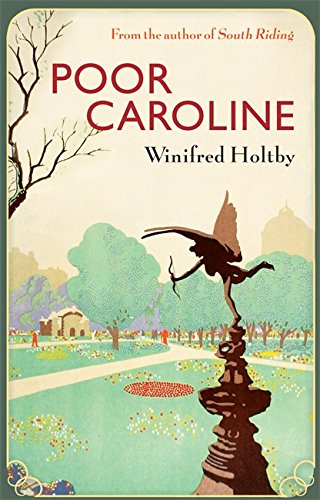
#BookReview ‘Poor Caroline’ by Winifred Holtby #historical

I can’t help but think this novel would be helped by a better title. Poor Caroline is such a negative sounding title for this, the fourth novel by Yorkshire author Winifred Holtby. From the first page, it is clear this is a fond but sharp satire of the inter-war years showing how the expectations of people can on the surface appear aligned but in reality are self-serving. Winifred HoltbyCaroline Denton-Smyth, honorary secretary of the Christian Cinema Company, works hard in the belief that her company is doing good. But the people on the board of directors each have their own reason for being involved with the company, reasons that are not admitted and which diverge hugely from Caroline’s intentions. One hopes to leverage connections with the chairman to gain entrance for his son to Eton. Another wishes to sell his new type of film. Caroline has so many ideas but little success. At the age of 72 she has no money and is dependent on loans from long-suffering relatives. But she is always hopeful. This is the story of Caroline, her fellow directors, and the Christian Cinema Company. Holtby tells the story of each person in turn so the full picture, and the extent of Caroline’s folly, becomes evident. You can’t help but feel simultaneously sorry for her and exasperated with her inability to see the truth.
It is a while before we meet the eponymous heroine. First we learn of her death, as some distant relatives return from her funeral. In her will, Caroline left bequests of money she didn’t have. “Oh, you can’t alter people like Caroline. She always thought she knew better than anyone. She was always going to do something extraordinary.”
Two scenes in particular stayed with me. The description of the odious Clifton Roderick Johnson’s screenwriting class is a classic. He spits instructions to his paltry four students. ‘They did not know, and indeed Mr Johnson hardly knew, that their lecturer who spoke so confidently of technique, cuts, drama and royalties had himself been able to sell for performance only one scenario and a set of captions.’ And the storm at film inventor Hugh Macafee’s derelict warehouse when he continues to work despite the efforts of two fellow directors to evacuate him before a wall collapses.
This novel requires patience, to allow the author time to draw the full scenario so the true manipulations, fraud, dissembling and love, can unfold.

Click the title to read my review of ANDERBY WOLD, also by Winifred Holtby.

If you like this, try:-
‘Miss Pettigrew Lives for a Day’ by Winifred Watson
‘Curtain Call’ by Anthony Quinn
‘Highland Fling’ by Nancy Mitford

And if you’d like to tweet a link to THIS post, here’s my suggested tweet:
#BookReview POOR CAROLINE by Winifred Holtby https://wp.me/p5gEM4-3nn via @SandraDanby

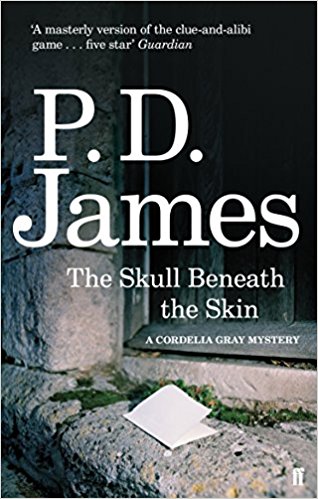
#BookReview ‘The Skull Beneath the Skin’ by PD James #crime

A classic closed room whodunit, The Skull Beneath the Skin is the second of only two Cordelia Gray private detective mysteries by PD James. I wonder why she didn’t write more? PD JamesGray’s fledgling detective agency is relying on finding missing cats when Sir George Ralston arrives unannounced to request Gray ensure the safety of his actress wife, Clarissa Lisle, at her next performance. Lisle has been receiving threatening letters and worries about freezing on stage. Sir George seems unconvinced of Clarissa’s danger. ‘The job I’m offering is a mixture of functions. You’d be part bodyguard, part private secretary, part investigator and part – well, nursemaid.’ Which sounds unpromising but the job pays well. So Cordelia leaves for Courcy Island, location of an amateur private performance of The Duchess of Malfi in which Lisle will play the starring role. As with all James’ novels, there is a delicious laying of pragmatic fact about those in attendance mixed with literary references and poetry.
Of course, Clarissa Lisle is murdered. The police arrive and Cordelia finds herself one of the suspects. There is the usual ragbag of potential murderers. The cuckolded husband; the dying former lover; the pampered stepson; the unsuccessful sister; the silent and sullen dresser; the efficient butler and his wife; the boatman and handyman; and the host of the event, arts patron and novelist Ambrose Gorringe. The setting is beautiful with hidden horror. Courcy Island, set off the Dorset coast, was the scene of nastiness and death during World War Two. Gorringe takes great delight in showing his newly-arrived guests around the island and displaying its dark past.
James writes such dense yet enlightening paragraphs that kindle curiosity. For example, at the end of chapter four, ‘He was discovering that even hatred died a little at the end. But it still lasted longer than desire, longer even than love. Walking slowly in the sunshine and thinking of the weekend ahead, he smiled at the realization that what was most alive in him now was the capacity for mischief.’  James, as always early in her novels, sets the scene with much hinting, veiling of the truth and making her own mischief.

Here’s my review of the first Cordelia Gray mystery:-
AN UNSUITABLE JOB FOR A WOMAN #1CORDELIAGRAY

Read my reviews of the Adam Dalgliesh mysteries:-
COVER HER FACE [#1 ADAM DALGLIESH]
A MIND TO MURDER [#2 ADAM DALGLIESH]
UNNATURAL CAUSES [#3 ADAM DALGLIESH]
SHROUD FOR A NIGHTINGALE [#4 ADAM DALGLIESH]
THE BLACK TOWER [#5 ADAM DALGLIESH]
DEATH OF AN EXPERT WITNESS [#6 ADAM DALGLIESH]
A TASTE FOR DEATH [#7 ADAM DALGLIESH]
DEVICES AND DESIRES [#8 ADAM DALGLIESH]
ORIGINAL SIN [#9 ADAM DALGLIESH] … read the first paragraph HERE
A CERTAIN JUSTICE [#10 ADAM DALGLIESH]
DEATH IN HOLY ORDERS [#11 ADAM DALGLIESH]
THE MURDER ROOM [#12 ADAM DALGLIESH] … read the first paragraph HERE
THE LIGHTHOUSE [#13 ADAM DALGLIESH]
THE PRIVATE PATIENT [#14 ADAM DALGLIESH]

And two other books by PD James:-
INNOCENT BLOOD
TIME TO BE IN EARNEST

If you like this, try:-
‘The Doll Funeral’ by Kate Hamer
‘Due Diligence’ by DJ Harrison
‘Good Me Bad Me’ by Ali Land

And if you’d like to tweet a link to THIS post, here’s my suggested tweet:
#BookReview THE SKULL BENEATH THE SKIN by PD James https://wp.me/p5gEM4-3n8 via @SandraDanby

#BookReview ‘Corpus’ by Rory Clements #thriller #WW2

It is 1936. The Spanish civil war is in full swing. A constitutional crisis looms as Edward VIII considers abdicating in order to marry the woman he loves. Corpus by Rory Clements starts in Berlin as a young Englishwoman slips away from a friend to deliver a secret package to an unnamed man. Soon after, Nancy Hereward is dead. Rory ClementsIt is Nancy’s death which makes Cambridge history professor Tom Wilde ask questions, awkward questions which lead him to uncover conspiracy, lies, and pre-war positioning by Stalin and Hitler.
Wilde makes an interesting amateur detective. For one, he is American with a different reading of human nature; he sits on the fence and observes. For another, he is a professor of history; he analyses and looks for proof rather than opinion. And third, he has a cool motorcycle that he uses to cross the fens and investigate isolated country houses. The story starts rather slowly as Clements fleshes out various groups involved without letting the reader know how these people are connected, and who is traitorous. There is one out-and-out baddie, another who looks like a baddie but possibly isn’t, and a journalist who may or not be a spy or a traitor. The reader’s confusion reflects Tom Wilde’s muddle as he and Nancy’s friend Lydia, both disillusioned with official efforts to explain Nancy’s death, unite to investigate. I particularly enjoyed the description of Cambridge in the 1930s, college life, the city and surrounding fens. The portrayal of Cambridge dons is rather polarised, they all seem to be either fascists or communists, reflecting the political jockeying that went on pre-war.
The plot features twist upon twist as Wilde, and the reader, doesn’t know who to trust: is that policeman really honest, or in the pay of the fascists or communists? Perhaps there is one twist too many as Clements manipulates history to fit his plotline. I have a few minor quibbles, knowing that this is the first book of a series. Some of the loose ends were tied off conveniently at the end with minimal or no explanation. The gold plot was lightly sketched and lacked significance. And the budding romance seemed rather one-sided.
A good read, not a great read, but it left me liking Tom Wilde and anticipating the next novel in this spy series.

Click the title to read my reviews of the other books in the Tom Wilde series:-
NUCLEUS #2TOMWILDE
NEMESIS #3TOMWILDE
HITLER’S SECRET #4TOMWILDE

A PRINCE AND A SPY #5TOMWILDE
THE MAN IN THE BUNKER #6TOMWILDE
THE ENGLISH FUHRER #7TOMWILDE

And from the Sebastian Wolff series:-
MUNICH WOLF #1SEBASTIANWOLFF

If you like this, try:-
‘An Officer and a Spy’ by Robert Harris
‘The Ways of the World’ by Robert Goddard
‘The Bone Church’ by Victoria Dougherty

And if you’d like to tweet a link to THIS post, here’s my suggested tweet:
#BookReview CORPUS by Rory Clements https://wp.me/p5gEM4-3cu via @SandraDanby

Great Opening Paragraph 109… ‘Sea Glass’ #amreading #FirstPara

“Honora sets the cardboard suitcase on the slab of granite. The door is mackereled, paint-chipped – green or black, it is hard to tell. Above the knocker, there are panes of glass, some broken and others opaque with age. Overhead is a portico of weathered shingles and beyond that a milk-and-water sky. Honora pinches the lapels of her suit together and holds her hat against the wind. She peers at the letter B carved into the knocker and thinks, This is the place where it all begins.”
Anita ShreveFrom ‘Sea Glass’ by Anita Shreve

Try one of these #FirstParas & discover a new author:-
The Camomile Lawn’ by Mary Wesley
‘Lucky You’ by Carl Hiasson
‘I Capture the Castle’ by Dodie Smith

Read my review of THE STARS ARE FIRE, also by Anita Shreve.

And if you’d like to tweet a link to THIS post, here’s my suggested tweet:
#Books #FirstPara SEA GLASS by Anita Shreve http://wp.me/p5gEM4-2xC via @SandraDanby

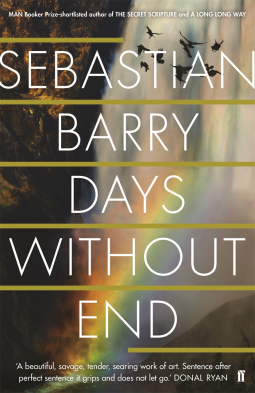
#BookReview ‘Days Without End’ by Sebastian Barry #historical

There is not a word out of place in this harrowing and beautiful tale of love, war, duty and sacrifice. Days Without End by Sebastian Barry deservedly had award success in 2016/2017. I already knew Barry could write about war, having read and loved A Long Long Way set in the Great War. What is different about Days Without End is the relationship between Thomas McNulty and John Cole. Barry tells the epic story of the Indian and Civil wars in America, combined with a heart-stopping tale of love. Sebastian BarryThe story is the first person narrative of Thomas, an Irish émigré fleeing the Irish famine. He arrives in a young America with so many disparate groups, contrasted and never seeming to connect: men, women; officers, foot soldiers; gay, straight; white, black; American, Irish immigrant; army, native Indian; north, south. Barry does not shy from telling the reality of the American wars, the brutality, the atrocities of army against Indians and vice versa; but also the comradeship and solidity of men fighting alongside each other. There is betrayal on both sides, brutality on both sides, and soldiers hating and turning on each other. At the core of this though is the story of Thomas and John Cole, who meet as boys and perform a cross-dressing act on stage before signing up for the army. It is not all about war. There are three sections of ordinary life when we see the ordinary life of the two men, finding a role for themselves and fitting into society.
Much was written at the time this novel was published about how Barry dedicated this book to his son. The portrayal of the men’s relationship is gentle, fond and loving, but the single thing which struck me most was their absolute loyalty to each other.
Full of beautiful prose, plot twists and turns, savage cruelty and betrayal, poignant loyalty at the expense of self, it feels like a slow-moving story but I didn’t want to put it down. Highly recommended.
The story is continued in the sequel, A Thousand Moons.

Read my reviews of these books also by Sebastian Barry:
A THOUSAND MOONS #2DAYSWITHOUTEND
A LONG LONG WAY
OLD GOD’S TIME
THE WHEREABOUTS OF ENEAS MCNULTY

If you like this, try:-
‘Barkskins’ by Annie Proulx
‘At the Edge of the Orchard’ by Tracy Chevalier
My Name is Yip’ by Paddy Crewe

And if you’d like to tweet a link to THIS post, here’s my suggested tweet:
#BookReview DAYS WITHOUT END by Sebastian Barry https://wp.me/p5gEM4-3oB via @SandraDanby

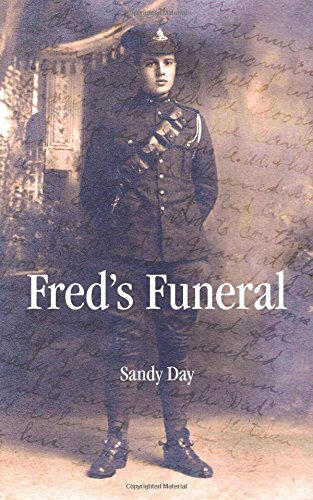
#BookReview ‘Fred’s Funeral’ by Sandy Day #genealogy #family #WW1

None of us have the luxury of hearing what is said about us after we are dead. In Fred’s Funeral, Canadian author Sandy Day tells the story of one soldier, returned from the First World War, who felt misunderstood and sidelined by his family. Only when he dies in 1986, seventy years after he went to war, does he observe his own funeral and find out what they really think of him. Sandy DayFred Sadler has lived his post-fighting years in one institution or another. Clearly he is suffering from some form of shell shock or Post-Traumatic Stress Disorder but this goes undiagnosed. There are periods of living in boarding houses, his family is unwilling to have him live with them, until his behaviour deteriorates and he is sent back to hospital. Now dead and trapped as an unwilling ghost, Fred observes his funeral presided over by Viola, the sister-in-law he always disliked. As the mourners sit around and share memories of Fred, he watches, frustration mounting, as he is unable to correct their observations. They portray a ‘Fred Sadler’ which he does not recognise. I kept expecting something to happen; a true memory of the war, an event, which would explain Fred’s illness and set the record straight with his family. But it didn’t come. The story is told in linear fashion; the anecdotes of Viola and the remaining family are interchanged with Fred’s reaction to these stories plus a few flashbacks to the war. Clearer signposting of these sections would make reading easier.
Day clearly captures the time and place of post-Great War Canada, a subject which is new to me. However I found the repeated digressions into the extended family history and details of the lifestyle a distraction from the main story [so many cousins, great-great grandparents and houses]. I so wanted to cut some of these unrelated sections to allow a stronger novel to push its way to the surface; simpler, more powerful. The inclusion of so many family details makes me wonder if the core of Fred’s Funeral is a memoir, inspired by a real family, from which the author feels unable to cut some relations and take the leap into pure fiction.
The portrayal of Fred’s experience at Whitby Hospital for the Insane is heart breaking, as is the disinterest of his family. For them, Fred is an embarrassment. It is a sad indictment of our treatment of soldiers returning from war and our ignorance that the effect of fighting can last a lifetime. It is easy to assume that in the 21st century this has changed, but the modern day strand of Day’s story suggests it hasn’t. It is as if Fred’s life has paused. “He banished feeling anything long ago. He feels timid. He feels tentative, like every step he takes is on a thick layer of ice and at any moment, he might crash through into a frenzy of drowning.”
At the end of the novel, there is no ‘reveal’, no surprise, and I felt a little let down. Overall, this is a thoughtful examination of how family tensions, petty jealousies and misunderstandings can spread down the generations. Gossip and guesses are transformed into ‘truth’.

If you like this, try:-
Etta and Otto and Russell and James’ by Emma Hooper
‘Wake’ by Anna Hope
‘Yuki Chan in Bronte Country’ by Mick Jackson

And if you’d like to tweet a link to THIS post, here’s my suggested tweet:
#BookReview FRED’S FUNERAL by Sandy Day https://wp.me/p5gEM4-35o via @SandraDanby

SaveSave

#BookReview ‘Vanishing Acts’ by @JodiPicoult #contemporary

This is the first book by Jodi Picoult which I have read, so I wasn’t sure what to expect. I would describe Vanishing Acts as long, intriguing, multi-layered. Is it the greatest? No, but it makes me want to read more of her books. Her multiple-perspectives mean you get a 360° view of a situation and see how different people view the same thing, something we are not always privy to in real life. Jodi PicoultDelia Hopkins lives in New Hampshire with her widowed father Andrew and her daughter Sophie. She works with her own search-and-rescue bloodhound to find missing people. She is about to marry Eric, a friend since childhood. Everything seems happy, except for strange dreams which she cannot explain. ‘I am little, and he has just finished planting a lemon tree in our backyard. I am dancing around it. I want to make lemonade, but there isn’t any fruit because the tree is just a baby. How long will it take to grow one? I ask. A while, he tells me. I sit myself down in front of it to watch. He comes over and takes my hand. Come on, grilla, he says. If we’re going to sit here that long, we’d better get something to eat.’ Fitz, a journalist, who also grew up with Delia and Eric, cannot explain the significance of the lemon tree. But the puzzles keep coming, after a policeman knocks on the door and arrests her father for kidnapping.
This is a story about repressed memory and triggered memory, the difference of which is central to the court case which is the core of this novel. It is about trust, instinct and loyalty and how sometimes the hardest thing to do is the right thing to do.
It is a long book and some sections felt over-written, a style I sometimes find with American authors; using two metaphors where one will do. But the plotting is excellent and the rope of tension pulls you mercilessly onwards. My paperback [below] is an American edition by Washington Square Press, it changes typeface for each different point of view which I found surprisingly irritating.

And read the first paragraphs of VANISHING ACTS and NINETEEN MINUTES, both by Jodi Picoult.

If you like this, try:-
‘Somewhere Inside of Happy’ by Anna McPartlin
‘Something to Hide’ by Deborah Moggach
‘Crow Blue’ by Adriana Lisboa

And if you’d like to tweet a link to THIS post, here’s my suggested tweet:
#BookReview VANISHING ACTS by @JodiPicoult via @SandraDanby http://wp.me/p5gEM4-2uE