Tag Archives: fiction

#BookReview ‘The Ways of the World’ by Robert Goddard #WW2 #thriller

I’ve been a fan of Robert Goddard since reading his first novel Past Caring in 1986. He is a hard-working author producing regular novels, and I admit I got out of the habit of buying them. Until I picked up The Corners of the Globe which I quickly realised was part two of a series. So to book one, The Ways of the World. I wasn’t disappointed. Not for nothing is Robert Goddard called ‘the king of the triple-cross.’ Robert GoddardThe setting is post-Great War, pre-World War Two. Max, aka James Maxted, goes to Paris to investigate the strange circumstances of his father’s death. He stumbles into a melee of Government secrets, inter-war political wrangling, love affairs and assassinations. I warmed to Max straight away and just as quickly disliked his brother. It is a time of high politics, politicians are jostling to make their mark, and there is already a sense that war may come again.
Suffice to say, that by the end of book 1, various ends are left untied, new questions posed, and I was left wanting to read more. So after finishing this, I quickly started reading The Corners of the Globe again.

Read my reviews of Goddard’s other books:-
THE CORNERS OF THE GLOBE #2WIDEWORLD
THE ENDS OF THE EARTH #3WIDEWORLD
PANIC ROOM
THE FINE ART OF INVISIBLE DETECTION
THIS IS THE NIGHT THEY COME FOR YOU

If you like this, try:-
A Hero in France’ by Alan Furst
The Aftermath’ by Rhidian Brook
Dominion’ by CJ Sansom

And if you’d like to tweet a link to THIS post, here’s my suggested tweet:
#BookReview THE WAYS OF THE WORLD by Robert Goddard http://wp.me/p5gEM4-19t via @SandraDanby 

#BookReview ‘The Miniaturist’ by Jessie Burton #historical #Amsterdam

The Miniaturist by Jessie Burton is an intriguing treasure box of a story. Eighteen-year-old Nella starts her new life as a married woman at her husband’s home in Amsterdam. He is a wealthy merchant and it is an arranged marriage. But Nella finds herself in a world she did not expect: a husband never at home, an abrupt and unwelcoming sister-in-law, two servants who behave as if life on the Herengracht is full of secrets. Nella feels always at a disadvantage. Jessie BurtonJohannes Brandt’s wedding gift to his wife is a cabinet, a kind of empty doll’s house for a young woman, a miniature of their home intended to be used by a young woman to learn how to run a home. “The accuracy of the cabinet is eerie, as if the real house has been shrunk, its body sliced in two and its organs revealed.” It frightens her but she is unable to formulate why. There is other disturbing imagery to suggest life in the house is not as it first appears. On the dark walls there are paintings of dead animals and at Nella’s first public outing as a wife, to the Silver Guild dinner, Nella meets Agnes Meermans. Agnes wears pearls in her hair, “The pearls are the same size as milk teeth.” Odd.
Nella orders her first miniature objects from a craftsman, a miniaturist, and the story burst into life after a slowish start. First, the three objects Nella orders are chosen as symbols of defiance against her new life. Secondly, the package is delivered by the intriguing Jack Philips of Bermondsey. Who is Jack, is he the miniaturist? Or does the title of the book refer to Nella? How else does the miniaturist know what is happening in Nella’s home, and her mind?
One thing is clear, everything in this book – and in the house on the Herengracht – is not as it seems. I raced through this.

Read my review of THE CONFESSION, also by Jessie Burton.

If you like this, try:-
Rush Oh!’ by Shirley Barrett
The Penny Heart’ by Martine Bailey
The Knife with the Ivory Handle’ by Cynthia Bruchman

And if you’d like to tweet a link to THIS post, here’s my suggested tweet:
#BookReview THE MINIATURIST by Jessie Burton via @SandraDanby http://wp.me/p5gEM4-17B

#BookReview ‘Summer House with Swimming Pool’ by Herman Koch #mystery #suspense

In Summer House with Swimming Pool by Herman Koch, Dr Marc Schlosser is popular with his patients because he doesn’t tell them they smoke too much or drink too much, he doesn’t tell them to lose weight, he doesn’t lecture them. So he becomes a popular general practitioner amongst the arty set. They invite him to their premieres, he doesn’t want to go. Herman KochBasically, he takes the easy way out; if a patient presents with a symptom he doesn’t recognise or is disgusting, he refers the patient to a specialist. Except Ralph Meier, the famous actor. Although Marc doesn’t like Ralph, he is sucked into the actor’s entourage.
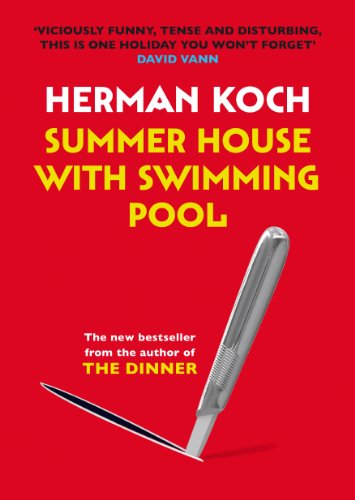
This is the story of one summer when Marc’s family stays at the summer villa rented by Ralph. Throw their wives into the mix, two teenage Meier sons and two teenage Schlosser daughters, plus a film director and his decorative girlfriend, summer heat, a swimming pool and a beach, and you can see trouble looming. It’s how Marc reacts to that trouble that makes the story. I found myself thinking ‘he’s not really going to do that is he? Oh, he has.’
Marc is a very unreliable narrator, skilfully handled by Koch. I didn’t trust him, I didn’t like him, but he made me laugh. His intolerances and lack of patience struck a chord with me [which should get me worried!]. Is it a story of medical incompetence or murder, I will let you decide. It is certainly a story of misunderstandings. The people are unlikeable, but the story draws you on. It is an excellent book to throw into the discussion about why all characters in fiction must be nice: we are not all nice, we all have light and dark in us, we all have habits we would rather keep to ourselves. So fiction should be populated by realistic characters.
But I am pleased Dr Marc Schlosser is not my doctor.

If you like this, try:-
The Bear’ by Claire Cameron
Stolen Child’ by Laura Elliot
Whistle in the Dark’ by Emma Healey

And if you’d like to tweet a link to THIS post, here’s my suggested tweet:
#BookReview SUMMER HOUSE WITH SWIMMING POOL by Herman Koch via @SandraDanby http://wp.me/p5gEM4-11c
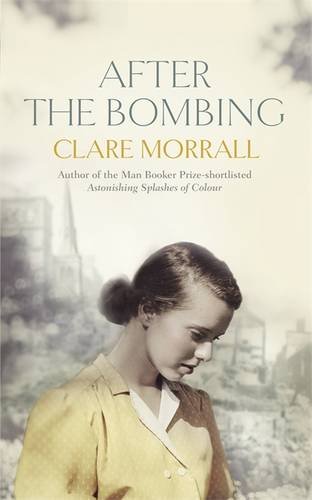
#BookReview ‘After the Bombing’ by Clare Morrall #WW2

I am a huge Clare Morrall fan and wasn’t disappointed by After the Bombing.  As with all Morrall’s novels, the observations of character are spot-on and so poignant. She peoples her novels with characters who feel real. Clare MorrallTwin story strands tell the story of Alma Braithwaite, before and after the bombing of her school near Exeter in May 1942, and in 1963 in a modern world which has moved on from the war. But Alma still remembers. “She’s conscious of sitting on a swing that has been steady for a long time and is starting to move again, gently but perceptibly, backwards and forwards, disturbing her equilibrium.”
The novel opens with the British bombing of Lübeck in March 1942, the raid which famously made Hitler pick up a copy of the Baedecker tourist guide and select at random the English cities of Bath, Norwich, York, Canterbury, and Exeter. That is how 15-year old Alma and her schoolfriends Curls, Giraffe and Natalie are forced to run from Merrivale, the boarding house at their girls’ school Goldwyns on the outskirts of Exeter, to the bomb shelter. When they emerge, Merrivale has gone.
The four girls, in that unspecified limbo between girl and woman, lodge in a mens’ hall of residence at the nearby university, living alongside male students for the first time. The influences there change their lives just as much as the bombing did, with freedoms they have never guessed exist, and the gentle presence of mathematics lecturer Robert Gunner. They are introduced by the men to the Lindy Hop, a vibrant, energetic dance which the girls, though initially nervous and suspicious, come to love dancing.
War is ever-present, a character of its own. There is a poignant scene where Alma and her brother Duncan, on a brief visit home from the war in an unspecified hot country, go back to their family home in Exeter after their parents’ death. Searching for some semblance of normality, they try to play tennis on the grass court. The grass has grown too long but they play anyway, and in their diving for the balls and their laughter, the reader gets a glimpse of their pre-war life and a sign of how everything is now different… after the bombing.
There are parallels in the 1942 and 1963 storylines: a concert which never takes place, flirtations, unexpected death and unexpected love. One of those books which, when I finished it, I wanted to re-read immediately.
CLICK HERE TO READ MORE ABOUT THIS BOOK AT AMAZON

Read my review of these other novels by Clare Morrall:-
NATURAL FLIGHTS OF THE HUMAN MIND
THE LANGUAGE OF OTHERS
THE LAST OF THE GREENWOODS
THE MAN WHO DISAPPEARED
THE ROUNDABOUT MAN

Read the first paragraph of ASTONISHING SPLASHES OF COLOUR here.

If you like this, try:-
Freya’ by Anthony Quinn
At Mrs Lippincote’s’ by Elizabeth Taylor
The Aftermath’ by Rhidian Brook

And if you’d like to tweet a link to THIS post, here’s my suggested tweet:
#BookReview AFTER THE BOMBING by Clare Morrall via @SandraDanby http://wp.me/p5gEM4-W4

Great opening paragraph… 51

iris murdoch - the sea, the sea 10-6-13“The sea which lies before me as I write glows rather than sparkles in the bland May sunshine. With the tide turning, it leans quietly against the land, almost unflecked by ripples or by foam. Near to the horizon it is a luxurious purple, spotted with regular lines of emerald green. AT the horizon it is indigo. Near to the shore, where my view is framed by rising heaps of humpy yellow rock, there is a band of lighter green, icy and pure, less radiant, opaque however, not transparent. We are in the north, and the bright sunshine cannot penetrate the sea. Where the gentle water taps the rocks there is still a surface skin of colour. The cloudless sky is very pale at the indigo horizon which it lightly pencils in with silver. Its blue gains towards the zenith and vibrates there. But the sky looks cold, even the sun looks cold.”
‘The Sea, The Sea’ by Iris Murdoch

#BookReview ‘The Accident’ by Chris Pavone #thriller

The Accident by Chris Pavone is a fast-moving thriller with so many questions. To start with, we have the Prologue about an unidentified man writing a book. This is his third draft of a manuscript called ‘The Accident.’ An excerpt from his m/s finishes: “…if what you are reading is a finished book, printed and bound and distributed into the world, I am, almost certainly, dead.” I was hooked. The Accident is Pavone’s second novel, his favourite thriller writer is John Le Carré and he certainly paces his storytelling the same way. Chris PavoneThe second person we meet is Isabel Reed, a New York literary agent. It is dawn and she has just finished reading a manuscript: ‘The Accident by Anonymous.’ She is astounded at the enormity of the story, the revelations and accusations. As well as being a page-turning thriller, this novel is also an insight of the publishing world in New York and how the connections of power function in the USA: media, publishing, Government, CIA, black-ops. Isabel was once a top literary agent, now she is desperate for the last big m/s. Is this it? She stands under the shower: “It all beats down on her, the shower stream and the manuscript and the boy and the past, and the old guilt plus the new guilt, and the new earth-shattering truths, and fear for her career and maybe, now, fear for her life.” There is a lot we don’t know about Isabel: how come she has this m/s; she thinks about a husband, where is he; she thinks about a child, Tommy, also absent. But the story moves so quickly, I put those questions aside and continued reading.
I admit that at the beginning, I lost track of who was where; so many characters are introduced with anonymous snapshots that I got a bit irritated. Which ‘he’ was this? But I stuck with it and the characters assumed names. The thing that kept me reading was the excerpts from the m/s – as Anonymous tells the story, bit-by-bit we learn more about the secret, the bombshell. So when the murders start to happen, I was expecting death. I was soon picking up my Kindle to grab two minutes reading on the run. Who is doing the killing? Who is the author? Is the m/s true, or revenge?
CLICK HERE TO READ MORE ABOUT THIS BOOK

And here’s my review of another thriller by Chris Pavone:-
THE TRAVELERS

If you like this, try:-
Purity’ by Jonathan Franzen
‘A Hero in France’ by Alan Furst
Wolf’ by Mo Hayder

And if you’d like to tweet a link to THIS post, here’s my suggested tweet:
#BookReview THE ACCIDENT by Chris Pavone via @SandraDanby http://wp.me/p5gEM4-QO

#BookReview ‘Insurgent’ by Veronica Roth #YA #fantasy

Insurgent, second in the fantasy trilogy by Veronica Roth, is action-led and the pace fairly trips along. Everyone living in the post-dystopian city of Chicago belongs to one of five factions, each represents a human virtue. When the factions disagree, there is a struggle for power. Veronica RothHeroine Tris is a complex mixture of two factions: her upbringing in Abnegation [considerate, selfless] and her adopted faction Dauntless [brave, daring, reckless]. This dangerous mixture gets her into trouble and that drives the story along. She is confrontational, brave, but often makes questionable decisions. She distrusts Four’s father and believes he is misleading them: ‘…sometimes, if you want the truth, you have to demand it.’ Demand, not ask: this tells me more about Tris than about Four’s father Marcus.
As this is the second novel of the trilogy there is more time for characterisation, we see more of Tris’s inner world in Insurgent compared with Divergent. She is maturing into her divergent personality, ‘I drift off to sleep, carried by the sound of distant conversations. These days its easier for me to fall asleep when there is noise around me. I can focus on the sound instead of whatever thoughts would crawl into my head in silence. Noise and activity are the refuges of the bereaved and guilty.’ And she is both.
I had difficulty keeping track of the huge list of characters and longed for a cast list. But more importantly is the lack of clarity about the main enemy: who is it? There’s lots of infighting to keep track of too, petty squabbles some of which have carried forward from the first book and which I had forgotten. I made the mistake of not reading the books back-to-back which would have really helped.
Tris’s confusion reminded me of my teenage years, confusion is universal: ‘Sometimes I feel like I am collecting the lessons each faction has to teach me, and storing them in my mind like a guidebook for moving through the world. There is always something to learn, always something that’s important to understand.’ Like all young people, Tris must learn there is no cut-off date by which she will have learned everything, adults continue to learn until they die.
CLICK HERE TO READ MORE ABOUT THIS BOOK AT AMAZON

Click the title to read my reviews of the other books in this series:-
DIVERGENT #1DIVERGENT
ALLEGIANT #3DIVERGENT

If you like this, try:-
Beneath the Keep’ by Erika Johansen #prequelTearling
Children of Blood and Bone’ by Tomi Adeyemi #1LegacyofOrisha
La Belle Sauvage’ by Philip Pullman #1TheBookOfDust

And if you’d like to tweet a link to THIS post, here’s my suggested tweet:
#BookReview INSURGENT by Veronica Roth via @SandraDanby http://wp.me/p5gEM4-Po

Great Opening Paragraph… 50

deborah moggach - these foolish things 10-6-13 [1 pic]“Muriel Donnelly, an old girl in her seventies, was left in a hospital cubicle for forty-eight hours. She had taken a tumble in Peckham High Street and was admitted with cuts, bruises and suspected concussion. Two days she lay in A&E, untended, the blood stiffening on her clothes.”
‘These Foolish Things by Deborah Moggach

#BookReview ‘Mrs Sinclair’s Suitcase’ by @Louisewalters12 #romance #WW2

rs Sinclair’s Suitcase by Louise Walters is a gentle mystery of a love affair during war and its consequences for the following generations. Louise Walters We follow the stories of two women: Dorothy Sinclair in 1940, and today Roberta who works at The Old and New Bookshop. Roberta is particularly fond of the secondhand stock, treasuring the notes and letters she finds hidden within their pages, wondering about the stories of the writer and the addressee. Each chapter starts with an excerpt from such a note.
The letter which starts Chapter One is dated 1941 and addressed to “My dear Dorothea” from Jan Pietrykowski in which he writes he “cannot forgive” her for “what you do, to this child, to this child’s mother, it is wrong.” The letter makes no sense to Roberta as it was written by her grandfather to her grandmother, and dated 1941 when Jan died in 1940. This is the puzzle which Roberta must unravel. What woman does Jan refer to, and what child?
Dorothy’s story starts with a plane crash. She lives on the edge of an airfield deep in the quiet Lincolnshire countryside, alone in her cottage [her husband is away at war] which she shares with two land girls. The plane crash brings the Polish pilot to her door. Nervous, Dorothy serves afternoon tea. She “watched Jan take a bite from a sandwich. His teeth were small, even and white. She noticed the way his fingers curved lightly around the sandwich. He was an elegant man… She watched him eat and he seemed unabashed, eating under her scrutiny. She, for her part, always ate guardedly. She hated the way eating contorted her face, and it made her feel exposed.” From their first meeting, he unsettles her. She is so buttoned-up; he is open, curious and confident.
There is a lot of sensuality in this tale. Despite herself, Dorothy wonders about the pilot. She does not miss her husband. When Jan visits the cottage again, she notices his “brown, lean, strong forearms and realizes how she feels… His arms were poetry.” But there is grief too, as this is wartime and what happened in the 1940s knocks on down the decades to affect Roberta, her father and her grandmother Babunia.

Here’s my review of A LIFE BETWEEN US, also by Louise Walters.

If you like this, try:-
At Mrs Lippincote’s’ by Elizabeth Taylor
The Paying Guests’ by Sarah Waters
After the Bombing’ by Clare Morrall

And if you’d like to tweet a link to THIS post, here’s my suggested tweet:
#BookReview MRS SINCLAIR’S SUITCASE by @Louisewalters12 http://wp.me/p5gEM4-Na via @SandraDanby

Great Opening Paragraph… 48

Chimamanda Ngozi Adiche - half of a yellow sun 10-6-13“Master was a little crazy; he had spent too many years reading books overseas, talked to himself in his office, did not always return greetings, and had too much hair. Ugwu’s aunty said this in a low voice as they walked on the path. ‘But he is a good man,’ she added. ‘And as long as you work well, you will eat well. You will even eat meat every day.’ She stopped to spit; the saliva left her mouth with a sucking sound and landed on the grass.”
‘Half of a Yellow Sun’ by Chimamanda Ngozi Adiche