Tag Archives: historical fiction

#BookReview ‘One Moonlit Night’ by Rachel Hore @Rachelhore #WW2

Life can turn on a sixpence and that’s what happens to Maddie and her two small daughters in the Blitz. One Moonlit Night by Rachel Hore doesn’t start with a glimpse of the main character’s ordinary life before the change happens. It starts with a shock… a family made homeless by a bomb. Rachel HoreAlone in the midst of chaos, her husband Philip has been missing for ten months since the British army’s retreat from Dunkirk, Maddie takes Sarah and Alice to Knyghton in Norfolk to stay with Philip’s elderly Aunt Gussie. Maddie is caught in limbo, unable to grieve for Philip, unable to make decisions, not accepting his probable death, while living in an isolated country house – where Philip spent his childhood – which is the focus of long-held rumour and superstition in the nearby village.
Trying to make a living as a book illustrator, Maddie is seldom without a pencil and paper. But when she draws the face of an unfamiliar young girl, enigmatic, mysterious, she doesn’t know where her inspiration came from. Instinctively she keeps her drawing secret, not wanting to upset the fragile atmosphere at Knyghton. A secret is being kept, by Aunt Gussie, Philip’s cousin Lyle who runs the Knyghton farm, by family retainers, the Fleggs, and Maddie is sure it surrounds this mysterious young woman.
Bookended by a Prologue and Epilogue both set in 1977, Hore tells the stories of Maddie and Philip during World War Two with a flashback to their meeting in 1934. Many of the book’s themes are established in this pre-war section. Wild animals, painted by Maddie, but shot by Philip; children raised while parents are absent; the sharing of some secrets and the keeping of others. It is a complex, emotional story as Maddie, who flees to Knyghton seeking sanctuary instead finds unexplained silences, whispers and rumours she fears are aimed at Philip. Meanwhile Philip, having survived a massacre of British troops by the German army, attempts to find a way home. Philip’s sections are tense, forlorn and at times hopeless, a vivid portrayal of soldiers fleeing through Occupied and Vichy France.
This is a slow-burning story which rewards the reader’s perseverance as tension in the final third picks up and Maddie finally finds some answers. It’s a book which rewards further reading as layers of information, missed on first reading, become significant.

Click the title to read my reviews of two other books by Rachel Hore:-
A BEAUTIFUL SPY
A WEEK IN PARIS
THE HIDDEN YEARS
THE LOVE CHILD

If you like this, try:-
‘The Book of Lies’ by Mary Horlock
The Tuscan Secret’ by Angela Petch
The Skylark’s Secret’ by Fiona Valpy

And if you’d like to tweet a link to THIS post, here’s my suggested tweet:
#BookReview ONE MOONLIT NIGHT by Rachel Hore @Rachelhore https://wp.me/p5gEM4-5PJ via @SandraDanby

#BookReview ‘This is the Night They Come for You’ by Robert Goddard #thriller

Robert Goddard is a thriller writer with a particular skill at writing mysteries where the past remains entangled with today. This is the Night They Come for You features Algerian police Superintendent Mouloud Taleb; believable, likeable, he’s the type of character you instantly root for. Robert GoddardThe story starts today in Algiers as Taleb, sweating in his dingy un-air-conditioned office, considers approaching retirement. But when Wassim Zarbi, a former agent convicted of corruption, is released from prison and then disappears, it is feared he is reuniting with old colleague Nadir Laloul. Events in Paris in 1961 come alive again and Taleb is pulled into the dangerous search for Laloul, Zarbi and the truth of a cold case murder.The history and peoples of Algeria and France are entwined and Goddard puts at the heart of his story a shadowy organisation in Algeria named ‘hizb franca’, the ‘party of France’, dedicated to undermining the success of the fledgling Algerian republic. A small practical note, it would have been helpful to have the Glossary at the front of the Kindle edition rather than at the back. And, for a novice at Algerian politics as I am, a short historical context would also be useful. As a character in the book says, ‘No one learns anything from history in Algeria. They just keep repeating it in ever more exaggerated forms.’
There are two strands to the story and I admit to temporary confusion about who is who, on which side, in the first half of the book. But Goddard portrays a situation and politics disrupted, with truths sewn together by deception. I trusted Goddard to make it all clear, and he does. The various allegiances become aligned as the story progresses, until the twists occur.
Taleb finds himself assigned to work with Souad Hidouchi, an agent from the Algerian secret service. Neither trusts the other, unsure of their unstated objectives. It is a delight to watch the development of their relationship, their suspicions, the small details of friendship, the willingness to take a risk on placing trust. In comparison, the second strand featuring Stephen Gray and Suzette Fontaine, is less dynamic. Stephen has dedicated his life to uncovering the truth about his sister Harriet who disappeared in Paris in 1961. Suzette meanwhile has received a strange call from a Swiss solicitor. A document, claimed to be a memoir written in Algeria by her bookseller father, Nigel Dalby, tells the truth of what happened in Paris in 1961.
As Goddard alternates the viewpoints with excerpts from Dalby’s typewritten manuscript, at times the reader knows more than the characters. But the characters are not all telling the truth, motivations and secrets are hidden, and Goddard juggles the tensions and unveilings like a master.
A thoroughly enjoyable historical thriller. Knowing little of Algerian politics, it’s so good to read fiction that makes me turn the pages while teaching me something new. A small design note, I hated the cover which trivialises the subject matter of the novel and is befitting a young adult title.

Read my reviews of Robert Goddard’s other books:-
PANIC ROOM
THE FINE ART OF INVISIBLE DETECTION #1UMIKOWADA
THE WAYS OF THE WORLD #1WIDEWORLD
THE CORNERS OF THE GLOBE #2WIDEWORLD
THE ENDS OF THE EARTH #3WIDEWORLD

If you like this, try:-
Waiting for Sunrise’ by William Boyd
The Museum of Broken Promises’ by Elizabeth Buchan
Exposure’ by Helen Dunmore

And if you’d like to tweet a link to THIS post, here’s my suggested tweet:-
#BookReview THIS IS THE NIGHT THEY COME FOR YOU by Robert Goddard https://wp.me/p5gEM4-5Pq via @SandraDanby

#BookReview ‘The Leviathan’ by Rosie Andrews #historical 

Soldier Thomas Treadwater returns home on leave from the army, summoned to Norfolk by a pleading letter from his sister Esther. ‘Our home is under attack by a great and ungodly evil’, she writes. The Leviathan by Rosie Andrews is a tale of religious extremism and intolerance, fear of witches, superstition and the power of evil. Rosie Andrews The atmosphere at all times is full of foreboding. As Thomas approaches his father’s farm at dawn, he sees dead animals in the field. This is 17th century Norfolk when England is riven by civil war. The story of Thomas and Esther, narrated by Thomas in two timelines – 1643 and 1703 – is ultimately a slow one. The beginning is excellent, ‘She is awake,’ and moves quickly as Thomas investigates the strange goings-on. When this moves from witchcraft to theology and the meaning of evil, the pace slows. The explanation of the title is remarkably late in arriving and I was distracted by trying to fit ‘the leviathan’ into the domestic story of the Treadwater family.
According to Esther, their religious father has been corrupted by their servant Chrissa Moore who is with child. Richard Treadwater is now insensible after suffering a stroke and cannot explain. Chrissa, since accused of witchcraft and imprisoned, denies she is pregnant. When Esther must give evidence in front of the Justice of the Peace, Sir Christopher Manyon, and his assistant John Rutherford, Thomas realises Esther herself may be charged as a deviant. Struggling to understand what is happening, he turns to his former tutor John Milton, for help. It was only after finishing The Leviathan that I made the connection with the real poet and author of Paradise Lost.
Steeped in historical detail and the superstitions of the time, the early mystery of the unexplained deaths and the accusations of witchcraft are well written but this momentum is lost as the story transitions to one about possession and evil. All of it is a metaphor for the cruel and intolerant acts of war when sensible men behave without reason.
I struggled for an emotional connection to the story and wonder if a second viewpoint – perhaps of Mary – may help, also sharper transitions between the three phases of story which seem oddly disconnected. But the early passage of Thomas walking home with his horse Ben is particularly lovely. I finished it not knowing what to think, wanting to like it more, in awe of the scope of subject matter and the intensity of writing.

If you like this, try:-
The Almanack’ by Martine Bailey
The Witchfinder’s Sister’ by Beth Underdown
Rush Oh!’ by Shirley Barrett

And if you’d like to tweet a link to THIS post, here’s my suggested tweet:
#BookReview THE LEVIATHAN by Rosie Andrews https://wp.me/p5gEM4-5OQ via @SandraDanby

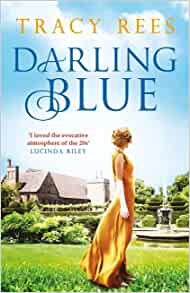
#BookReview ‘Darling Blue’ by @AuthorTracyRees #historical

The Blue of the title is Ishbel Camberwell but Darling Blue by Tracy Rees is not the story of one woman but three. Although the main voice is that of Blue’s, this is really an ensemble piece about a year in the life of a wealthy family living in Richmond-upon-Thames in the 1920s. Tracy Rees At her 21st birthday party, Blue’s father makes a startling announcement. Suitors interested in marrying Blue must woo her by letter within the next twelve months. Blue, who wants to be a writer and has no pressing desire to marry, is horrified by her father’s challenge. She’s even more appalled when she receives three letters. Determined to make her own decisions, she gets a temporary job as a reporter on the local newspaper.
Delphine Foley is trapped in a violent marriage. Desperate to escape and determined to protect her mother and sister from potential threats from her husband, she forges a secret plan. When her plan takes an unexpected turn, she finds herself in Richmond-upon-Thames, a beautiful place only miles from where she lived but somewhere she didn’t know existed. When an accident throws her into the path of the Camberwell family, she senses a chance of a new start.
The third woman whose story this is, is Midge, Blue’s step-mother, who spends the first part of the book involved in a plan to redecorate their grand townhouse, Ryan’s Castle. As a new bride, her husband Kenneth brought her home to the house he shared with his first wife Audra. The presence of the deceased Audra remains and puts pressure on Midge’s sense of inferiority and she becomes more lost as the story progresses.
The character I found most fascinating was Delphine, a stranger whose path crosses with the Camberwell family in the most unexpected manner. An enjoyable and quick read, this is by no means a Bright Young Things light portrayal of the Twenties. The author lived in Richmond and it shows in her accurate portrait of the town. The story is set in a time of confusion and change as the effects of the Great War continue to affect the population, with opportunities and hardships affecting people unequally. Blue is accused of taking work away from ex-soldiers when she doesn’t need the money. Workers are about to go on strike, and domestic violence and prejudice against homosexuals add darker undertones.
Tracy Rees always tells a good story built on a solid historical foundation and Darling Blue is no different. Despite the romantic cover design, there is a strong focus on the lives of women and their struggles to overcome their lot in life, featuring experiences not identified at the time but recognised now a century later.
CLICK HERE TO READ MORE ABOUT THIS BOOK

Note: I bought this hardback copy of Darling Blue in the Book Aid for Ukraine charity auction in spring 2022. The book is now published as The Love Note. Tracy Rees

Click the title below to read my reviews of three other novels by Tracy Rees:-
AMY SNOW
THE ELOPEMENT
THE HOUSE AT SILVERMOOR
THE ROSE GARDEN

If you like this, try:-
The Glass House’ by Eve Chase
The Cottingley Secret’ by Hazel Gaynor
The Ballroom’ by Anna Hope

And if you’d like to tweet a link to THIS post, here’s my suggested tweet:
#BookReview DARLING BLUE by @AuthorTracyRees https://wp.me/p5gEM4-5ML via @SandraDanby

#BookReview ‘The Silver Wolf’ by JC Harvey @JCollissHarvey #historical

The Silver Wolf by JC Harvey is first in the Fiskardo’s War series set in 17th century Europe during the Thirty Years War. If, like me, your history is a little hazy, the author’s note at the beginning is helpful. This was a time of sprawling wars and disputes, religious, political and national plus local personal grudges being settled. Into this soup of battle, Harvey has inserted the story of Jack Fiskardo. And what a story this is. JC HarveyYoung Jack is an orphan, surviving on his wits in the Amsterdam docklands. Around his neck he wears a silver token of a wolf. He knows neither its provenance nor its meaning. People who meet him and recognise it, look at him askance. Jack is a brilliant hero. Feisty, brave yet considered, he has a fondness for the bullied and those weaker than himself. And he is also something of a horse whisperer.
This is a long book – 560 pages, though not as long as Ken Follett’s The Pillars of the Earth – and slowly we pick up hints about the relevance of Jack’s wolf necklace. There is a huge cast of characters, but a limited number in each place that Jack tarries awhile. All of the time, he is on the move, looking for answers to the mysterious deaths of his parents, seeking the murderer. He slips quietly into each new community, clearly different, attracting curious glances but earning respect and affection. And all the time, war is raging somewhere in Europe. Troops are on the move, battles are won and lost, soldiers must be fed and watered, billets found. Around the troop movements, a village of suppliers grows; food, alcohol, whores, horses, munitions. Jack slips in and out of groups, sometimes changing his name.
Once I stopped worrying about the true historical context and relaxed into Jack’s story, the pages turned easily despite the occasional lull in pace. There are occasional flashbacks to Jack’s childhood in the seaside village of Belle-Dame, near Rochelle in France. Some names are similar and therefore confusing – I constantly got Bronheim and Bertholt confused – others have names and nicknames.
Excellent. Such an ambitious novel for a debut. The research and world-building is extensive, but the real star is Jack. The series can only get better.

Here are my reviews of other books the Jack Fiskardo series:-
THE DEAD MEN #2FISKARDO’SWAR
PEACE AND LOVE #3FISKARDO’SWAR
THE WANTON ROAD #4FISKARDO’SWAR

If you like this, try:-
The Burning Chambers’ by Kate Mosse #1JOUBERT
The Evening and the Morning’ by Ken Follett #PREQUELKINGSBRIDGE
Winter Pilgrims’ by Toby Clements #1KINGMAKER

And if you’d like to tweet a link to THIS post, here’s my suggested tweet:
#BookReview THE SILVER WOLF by JC Harvey @JCollissHarvey https://wp.me/p5gEM4-5Lo via @SandraDanby

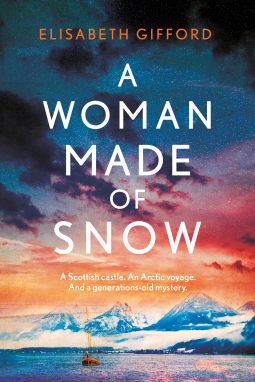
#BookReview ‘A Woman Made of Snow’ by Elisabeth Gifford #historical

A Woman Made of Snow by Elisabeth Gifford is a historical mystery moving between post-World War Two Scotland and the Arctic in the nineteenth century. Elisabeth GiffordThis is an ambitious, well-researched dual timeline story encompassing exploitation of the Inuit people, the whaling industry, racial prejudice, the maintenance of sprawling country estates and the iron will of a mother for her son to marry the woman she prefers rather than the woman he loves. In 1949, Caro moves to Kelly Castle near Dundee with husband Alasdair and new baby Felicity, to live with his mother Martha. As the two women scratch along together, Martha asks Caro to organise the family records which have fallen into confusion. Sorting the piles of documents, Caro finds an intriguing photograph of Oliver Gillan, Alasdair’s great-grandfather, and two unknown young women. As she sets out to identify the strangers, workmen on the estate uncover bones of a woman in an unmarked grave. Caro jumps to the assumption that the bones might belong to one of the women in the photograph.
This 1949 storyline is alternated with that a century earlier of Oliver, a medical student, who grew up at Kelly Castle. Gifford lays clues for the reader – could Caro’s mysterious bones be those of one of two girls befriended by his family when he was growing up? And are these the girls in the mystery photo? He is keen on Louisa, her sister Charlotte is keen on Oliver; his mother is keen on neither girl. Oliver leaves home to study medicine in Edinburgh but finds himself instead in Dundee as medical officer on a whaling ship, the Narwhal, bound for the Arctic.
I finished the book with mixed feelings. I loved the Arctic sections and wanted more. The 1949 sections left me feeling curiously flat and wonder if the viewpoint affected my response. I so wanted to hear Yarat’s voice directly, instead we see her only through Oliver’s diary and Caro’s imagination.
This was a slow read for me, I delayed picking it up again which surprised me as I loved Gifford’s The Lost Lights of St Kilda. Erratic shifts between chapters didn’t help, the jerky changes of subject took me away from the page and the mystery interested me less than the story of Oliver’s life. I most enjoyed reading about the Arctic and the emotional upheaval of falling in love with a woman so alien to your own home and the repercussions that must be faced.

Read my 5* review of THE LOST LIGHTS OF ST KILDA also by Elizabeth Gifford

If you like this, try:-
The Surfacing’ by Cormac James
Dark Matter’ by Michelle Paver
Rush Oh!’ by Shirley Barrett

And if you’d like to tweet a link to THIS post, here’s my suggested tweet:
#BookReview A WOMAN MADE OF SNOW by Elisabeth Gifford @elisabeth04liz  https://wp.me/p5gEM4-5Hc via @SandraDanby

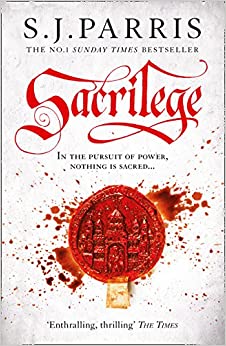
#BookReview ‘Sacrilege’ by SJ Parris @thestephmerritt #historical #crime

Everywhere he goes in the England of Queen Elizabeth I, Italian philosopher Giordano Bruno runs into trouble. In Sacrilege, third in this quickly-becoming-addictive series by SJ Parris, Bruno is in Canterbury to help an old friend prove her innocence of murder. And to spy for his master, Sir Francis Walsingham. SJ ParrisWhen the woman he loved in the first book of the series asks for his help, Bruno risks the wrath of Walsingham and heads to Canterbury. Set in turbulent political times, the various historical plots are twisted and complicated. Weary at Bruno’s determination to pursue what he believes is a lost cause, Walsingham charges him with identifying a traitor in the cathedral administration in Canterbury. Parris weaves a fictional plan by Catholics in Britain and France to use the ‘discovered’ bones of Thomas Becket to anoint a new Catholic king when France should invade England. The labyrinthine politics and geography of the inner sanctums of Canterbury cathedral add to the tension. The scenes in the crypt are thrilling as Bruno again and again takes huge risks to discover the truth. When he is charged with murder and a fabricated charge of theft, he realises his contacts at the royal court in London are too far away to help.
Bruno is a foreigner in England, a country where a strange accent and tanned skin make him an instant threat, his guilt automatically assumed. Parris populates her Canterbury with a collection of believable fictional characters, conflicted people who must sometimes take a wrong decision in order to survive or protect a loved one. Throw in an odious servant, a persecuted family of Huguenot weavers, a tremulous canon who has spied for Walsingham but missed some big hints of trouble and an independently-minded young woman not afraid to tell the truth as she sees it.
At times the pace slows to walking speed but turn a page and another chase begins or clue arrives. When the twist arrived at the end I was surprised, then realised I had known all along. Surely a satisfactory conclusion?
CLICK HERE TO READ MORE ABOUT THIS BOOK AT AMAZON

Read my reviews of other books in the series:-
HERESY #1GiordanoBruno
PROPHECY #2GiordanoBruno

If you like this, try:-
The Diabolical Bones’ by Bella Ellis
Lord John and the Private Matter’ by Diana Gabaldon
Or the Bull Kills You’ by Jason Webster

And if you’d like to tweet a link to THIS post, here’s my suggested tweet:
#BookReview SACRILEGE by SJ Parris @thestephmerritt https://wp.me/p5gEM4-5CC via @SandraDanby

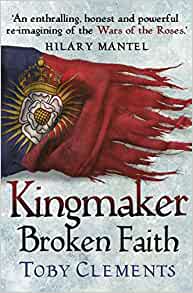
#BookReview ‘Broken Faith’ by Toby Clements #historical #WarsoftheRoses

Broken Faith, second in the Kingmaker series by Toby Clements, takes place in the lull after the 1461 battle of Towton and 1464 when Edward IV marries Elizabeth Woodville. The history of these intervening years is subject to much confusion, guesswork and mystery, wonderful territory for an imaginative novelist. Toby Clements Clements gives Katherine and Thomas, who we first met in Winter Pilgrims, a secret which if revealed will change the succession to the throne of England. Exactly what the Yorkists and Lancastrians are fighting about.
The battles are bloodthirsty, the battlefield surgery by Kit [aka Katherine in disguise] is gruesome but surprisingly modernistic, the betrayals of self-seeking lords are countless and amongst it all shine the people of genuine morals, driven by belief in what is right, with humble and generous natures. That brave and endearing pair Thomas and Kit are separated, not sure if the other is alive, and forced to do what is necessary to survive. Life in the 15th century was tough enough without living through war, Clements describes the life of a common soldier, the weapons, the methods of fighting, the battle tactics, the food, the smells. Although the detail is fascinating, Clements doesn’t leave the story languishing. Thomas and Katherine move north from one castle to another, one battle to another, as soldiers run from the battlefield and lords turn their coats. Thomas and Katherine though cannot turn back until a lost book is found and a lord is killed.
Mostly set in the north, while reading the northern scenes I pictured the Northumbrian castles of Alnwick and Bamburgh which makes the adventure come alive. An enthralling chapter in this War of the Roses story which at times, like the real history, is a tad confusing. Just go with the flow and enjoy it!

Read my reviews of the other books in this series:-
WINTER PILGRIMS #1KINGMAKER
DIVIDED SOULS #3KINGMAKER

And also by Toby Clements:-
A GOOD DELIVERANCE

If you like this, try:-
Cecily’ by Annie Garthwaite
The Pillars of the Earth’ by Ken Follett #1KINGSBRIDGE
Gone are the Leaves’ by Anne Donovan

And if you’d like to tweet a link to THIS post, here’s my suggested tweet:
#BookReview BROKEN FAITH by Toby Clements https://wp.me/p5gEM4-5yE via @SandraDanby

#BookReview ‘Devotion’ by @HannahFKent #historical #emigration

In Prussia, 1836, fourteen-year-old Hanne lives in a world-within-a-world, a strict religious group where worship must be kept secret and hidden from the sight of neighbours. Devotion by Hannah Kent is the story of Hanne’s persecuted community. They live in fear of expulsion or worse. But when a new family arrives Hanne meets another outsider, Thea, and her life is changed forever. Hannah Kent Kent takes her time with the first half. This is a slow start, a painstaking building of the relationship between Hanne and Thea, drawing the world in which neither fits. As Hanne reaches womanhood, her life is changing in small ways. Her mother increasingly separates her from twin brother Matthias as they are prepared for different adult lives. Hanne simply longs to be free to be in the woods, to listen to the sounds of nature alive. But in times of fear or uncertainty, when she bristles against the strict confines set by her mother, the unshakeable belief of her father, she cleaves to her twin. The glimpse of a different world offered by Thea’s family, the more open way they behave with each other, makes Hanne’s mild dissatisfaction with her life become an acute fear of being trapped.
When the offer of safe passage to Australia comes from a helpful member of their congregation, a new life where they will be able to worship without fear becomes possible. ‘Without my father’s devotion to that Bible I would not be here. Without that Bible, nothing would have happened.’
The story is told in three parts, or ‘days’, and the event occurring at the end of the first day is perhaps not surprising but what follows is. To explain, is to tell too much of the plot. The second part, when the travellers settle in the Adelaide Hills, is slow paced. After the sections in Prussia and onboard ship, the indulgence of the writing in what is already a slow-paced novel begins to drag a little.
Kent’s writing is strongest when describing Hanne’s visceral connections with land and sea, with nature, with animals. She seems to directly commune with living creatures, to hear their voices. There is a magical element – magic or witchcraft – threaded throughout the story which is both a benefit and a curse, a source of division within the Lutherans but a form of communication with the native Peramangk community who live on the land the Lutherans claim for their settlement of Heiligendorf.
The theme of devotion, and love, runs throughout. The love shared by Hanne and Thea, but also Hanne’s love for her brother, her friend Hans and her parents. The devotion both to their shared faith and to each other. It is Hanne alone who feels the connection to nature and her devotion to every living creature, and this sets her apart.
At times the beautiful prose dominates the storyline and I lost track of the moment where the action paused. I admit to skipping chunks. No matter the beauty, the tenderness of the writing, a strong narrative is essential to stop the reader floundering and continue reading.
Basically, this is a love story, of love unobtainable and out of reach, but a love all-consuming.

Read my reviews of Hannah Kent’s two other novels:-
BURIAL RITES
THE GOOD PEOPLE

If you like this, try:-
The Wonder’ by Emma Donoghue
At the Edge of the Orchard’ by Tracy Chevalier
The Ninth Child’ by Sally Magnusson

And if you’d like to tweet a link to THIS post, here’s my suggested tweet:
#BookReview DEVOTION by @HannahFKent https://wp.me/p5gEM4-5wS via @SandraDanby

#BookReview ‘The Key in the Lock’ by Beth Underdown #historical

Two unrelated deaths, thirty years apart, set in motion a chain of cause and effect. Decades later, so many answers remain unspoken. The Key in the Lock by Beth Underdown is an unusual multiple timeline historical mystery set in Cornwall, rather like Mary Stewart mysteries but darker. Beth Underdown Ivy Boscowen has known two deaths in her life. In 1918 she is mourning the death in the Great War of her son, Tim. The exact circumstances of his death cannot be confirmed and this haunts her, she becomes afraid that her reluctance for him to enlist actually forced him to go and so feels responsible for his death. At night she dreams of Tim when he was a child, hiding beneath a bed. This dream morphs into the memory of another young death; when Ivy was nineteen, young William Tremain died in a house fire at the nearby Polneath. He was found asphyxiated beneath a bed. The two deaths are unconnected in terms of circumstances and cause, but are forever connected in Ivy’s mind because of decisions taken.
When she was a teenager, Ivy was sweet on Edward Tremain, son of ‘Old’ Tremain, owner of Polneath and the gunpowder works. Appropriately, at the heart of this novel are two fires plus explosive secrets hidden for decades. Ivy is a rambling, unreliable narrator who makes inconsistent statements, assumptions and rash decisions, and I found it difficult to warm to her.
The echo in the opening sentence of Daphne du Maurier’s first sentence of Rebecca felt unnecessary and heavy-handed. Yes, this novel is also set in Cornwall, but tone and style are different. This is more a character piece than a mystery and I didn’t find it particularly gothic. Some events are mentioned in advance so there is no mystery when they happen, others are simply disorientating rather than curious. The timeline switches between the two main timelines – 1888 and 1918 – plus flashbacks to Tim’s childhood and 1919, and it’s not always clear when things are happening.
I finished the book in two minds. I prefer the 1888 storyline but can’t help thinking there is a clearer, stronger story buried within, hidden by unnecessary plot complications and red herrings.

Read my review of THE WITCHFINDER’S SISTER, Beth Underdown’s debut novel.

If you like this, try:-
The Animals at Lockwood Manor’ by Jane Healey
Touch Not the Cat’ by Mary Stewart
The Vanishing of Audrey Wild’ by Eve Chase

And if you’d like to tweet a link to THIS post, here’s my suggested tweet:
#BookReview THE KEY IN THE LOCK by Beth Underdown https://wp.me/p5gEM4-5×7 via @SandraDanby