Tag Archives: novels set in Prague

#BookReview ‘Alchemy’ by SJ Parris @thestephmerritt #historical #crime

Prague 1588, the city of a hundred spires is also a city in political and scientific turmoil. In Alchemy, seventh in the excellent Giordano Bruno series by SJ Parris, lapsed Catholic Bruno arrives in Prague as a spy for Elizabeth I. He quickly discovers that this tolerant city, famed for freedom of thought and expression, is really seething with barely concealed hatred, suspicion and violence. SJ ParrisLiving a quiet academic life in the German city of Wittenberg, teaching at the university, Bruno receives a secret letter from the Queen’s spymaster, Sir Francis Walsingham. He bids him speed to Prague where he believes there is a plot against Emperor Rudolf, the Holy Roman Emperor and ally of Queen Elizabeth. When Bruno and his young student assistant Besler arrive in the city, they see a grizzly sight; the corpse of an alchemist hanging from the Stone Bridge, his eyes and tongue cut out. Killed, it is rumoured on the streets, by the Golem, a Jewish monster conjured by the Chief Rabbi of Prague and released in the city.
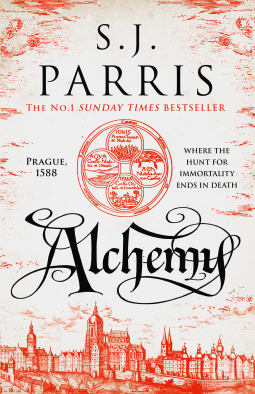
Bruno, who is hoping the emperor may be a patron enabling him to settle in the city to write and publish his philosophical books, arrives at the house where his mentor, scientist and free-thinker John Dee is lodging, to find him disappeared. Keen to find Dee, Bruno is instead tasked by the emperor to find the murderer of the alchemist, a favourite of his, Ziggi Bartos. Soon Bruno is confronted by an old enemy, one he hasn’t seen since he renounced the Catholic faith and fled Italy.
The juxtaposition of wealth and poverty, believers and chancers, scientists, gamblers and swindlers, is handled excellently. Parris has plotted a thriller which twists together the destinies of an eccentric emperor, a powerful Catholic lobby with a gang of toughs ready to threaten and kill, a disparate band of scientists all eager to make a big discovery and win the favour of Rudolf, and a Jewish quarter watched with suspicion and prejudice. As always Bruno is a reluctant detective who throws himself enthusiastically into his investigation, with multiple suspects and plots to explore. Being a stranger in town who doesn’t know the streets or speak the local language is a significant disadvantage. Bruno, sometimes too quick to trust, is made to reflect more than usual on his theories by the logical questions of his young assistant. Besler repeatedly asks why, and how?
A fascinating historical story packed with myth, legend and superstition, it is also great fun. Throw in a lion, the Emperor’s renowned erotic art collection, a precocious 11-year old, the naïve and charming Besler, the mysterious Powder Tower where the alchemists work, and Rudolf’s castle with its dark underground passages and opulent rooms full of artistic and scientific wonders. Wonderful.

Read my reviews of other books in the series:-
HERESY #1GIORDANOBRUNO
PROPHECY #2GIORDANOBRUNO
SACRILEGE #3GIORDANOBRUNO
TREACHERY #4GIORDANOBRUNO
CONSPIRACY #5GIORDANOBRUNO
EXECUTION #6GIORDANOBRUNO

If you like this, try:-
‘The Angel’s Mark’ by SW Perry #1JACKDAWMYSTERIES
‘A Column of Fire’ by Ken Follett #3KINGSBRIDGE
Lord John and the Private Matter’ by Diana Gabaldon

And if you’d like to share a link:
#BookReview ALCHEMY by SJ Parris @thestephmerritt https://wp.me/p2ZHJe-7Z1 via @SandraDanby

COMING SOON… THE NEXT BOOK I REVIEW WILL BE:- Helena Dixon
#BookReview ‘The Second Midnight’ by Andrew Taylor @AndrewJRTaylor #WW2

In The Second Midnight, Andrew Taylor unpicks the connections between a group of people – a dysfunctional family, spies, ordinary people – before, during and after World War Two in England and Czechoslovakia. Essentially it is a novel of relationships wrapped up in the parcel of wartime spying, lies and romance. In its scope it reminds me of Robert Goddard’s Wide World trilogy, except Taylor covers the subject in one book rather than three. Andrew TaylorIt is 1939 and twelve year old Hugh Kendall is bullied by his father, sighed over by his harried mother, ignored by his older brother and manipulated by his older sister. Hugh retreats into imaginative games with his toy soldiers. His father, failing glass importer Alfred Kendall, is recruited by the Secret Services as a courier on a glass-buying trip to Czechoslovakia. In tow is Hugh, recently expelled from school, a nuisance to his father. Alfred is not a natural spy, though he thinks he is. When things get sticky and Alfred must return to England, the Czech Resistance keeps Hugh as collateral to ensure his father’s quick return. But Hugh finds himself alone in Prague after the German invasion, unsure who to trust, unsure if he will be rescued. He quickly learns to live on his wits. This for me was the best section of the book.
The thing that makes this story stand apart for me is Hugh. He makes an uncanny narrator, giving us a view of life in an occupied country, stranded from everything that is safe and familiar. Adept at languages, Hugh quickly becomes familiar with Czech and German allowing him to assume a false identity as Rudi Messner, a Czech-Hungarian boy.  Cared for by a German officer, Colonel Helmut Scholl, Hugh works as the gardener’s boy at Scholl’s mansion in Prague and meets the colonel’s children, Heinz and Magda. These relationships weave across the years and the pages into the post-war years and the fight against communism.
The significance of the title left me wondering if I had missed something. It is set up with an intriguing connection between two characters, then abandoned. The connection with the Prologue was also lost on me as it is only mentioned again at the end and I had forgotten what happened; ends neatly tied without adding understanding. Taylor knows how to tell a page turning story, I read this quickly. This is a fascinating read over a complex time period, but an enormous subject; I wish it had been given the space of three books to explore fully.

Read my reviews of Andrew Taylor’s ‘Marwood & Lovett’ series that starts on the night of the Great Fire of London:-
THE ASHES OF LONDON #1FIREOFLONDON… and read the #FirstPara of THE ASHES OF LONDON
THE FIRE COURT #2FIREOFLONDON
THE KING’S EVIL #3FIREOFLONDON
THE LAST PROTECTOR #4FIREOFLONDON
THE ROYAL SECRET #5FIREOFLONDON
THE SHADOWS OF LONDON #6FIREOFLONDON

If you like this, try:-
Corpus’ by Rory Clements #1TOMWILDE
The Ways of the World’ by Robert Goddard #1WIDEWORLD
Five Days of Fog’ by Anna Freeman

And if you’d like to tweet a link to THIS post, here’s my suggested tweet:
#BookReview THE SECOND MIDNIGHT by Andrew Taylor @AndrewJRTaylor https://wp.me/p5gEM4-4gC via @SandraDanby

#BookReview ‘The Bone Church’ by Victoria Dougherty @vicdougherty #war #WW2

The Bone Church was a difficult story to get into for me, which surprised me. The premise by Victoria Dougherty seems so good – Czechoslovakia, wartime, fugitive lovers, a faked religious icon, and a plot to assassinate Josef Goebbels – the promise of which kept me reading. But I found the time shifts, the point of view shifts, and the way the action changed from paragraph to paragraph quite confusing. Assuming this was a formatting issue with my Kindle copy, I kept reading. Victoria DoughertyThe story starts in Rome in 1956 in the Vatican City with a Cardinal and a man called Felix. Then we see Magdalena and her son Ales in Czechoslovakia, a man arrives and takes away her son. Then the action switched to 1943, as Felix and Magdalena are on the run in Prague. He is a famous hockey player, a celebrity, she is a Jew. By this point, the story should have gripped me but I’m afraid it didn’t, I hadn’t read enough about the two characters to care. I think my basic problem is the way the story was told, not the actual story itself; the writing is rich with description and the author certainly knows her history. Halfway through, things started to make a little more sense though at times the plot seemed unnecessarily complicated.
The best bit? An assassination scene, involving a birthday cake, a gun, and Josef Goebbels.

If you like this, try:-
‘Life After Life’ by Kate Atkinson
‘The Little Red Chairs’ by Edna O’Brien
‘Dominion’ by CJ Sansom

And if you’d like to share a link:
#BookReview THE BONE CHURCH by Victoria Dougherty @vicdougherty http://wp.me/p5gEM4-1Bl via @SandraDanby