Tag Archives: Paris

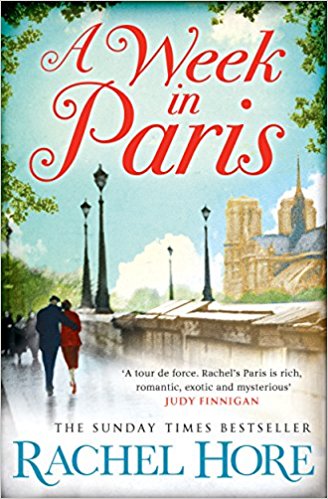
#BookReview ‘A Week in Paris’ by Rachel Hore @Rachelhore #mystery #WW2

I really enjoyed this book but can’t help feeling the title did it no favours. A Week in Paris by Rachel Hore is a story of hidden secrets, wartime Paris, resistance, collaboration, bravery and music. Because of the title I was expecting something more cosy and romantic; although there is a romantic strand to the story, this book is worth reading for so much more. Rachel HoreThe week in Paris in question happens in 1956 when teenager Fay goes on a school trip to Paris. Two significant things happen to her there. She meets a fanciable boy, Adam, and has a strange fainting episode triggered by the ringing of the bells at Notre Dame. Back home, she questions her mother Kitty who denies that Fay has ever been to Paris. But Fay cannot shake off the feelings of familiarity.
In 1961 Fay, now a professional violinist, has the chance to go to Paris for a series of performances. However her mother, always emotionally vulnerable, has taken an accidental overdose and is in St Edda’s Hospital. Before she leaves for Paris, Fay visits her mother who tells her to look at the bottom of a locked trunk at home. In it, Fay finds a small canvas rucksack. Attached to it is a label. On one side is written ‘Fay Knox, Southampton’, on the reverse, ‘Convent Ste-Cécile, Paris.’
‘She sat staring at the label for some time, while the faintest glimmer of a memory rose in her mind. Sunshine falling on flagstones, the blue robes of a statuette, and… but no, it was gone. It was as though a door had opened, just a chink, in her mind, before it shut again.’
The story is told in two strands, World War Two and afterwards, from the viewpoints of Kitty and Fay. Gradually the mysteries are unveiled. Fay has the unsettling feeling that her mother is keeping secrets, while Kitty knows she must some day explain everything to her daughter. For a long time, the reader keeps guessing.
In Paris, Fay sets off to find the convent mentioned on the label. There she slowly unravels the truth. How, despite denying to Fay that she has ever been to France, Kitty went to Paris in 1937 to study piano at the Conservatoire. What follows is an unveiling of a secret life during the Second World War, a time when Fay was a toddler, a time her mother told her they lived in a pretty cottage in Richmond. The real story of Kitty’s pre-war life in Paris, her meeting and love affair with Fay’s father Eugene, and what happened next, is fascinating. Again, Fay experiences feelings of déjà vu but this time she is old enough to seek the answers. She never imagined the truth she discovers.
I found myself picking up the book at every opportunity, just to read another couple of pages. It is a fascinating study of wartime secrets being kept from the next generation, not in an attempt to deny but as a way of pushing away the pain, grief and shame of what happened in an occupied city.

Click the title to read my reviews of other books by Rachel Hore:-
A BEAUTIFUL SPY
ONE MOONLIT NIGHT
THE HIDDEN YEARS
THE LOVE CHILD

If you like this, try these:-
‘The Ballroom’ by Anna Hope
‘The Book of Lies’ by Mary Horlock
‘In Another Life’ by Julie Christine Johnson

And if you’d like to tweet a link to THIS post, here’s my suggested tweet:
#BookReview A WEEK IN PARIS by @Rachelhore http://wp.me/p5gEM4-2RH via @SandraDanby
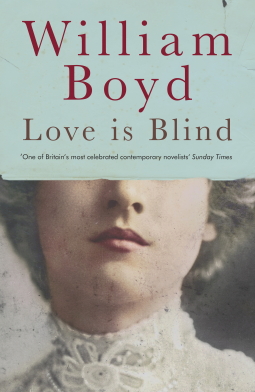
#BookReview ‘Love is Blind’ by William Boyd #historical

When a new novel by William Boyd features a male protagonist, my first thought ‘is it another Logan Mountstuart’ with a feeling of anticipation. But Love is Blind is not another version of Any Human Heart. It tells the story of Brodie Moncur, a young Scottish piano tuner who travels Europe as he seeks warmer climes and the love of his life. William BoydBoyd is on good form and I raced through Love is Blind, enveloped in Brodie’s end of 19thcentury/early 20thcentury story. Told almost exclusively from Brodie’s viewpoint, plus some of the letters he writes and receives, we see the world and the people he meets through his eyes so, as he falls in with thieves the sense of impending doom increases. He is a likeable, believeable character, son of a fire-and-brimstone alcoholic preacher, living in a time of great change as motor cars appear on the road and the signs of war increase but when consumption kills. The details of Brodie’s piano tuning are fascinating, these skills are the passport to his travels, getting him into and out of trouble, enabling him to earn money wherever he finds himself.
When the story starts in 1894 Brodie is a piano tuner for Channon & Co in Edinburgh. Offered a job at the Channon shop in Paris, he takes the opportunity to escape his oppressive father and so falls in with John Kilbarron, a fading Irish concert pianist who comes to rely on Brodie’s magical skills with his tuning tools. The major difficulties of Brodie’s story are established in Paris. He falls in love with Lika Blum, would-be Russian opera singer, who may or may not be in a relationship with Kilbarron. And he starts to cough up blood.
Consumption is diagnosed and Brodie travels to Nice in search of a warmer climate, unable to work, leaving Lika behind. From the beginning, Brodie pursues Lika rather than the other way round, she insists on secrecy and is enigmatic when pressed for details of her earlier life. Warning signs that are obvious to the reader but to which Brodie is blind, the blindness of the title, are everywhere. Lika does not share many secrets and there is no authorial voice to fill in her backstory. He is a young man in love/lust and cannot see what seems to be staring him in the face. He writes a succession of letters which, given the need for secrecy, are foolhardy. So when trouble finds him, in the shape of Kilbarron’s thuggish brother Malachi, it is not a surprise.
The character of Lika is lightly drawn but that is perhaps because Brodie knows so little about her. They arrange assignations in hotel rooms and on riverbanks, passing notes to each other and sharing significant glances. The affair continues as the Kilbarron party moves to St Petersburg, Russia, to perform a programme for a new wealthy benefactor. It is here that the cracks start to appear in the Kilbarron/Moncur relationship.
The final part of the book was less satisfactory for me. The Prologue to the story is a short letter written in 1906 by a woman called Page from an address in the Andaman Islands, Indian Empire, in which Brodie Moncur is briefly mentioned. In Part VII, Brodie is living at Deemer’s Hotel, Port Blair, the Andamans. I found his encounter with ethnologist Page Arbogast and their research trip to the Nicobar Islands superfluous.

Read my reviews of:
ANY HUMAN HEART
NAT TATE: AN AMERICAN ARTIST 1928-1960
ORDINARY THUNDERSTORMS
SWEET CARESS
THE BLUE AFTERNOON
THE DREAMS OF BETHANY MELLMOTH
TRIO
WAITING FOR SUNRISE
… and try the first paragraph of ARMADILLO

If you like this, try these:-
‘After the Bombing’ by Clare Morrall
‘The Translation of Love’ by Lynne Kutsukake
‘Exposure’ by Helen Dunmore

And if you’d like to tweet a link to THIS post, here’s my suggested tweet:
#BookReview LOVE IS BLIND by William Boydhttps://wp.me/p5gEM4-3we via @SandraDanby

#BookReview ‘These Dividing Walls’ by Fran Cooper @FranWhitCoop #historical

A young man arrives in Paris seeking respite from his grief, surrounding himself in the solitude of an attic flat loaned from a friend. Alongside him, his neighbours are happy and unhappy, they are getting by, they are lying to loved ones, lying to themselves. These Dividing Walls by Fran Cooper is a multi-layered story of microcosm and macrocosm, of an apartment block in Paris and its inhabitants, of city-wide anti-immigrant protests. Fran CooperA wave of racist violence enters the centre of Paris and the unfolding events are told through the lives of the residents at Number 37. Their lives converge and depart from each other, some are socially-minded, others watch from behind curtains. The young mother stretched so thin in the care of her three young children that she fears she will break. The banker who lost his job but is too ashamed to tell his wife. The homeless man who sleeps in a doorway on the street nearby. The silver-haired seller of art books who mourns her dead son. A young couple, new residents at Number 37, lock their door and turn off the television. The lives of all these people are affected by the xenophobic hatred which enters their street.
These Dividing Walls is at once a tender story and a violent one. Cooper writes with a love for Paris, a city she knows well, and this knowledge is in every sentence. A fond familiarity with Paris shines off every page, gently done, without shouting. The best book I have read this year.

If you like this, try:-
‘Quartet’ by Jean Rhys
‘An Officer and a Spy’ by Robert Harris
‘Fair Exchange’ by Michèle Roberts

And if you’d like to tweet a link to THIS post, here’s my suggested tweet:
#BookReview THESE DIVIDING WALLS by Fran Cooper @FranWhitCoop http://wp.me/p5gEM4-2KC via @SandraDanby