Tag Archives: WW2

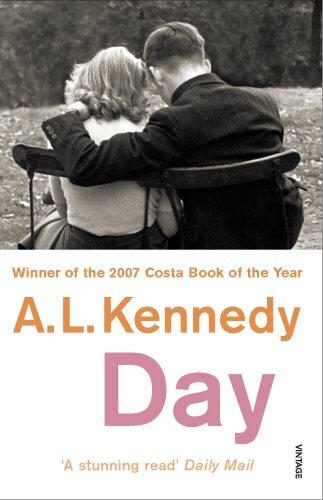
#BookReview ‘Day’ by AL Kennedy @Writerer #WW2

Day, the title of this novel by AL Kennedy, does not refer to a period of twenty-four hours, but to Alfred Francis Day. Alfie. Rear gunner in a Lancaster in World War Two and now extra on the set of a war film. Past and present are mingled together as he starts to remember things he would rather forget. The passages in the bomber are electrifying, in their detail and understanding. The cold, the smell, the fear, how the professionalism of their training kicks in when the action starts. It is totally believable. AL KennedyThe timelines are mixed here as Alfred’s memories are inter-mingled: when Alfred was a member of the bomber crew; his time in a prisoner-of-war camp; and as a film extra in 1949. Where the novel is not so clear, for me, is the intermingling of these three timelines, though after fifty pages everything started to clarify. If you find this, persist and everything will fall into place.
Through Alfred’s memories and his conversations with Ivor, his post-war employer at a bookshop, his bomber crew and the other film extras, we start to piece together the story of his life. It is particularly poignant when he falls in love, heavily, after a fleeting encounter during a bombing raid in London. He meets Joyce in a shelter and from then on she fills his head, when his head should be concentrating on shooting down enemy fighters as his crew drops bombs on Hamburg. ‘Turning his head and turning his head while the heath beyond him dreams, his head pressing back in his pillow and eyes closed and no clear memory he can see, only the wonder that her heartbeat was everywhere in her skin.’
Alfie is a complex character. He is a small man who reads to educate himself. He is nicknamed ‘Boss’ by his flight crew even though he is not the skipper. In flight training, he asks Sergeant Hartnell to show him how to fight and win. ‘Look, son… You’re not the first. Happens quite often in fact. Lads come along and they ask me for help… help with an argument they’ve got to settle back home…’ He tells Alfred his best bet is to hit them from behind with a bit of pipe, but when Alfred gets his chance he throws bricks.
We learn most about him as he remembers his mother and father, both of whom die during the war. In Alfred’s head, his mother and Joyce seem connected and he learns that memories are fickle, the things we would rather forget are the ones that return. ‘Some memories, the ones you’d rather keep – the more you tried to look at them, the more they wore away.’
CLICK HERE TO READ MORE ABOUT THIS BOOK AT AMAZON

And click the title to read my reviews of these other AL Kennedy books:-
ALL THE RAGE
ON WRITING
SERIOUS SWEET

If you like this, try:-
‘The Paying Guests’ by Sarah Waters
‘The Slaves of Solitude’ by Patrick Hamilton
‘Wake’ by Anna Hope

And if you’d like to tweet a link to THIS post, here’s my suggested tweet:
#BookReview DAY by AL Kennedy @Writerer via @SandraDanby http://wp.me/p5gEM4-2C6

#BookReview ‘The Translation of Love’ by Lynne Kutsukake #WW2 #war

How to describe The Translation of Love by Lynne Kutsukake? What a charming and unusual novel it is, if at some times a trifle confusing. The setting is unusual, post-war Tokyo when the country is being run by the US General MacArthur and at times it reminded me of Rhidian Brook’s wonderful The Aftermath set in post-war Berlin. It is about war and what it does to us, how a broken society can ever begin to heal, how the young will ever be able to live a normal life, when the word normal ceases to exist. Lynne KutsukakeSensitively written, each page draws a picture of Tokyo from a different point of view – Aya, a Japanese-Canadian schoolgirl feels the odd one out in her new school; her classmate Fumi misses her elder sister who left home to find work; Sumiko has a job in a dance hall dancing with the GIs but is ashamed to tell her family what she is doing; Kondo Sensei, the teacher of the younger girls and also part-time translator and writer of letters; and Matt Matsumoto, the Japanese-American soldier who translates the letters sent to General MacArthur by Japanese citizens.
Letters are an important tool in this story which is essentially a young girl’s quest to find her sister. When Fumi finds out that Aya can write in English, she asks for her to write a letter to General MacArthur asking for his help to find her Sumiko. As the letter changes hands and Matt and a colleague become involved in searching for Sumiko, the story unfolds gently against a terrible backdrop of bomb damage, poverty, starvation, pride, culture clash and above all the determination to survive.
It was a while before all the Japanese characters, and some of the Japanese vocabulary, started to fall into place. A touching story inspired by the letters written by Japanese citizens to MacArthur, it draws a picture of a period in Japanese history of which I knew nothing.

If you like this, try:-
The Bird in the Bamboo Cage’ by Hazel Gaynor
The Aftermath’ by Rhidian Brook
Homeland’ by Clare Francis

And if you’d like to tweet a link to THIS post, here’s my suggested tweet:
#BookReview THE TRANSLATION OF LOVE by Lynne Kutsukake via @SandraDanby http://wp.me/p5gEM4-2cE

#BookReview ‘The Ends of the Earth’ by Robert Goddard #WW2 #thriller

Don’t do what I did, and read the first two books in this series by Robert Goddard and then leave 12 months before reading The Ends of the Earth, the third. Ideally this trilogy should be read back to back, in full sun when sitting on a sunlounger. The story runs along at a cracking pace, with dense plotting, loads of characters, politics, spies and locations from Europe to Japan. The pace of this, the third book, is constant, hardly time to draw a breath. Robert GoddardQuestions that I had forgotten about from the first book are revisited, challenged and solved. Japan is the scene for the climax of this tale of James Maxted, ‘Max’, and his hunt for the truth about his father’s death. But this is so much more than a single case of murder, on it hangs the future of post-Great War Europe and the twentieth-century relationship of Japan and America. At times things happen which seem a little convenient, a person turns out to have a skill or history of which we knew nothing before, but I forgave Goddard for this. He is a prime storyteller. It is clear he knows his settings – Paris, Marseilles, Switzerland, Japan – and this adds to the verisimilitude.
In this rollicking spy story, Goddard examines the nature of courage. Max finds himself drawing on the type of bravery he needed to survive in the Royal Flying Corps. “He was not surprised by how calm he felt, how undismayed by what lay before him. He had discovered his aptitude for taking risks early in the war. ‘You should be more careful, sir,’ Sam had said to him more than once. And Max had always given the same reply. ‘Being careful is what gets a chap killed.’ Eventually, he had come to believe that. And it was a belief that had served him well. So far.”

Read my reviews of Goddard’s other books:-
THE WAYS OF THE WORLD #1WIDEWORLD
THE CORNERS OF THE GLOBE #2WIDEWORLD
PANIC ROOM
THE FINE ART OF INVISIBLE DETECTION #1UMIKOWADA
THIS IS THE NIGHT THEY COME FOR YOU #1SUPERINTENDENTTALEB

If you like this, try:-
Midnight in Europe’ by Alan Furst
Stay Where You Are and Then Leave’ by John Boyne
Slow Horses’ by Mick Herron #1SLOUGHHOUSE

And if you’d like to tweet a link to THIS post, here’s my suggested tweet:
#BookReview THE ENDS OF THE EARTH by Robert Goddard http://wp.me/p5gEM4-1O8 via @SandraDanby 

#BookReview ‘All Change’ by Elizabeth Jane Howard #historical #WW2

All Change is a leap forward in time; the fourth book in ‘The Cazalet Chronicles’ by Elizabeth Jane Howard left us in 1947 but this, the last in the series, runs from June 1956 to December 1958. Much has changed in the 11 years after VE Day: Queen Elizabeth succeeds to the throne after the death of her father King George VI, there are eight million refugees within Germany’s borders, President Eisenhower is elected. And in the world of the Cazalets, there is death too. Elizabeth Jane HowardThis final book is an examination of the nature of love that persists despite pain and trouble. The cousins experience difficulties in love – affairs, divorce, misguided attachments and betrayal – while their parents are fractured by the failure of the family timber business. Suddenly there is no money: houses must be sold, servants let go after years of service, meals cooked and houses cleaned without help. Family love persists through this dark time and, as throughout the war, the Cazalet family emerges out the other side, shaped differently for the next decade.
Reading the last book in a well-loved series is always a mixed feeling: delight and loss. So it is with wonder that I consider how Elizabeth Jane Howard wrote this final book of the series when she was 90, completing it before she died in January 2014.

Read my reviews of the other books in ‘The Cazalet Chronicles’:-
THE LIGHT YEARS #1CAZALET
MARKING TIME #2CAZALET
CONFUSION  #3CAZALET
CASTING OFF #4CAZALET 

If you like this, try:-
‘The Garden of Angels’ by David Hewson
‘One Moonlit Night’ by Rachel Hore
‘Dear Mrs Bird’ by AJ Pearce

And if you’d like to tweet a link to THIS post, here’s my suggested tweet:
#BookReview ALL CHANGE by Elizabeth Jane Howard via @SandraDanby http://wp.me/p5gEM4-1CK

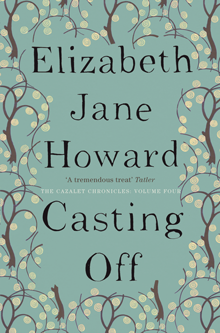
#BookReview ‘Casting Off’ by Elizabeth Jane Howard #historical #WW2

Casting Off by Elizabeth Jane Howard starts in July 1945 as Hugh Cazalet must decide what to do as Miss Pearson, his secretary for 23 years, resigns. But the end of the European war is in sight. When this book ends, war is over and there are more engagements, marriages and divorces, births and deaths in the Cazalet family. This is the fourth book in a five-book series. Elizabeth Jane HowardThe title refers not just to ending relationships, but to letting go of war-time life. This is more complicated than anticipated. Longing for something for so long, does not make it easy to live through when it happens. Change is challenging. Post-war life is not all it is expected to be, in some ways it is harder.  Though the privations of rationing continue, often harsher than during the war itself, possibilities for new life unfold like a flower in bloom. But there are no easy answers.
The three cousins are grown-up. Polly, Louise and Clary now face life as young adults, their idealism tainted by the sadness and disappointments of war. But there are surprises in store for Clary, while the Cazalet brothers must make a business decision which affects the financial future of the whole family. Can they still afford the Sussex home, the anchor for the family throughout the war, and home to The Duchy and The Brig? And where will this extended war-time family now live, separated from one another?
Expecting happiness after the end of the war, ordinary life disappoints as the trials and disappointments continue. Louise’s friend Stella explains: “… when anyone becomes more than a certain amount unhappy they get cut off. They don’t feel any comfort or concern or affection that comes from other people – all of that simply disappears inside some bottomless pit and when people realize that, they stop trying to be affectionate or comforting. Would you like some grey coffee, or some pink-brown tea?”
Howard’s characters are so clearly drawn that they became real people for me, while I read these books. They feel like real friends. That is a huge achievement for any novelist.

Read my reviews of the other books in ‘The Cazalet Chronicles’:-
THE LIGHT YEARS #1CAZALET
MARKING TIME #CAZALET
CONFUSION  #3CAZALET
ALL CHANGE #5CAZALET 

If you like this, try:-
‘Life After Life’ by Kate Atkinson
‘The Heat of the Day’ by Elizabeth Bowen
While Paris Slept’ by Ruth Druart

And if you’d like to tweet a link to THIS post, here’s my suggested tweet:
#BookReview CASTING OFF by Elizabeth Jane Howard http://wp.me/p5gEM4-1CH via @SandraDanby

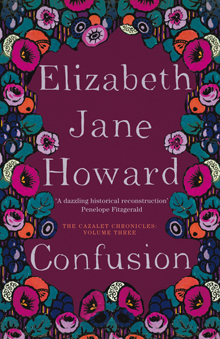
#BookReview ‘Confusion’ by Elizabeth Jane Howard #historical #WW2

Confusion, the third in the five-book series by Elizabeth Jane Howard which is ‘The Cazalet Chronicles,’ covers March 1942 to July 1945, again we see the family’s experiences through the teenage eyes of Polly, Louise and Clary. Much has changed now as the war progresses, particularly affecting the role of women, the breakdown of class barriers, the empowerment of working women and educated poor. Elizabeth Jane HowardThese books are quite a social history of a period which more often is the reserve of thrillers and spy novels. Elizabeth Jane Howard has a subtle hand when it comes to observing relationship, such as Polly’s observation after her mother’s death: “It was possible to believe that she was gone; it was their not ever coming back that was so difficult.” Confusion is in part a study of the grief of Polly and her father Hugh; and that of Clary and Neville, whose father Rupert has disappeared in action in France. Clary continues to believe her father is still alive, though the rest of the family quietly accepts his death. Then word from France brings a sliver of hope. Clary grieves for the father she remembers as a child, writing a daily diary for him, and not as the soldier he died as.
The other theme in Confusion is love, or the lack of it. Louise’s story is not about death but about young love, expectations and marriage and the realization that her husband Michael is more strongly wedded to his mother Zee than to her. There are war-time affairs, some lust, some love, and with all of them comes the confusion of uncertain times, stress and the pressure of living life ‘now’.
War seems ordinary in the everyday sense, but the Cazalets are living through extra-ordinary times. The familiar characters continue from the first two books, their story arcs going through radical change now as the war progresses and everyone’s life is changed forever.

Read my reviews of the other books in ‘The Cazalet Chronicles’:-
THE LIGHT YEARS #1CAZALET
MARKING TIME #2CAZALET
CASTING OFF  #4CAZALET
ALL CHANGE #5CAZALET

If you like this, try:-
‘At Mrs Lippincote’s’ by Elizabeth Taylor
‘Freya’ by Anthony Quinn
‘The Aftermath’ by Rhidian Brook

And if you’d like to tweet a link to THIS post, here’s my suggested tweet:
#BookReview CONFUSION by Elizabeth Jane Howard http://wp.me/p5gEM4-1CD via @SandraDanby

#BookReview ‘Homeland’ by Clare Francis #WW2 #mystery

Homeland by Clare Francis is set after World War Two in the quiet rural corner of England that is the Somerset Levels. A land of rising and ebbing water levels, and unworldly place of withies and willows.Clare Francis Into this walks Billy Greer on his return from the war, going back to the house of his uncle and aunt where he spent the difficult teenage years before the war. There, he finds the house and farm in disarray, his uncle dramatically aged, and his aunt upstairs confined to bed after a stroke. And he meets again the woman who made his spine tingle when they were both teenagers.
Will he stay to rebuild the farm, or will he go to the promised job in London. And what of Annie, the local girl he could not forget while he fought his way around Europe?
Underlying the telling of Billy’s story is that of the Polish soldiers, in a holding camp while they await either return to Poland or settlement in the UK. It is a difficult decision: their beloved country is unrecognizable and run by the Soviet Union, but they do not feel 100% welcome in England. Wladyslaw, a literature student who left university to join the Polish army, is an intellectual and a dreamer. But he takes a job working for Billy Greer, helping to set the rundown farm to rights. And there he meets local schoolteacher Stella who agrees to give him English lessons.
This feels like a quiet tale – and it is not a thriller in the ‘spy story’ definition – but it is a story which kept me turning the pages. There are many uncertainties: the future of the Poles, the various love triangles, locals and immigrants living alongside each other without a common language with inevitable arguments and misunderstandings. The denouement is not what I expected.

If you like this, try:-
‘The Aftermath’ by Rhidian Brook
‘The Translation of Love’ by Lynne Kutsukake
‘Freya’ by Anthony Quinn

And if you’d like to tweet a link to THIS post, here’s my suggested tweet:
#BookReview HOMELAND by Clare Francis http://wp.me/p5gEM4-1Dt via @SandraDanby

#BookReview ‘The Bone Church’ by @vicdougherty #war #WW2

The Bone Church was a difficult story to get into for me, which surprised me. The premise by Victoria Dougherty seems so good – Czechoslovakia, wartime, fugitive lovers, a faked religious icon, and a plot to assassinate Josef Goebbels – the promise of which kept me reading. But I found the time shifts, the point of view shifts, and the way the action changed from paragraph to paragraph quite confusing. Assuming this was a formatting issue with my Kindle copy, I kept reading. Victoria DoughertyThe story starts in Rome in 1956 in the Vatican City with a Cardinal and a man called Felix. Then we see Magdalena and her son Ales in Czechoslovakia, a man arrives and takes away her son. Then the action switched to 1943, as Felix and Magdalena are on the run in Prague. He is a famous hockey player, a celebrity, she is a Jew. By this point, the story should have gripped me but I’m afraid it didn’t, I hadn’t read enough about the two characters to care. I think my basic problem is the way the story was told, not the actual story itself; the writing is rich with description and the author certainly knows her history. Halfway through, things started to make a little more sense though at times the plot seemed unnecessarily complicated.
The best bit? An assassination scene, involving a birthday cake, a gun, and Josef Goebbels.

If you like this, try:-
‘Life After Life’ by Kate Atkinson
‘The Little Red Chairs’ by Edna O’Brien
‘Dominion’ by CJ Sansom

And if you’d like to tweet a link to THIS post, here’s my suggested tweet:
#BookReview THE BONE CHURCH by @vicdougherty http://wp.me/p5gEM4-1Bl via @SandraDanby

#BookReview ‘Inflicted’ by Ria Frances #WW2 #holocaust

Theo is sixteen, and unhappy. He stumbles into the life of an elderly neighbour, Anna. Together they share their secrets and Anna, by telling the story of her own life as a teenager, helps Theo face up to his difficult emotions. Inflicted is the debut novel of English author Ria Frances and, despite the unflinching approach to a difficult subject, is I think aimed at teenagers. Ria FrancesIt tells the story of Anna, a teenager in the Second World War, on the run with her parents from the German army. Her mother dies and Anna is separated from her father as they are taken to Theresienstadt, the city-turned-ghetto run by the Nazis. Anna’s story of hardship is a difficult emotional read, the author does not sweeten the hardships, but the central message is one of hope, courage and love amidst suffering.
I wanted to know how Anna’s story ended, even though the adult Anna was telling her own story, because I was curious about her journey from the Czech village of Lidice, to Theresienstadt, Berlin and finally to Sussex in 2010. Curiously, it was Anna’s story which drew me on not Theo’s.
I found the ending rather rushed and difficult to follow, perhaps in the author’s effort to tie-up all the loose ends. But I don’t mind some loose ends at the end of a novel, it leaves the story fresh in my mind and gives me something to consider.

If you like this, try:-
‘The Little Red Chairs’ by Edna O’Brien
‘The Bone Church’ by Victoria Dougherty
‘All The Broken Places’ by John Boyne

And if you’d like to tweet a link to THIS post, here’s my suggested tweet:
#BookReview INFLICTED by Ria Frances http://wp.me/p5gEM4-1q8 via @SandraDanby

#BookReview ‘The Corners of the Globe’ by Robert Goddard #WW2 #thriller

The Corners of the Globe is a very fast-moving sequel by Robert Goddard, second in his Wide World series. There’s a Scotland to London train chase complete with spies, a captured German warship, murder, kidnapping, secret codes and jumping on and off trains which would rival The 39 Steps [which Goddard playfully has one of his characters read in the restaurant car of one of the trains]. Robert GoddardGreat War flying hero James Maxted is in London, convinced that the death of his father [in the first book] is not as simple as it appeared. His investigations take him further into danger, into the dark and deadly preview of the Second World War. You really do need to read book one first [see the link below for my review] although there is a little exposition at the beginning in the form of a Secret Service report, but to be honest it functions more as a recap for the reader who has read the first book than as an introduction for a newcomer.
I failed to guess the ending of the first book, did I guess the ending of this one correctly? No.

Read my reviews of Goddard’s other books:-
THE WAYS OF THE WORLD #1 THE WIDE WORLD TRILOGY
THE ENDS OF THE EARTH #3 THE WIDE WORLD TRILOGY
PANIC ROOM
THE FINE ART OF INVISIBLE DETECTION #1UMIKOWADA
THIS IS THE NIGHT THEY COME FOR YOU #1SUPERINTENDENTTALEB

If you like this, try:-
Corpus’ by Rory Clements
The Second Midnight’ by Andrew Taylor
Noonday’ by Pat Barker

And if you’d like to tweet a link to THIS post, here’s my suggested tweet:
#BookReview THE CORNERS OF THE GLOBE by Robert Goddard via @SandraDanby http://wp.me/p5gEM4-19H