Tag Archives: novels set in WW2 London

#BookReview ‘The Silk Code’ by Deborah Swift @swiftstory #WW2

World War Two is one of my favourite periods to read about and so I expected much from The Silk Code by Deborah Swift, especially as it is based on the Special Operations Executive in London. Coding, female agents, secrets, spies. Deborah SwiftOn the rebound from a broken engagement, Nancy Callaghan leaves her beautiful but claustrophobic home in Scotland for London. Her brother Neil, who works in an unnamed adminstrative department in Baker Street, offers to put her forward for a secretarial job. Except Baker Street is the home of SOE and Nancy turns out to be a dab hand at decoding, especially the ‘indecipherables,’ the messages sent by agents that are muddled and meaningless. Nancy finds Neil much changed; he seems to sleep little, is out much of the night, is grumpy and uncommunicative. Then when Nancy takes a shine to Tom Lockwood, the expert who trains the coders, Neil instantly disapproves. Of course there is more going on here than office politics. Is it simply a matter of professional jealousy or is there a traitor in the building? Why is the death rate of SOE agents parachuted into Holland so high? And why won’t the bosses listen to Tom’s suspicions? When Nancy is given an ultimatum – spy on your colleagues for the good of your country, or be demoted and moved from Baker Street – she feels she has no choice.
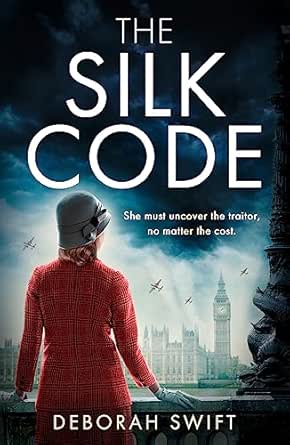
This is a thrilling story packed with moral choices of the ‘do the easy thing or the right thing’ type. Based on true history but populated with mostly fictional characters, Swift has written a novel that kept me reading just another chapter. The pace is fast following the introduction to Nancy in rural Scotland and Swift convincingly shows Nancy’s difficulties arriving in a strange city, living in a box room in her taciturn brother’s flat, training to do a job that isn’t explained alongside colleagues who have all signed the Official Secrets Act. As Nancy is trying to work out what is going on, so is the reader. Everyone knows only so much and everyone, it seems, has secrets.
When Tom and Nancy invent a method of printing one-time codes on silk cloth that can be hidden in the agents’ clothing, little do they realise that Nancy will soon be in Holland. Half-Dutch and fluent in the language, Nancy is a natural for SOE espionage training. But she truly has little idea of what she is flying into. N-Section in Holland is a vipers’ nest of double agents with Nazis masquerading as Allied coders. From the moment her feet touch the ground, she doesn’t know who to trust.
The Silk Code is a very good introduction to Swift’s WW2 Secret Agent series. Next is The Shadow Network. Deborah Swift is a new author to me and I’d also like to read some of her historical fiction.

Here’s my review of the next in this series:-
THE SHADOW NETWORK #2WW2SECRETAGENT

If you like this, try:-
‘The Guernsey Literary & Potato Peel Pie Society’ by Mary Ann Shaffer & Annie Barrows
‘Dominion’ by CJ Sansom
‘The Rose Code’ by Kate Quinn

And if you’d like to share a link:
#BookReview THE SILK CODE by Deborah Swift @swiftstory https://wp.me/p2ZHJe-8Sr via @SandraDanby

COMING SOON… THE NEXT BOOK I REVIEW WILL BE:- Renita D’Silva
#BookReview ‘Transcription’ by Kate Atkinson #WW2

Few of the characters in Transcription by Kate Atkinson are who they seem to be. A novel of the Second World War, Transcription suggests that the ripples of wartime secrecy spread out through the following years so that outstanding lies and betrayals are eventually repaid. Many years later. Kate AtkinsonIn 1940, Juliet Armstrong intends to join one of the women’s armed forces when she receives a letter on government notepaper and is summoned to an interview. After being informed by telegram that she has got the, still unspecified, job, Juliet boards a bus which takes her to Wormwood Scrubs prison, now converted into government offices. There she works in Registry, shuffling files around, until Perry Gibbons says, ‘I need a girl’ and Juliet finds herself working for Perry’s MI5 counter-fascism team at a flat in Dolphin Square.
Told across two timelines, 1940 and 1950 – with a brief glimpse at 1981 in the prologue and epilogue – Transcription has a huge cast of characters, most of whom I confused and, I suspect, Atkinson wishes me to confuse. Some characters are spies with cover names, some are only described and have no name while others seem innocent, too innocent to actually be innocent. If this is all confusing, it is meant to be. That is Atkinson’s point. This is a story about the importance of truth and how lies, which seem pragmatic and normal in wartime, are still lies. And that the most obvious traitors are not always the ones to be worried about.
The 1940 storyline covers the MI5 operation. At first, Juliet’s job is type up transcripts of bugged conversations between fascist supporters in the next door flat; later she takes on the persona of Iris to infiltrate a group of fascist agitators. Sometimes she fluffs her lines, sometimes she is impulsive and gets into trouble. At all times she feels isolated and unsure of the value of what she is doing. She is also a young woman and looks for signs of interest from the men surrounding her. In 1950, while working in the Schools Department of the BBC making educational radio programmes with titles such as ‘Can I Introduce You To?’ and ‘Have You Met?’, she sees familiar faces from her wartime days and the past revisits her.
Atkinson excels at the small detail which makes these workplaces convincing, creating believable relationships between Juliet and radio engineer Cyril at Dolphin Square, and with junior programme engineer Lester Pelling at the BBC. I enjoyed this book but wouldn’t describe it as a page turner. I’m not sure I liked Juliet but she held enough fascination for me as I tried to figure out what she did and didn’t believe in. I was never totally sure if I believed in her.
The Author’s Note at the end of the book is fascinating and perhaps would have served better as a Foreword. So, in summary, not my favourite Atkinson novel but not a bad one either.

Click the title to read my reviews of these other books by Kate Atkinson:-
A GOD IN RUINS
BIG SKY #5JACKSONBRODIE
DEATH AT THE SIGN OF THE ROOK #6JACKSONBRODIE
LIFE AFTER LIFE
NORMAL RULES DON’T APPLY
OUR NOBLE SELVES
SHRINES OF GAIETY
… and try the #FirstPara of EMOTIONALLY WEIRD

If you like this, try:-
‘The Heat of the Day’ by Elizabeth Bowen
‘After the Party’ by Cressida Connolly
‘Shelter’ by Sarah Franklin

And if you’d like to share a link:
#BookReview TRANSCRIPTION by Kate Atkinson https://wp.me/p5gEM4-4cx via @SandraDanby

#BookReview ‘Dominion’ by CJ Sansom #WW2 #dystopian #thriller

You know that feeling, it happens once in a while, when you finish reading a book that was so good you want to go back to the beginning and start again? Well, it was like that for me with Dominion by CJ Sansom. CJ SansomIt was the premise that caught my attention as soon as I read the pre-publication reviews: an alternate history set in Britain in 1952, peace is made with Hitler in 1941 which changes the direction of World War Two. An alternative world. Previously I had read one Sansom novel, Winter in Madrid, which I enjoyed; three of his Matthew Shardlake mysteries sit on my to-read shelf. After Dominion, I will turn to them quickly.
The story focusses on four main characters, a scientist, a civil servant, the civil servant’s wife, and a Gestapo officer based at Senate House in London, the tall university building being the Gestapo’s London HQ with torture cells in the basement. This is a different Britain, where Jews are being rounded-up and transferred to camps in the country, where the Isle of Wight is occupied by the German army [which is still fighting in Russia], and where it is rumoured in Berlin that Hitler is either dead or dying.
To say more would risk spoiling the plot twists, of which there are plenty. The darkness of the time is shown symbolically by the Great Smog which actually happened in London, December 1952. It sheds a stifling blanket of choking fog which stops life and blinds everything more than a foot away. The smog is a metaphor of course for the blindness of the Government, and much of the population, who accept their situation with apathy and do nothing to aid the Resistance led, inevitably, by Churchill.
Sansom’s central message is about the danger of nationalism and xenophobia and what, in the extremes, they can lead to. A subject which, as he says in the Appendices, he fears is all too relevant in modern Europe.
A thought-provoking read.

And here are my reviews of CJ Sansom’s Shardlake detective series:-
DISSOLUTION #1SHARDLAKE
DARK FIRE #2SHARDLAKE
SOVEREIGN #3SHARDLAKE
REVELATION #4SHARDLAKE
HEARTSTONE #5SHARDLAKE
LAMENTATION #6SHARDLAKE
TOMBLAND #7SHARDLAKE

If you like this, try:-
‘The Aftermath’ by Rhidian Brook
‘Homeland’ by Clare Francis
‘The Bird in the Bamboo Cage’ by Hazel Gaynor

And if you’d like to share a link:
#BookReview DOMINION by CJ Sansom https://wp.me/p2ZHJe-4aP via @SandraDanby