Tag Archives: historical fiction

#BookReview ‘Master of Shadows’ by Neil Oliver #historical

Master of Shadows starts with a historical note about 1453 and the advance of the Ottomans on the eastern Christian empire of Constantinople. Rumoured to be among the city’s defenders was a Scot called John Grant. Author Neil Oliver takes the real life Grant and fictionalizes him in this, his debut novel; a novel rich in detail, historical context, colours and smells. Neil OliverIt starts with disparate snapshots: a boy lies in a meadow and feels invisible; a stranger arrives at a Scottish village; a woman, chopping wood, feels threatened; a young girl leaps from a high wall, expecting to die.
A Moorish solider, tall and imposing with his curved blade, arrives in Scotland at the castle of a Lord. Secretly he is seeking a specific woman. He had fought in wars alongside her husband and promised to keep her and their son safe if he should die. Badr becomes a surrogate father to the boy and teaches him everything he knows, later they fight side-by-side in battle. Leña lives amongst nuns. Given her name – which means ‘firewood’ in Spanish – I thought was a Spanish woman but in the memories of her childhood we learn she, too, has been to Scotland, and speaks French. So the mystery continues. The storylines are many and intriguing and for a long time I puzzled over how they connected. It is a story about the connections of blood, the duty owed to family. It is a long book (448 pages) but never seemed so long to be off-putting. There were passages a little too ‘history heavy’ for me, but I’m sure some readers will gobble it up.
All-in-all, a great debut. Not all historians can tell a page-turning fictional story, for some it takes three or four novels before they hit their stride, so I’m looking forward to Oliver’s next novel.
CLICK HERE TO READ MORE ABOUT THIS BOOK AT AMAZON

If you like this, try:-
‘The Surfacing’ by Cormac James
‘Gone Are The Leaves’ by Anne Donovan
‘Wilderness’ by Campbell Hart

And if you’d like to tweet a link to THIS post, here’s my suggested tweet:
#BookReview MASTER OF SHADOWS by Neil Oliver https://wp.me/p2ZHJe-1Qr via @SandraDanby

#BookReview ‘How to be Both’ by Ali Smith #art #historical

I admire Ali Smith, own quite a few of her books, so it was without hesitation that I stared to read How to be Both knowing it is an ‘experimental’ novel, a twisting, spiralling tale which has been shortlisted, longlisted, and won awards up the ying-yang. Ali SmithI wasn’t prepared for the first 20-30 pages [it’s difficult to be accurate on a Kindle] which completely lost me. Complete non-sequiturs, verse, stream of consciousness. Rambling, with little context. If it had been an unknown author I would have run out of patience, but it’s Ali Smith so I stuck with it and fell into the story of Francescho. The writing is beautiful, atmospheric, still a little short on fact for me: a child [boy or girl?] with artistic talent, whose father is a skilled brickmaker. The story of the child Francescho twists and twirls with that of the adult Francescho, a Renaissance painter of frescoes, who in his own quiet way challenges the status quo.
If you love books about artists, you will enjoy this one. In a brothel, Franchescho paints the women rather than laying with them, and becomes known for this. As he paints, he remembers the words of ‘the great Alberti’. “The great Alberti says that when we paint the dead, the dead man should be dead in every part of him all the way to the toe and finger nails, which are both living and dead at once : he says that when we paint the alive the alive must be alive to the very smallest part, each hair on the head or the arm of an alive person being itself alive : painting, Alberti says, is a kind of opposite to death…”
Just at the point when you wonder where Francescho’s story is going, Part Two starts. And what a contrast. 21st century. George is a modern-day teenager, grieving for her mother, remembers a visit they made to Italy because her mother was drawn to see a fresco by an unknown artist. There, they discover elements of the fresco which we saw Franchescho paint, their modern-deay interpretation, and Franchescho’s reason for painting them.
Through George’s eyes, and through her conversations with Mrs Rock, the school counsellor, we see the binary nature of the world: boy/girl, truth/lies. Is this the ‘both’ of the title? Mrs Rock says a truth teller is “usually someone with no power, no social status to speak of, who’d take it upon themselves to stand up to the highest authority when the authority was unjust or wrong, and would express out loud the most uncomfortable truths, even though by doing this they would probably even be risking their life.”
This is a book to read and read again. Complex, challenging and beautiful, this is not an easy read, it demands concentration, but it is worth it.

Click the title to read my reviews of other books by Ali Smith:-
AUTUMN #1SeasonalQuartet
WINTER #2SeasonalQuartet
SPRING #3SeasonalQuartet
SUMMER #4SeasonalQuartet
COMPANION PIECE #5SeasonalQuartet

If you like this, try:-
The Miniaturist by Jessie Burton
The Signature of All Things by Elizabeth Gilbert
‘Girl in Hyacinth Blue’ by Susan Vreeland

And if you’d like to tweet a link to THIS post, here’s my suggested tweet:
#BookReview HOW TO BE BOTH by Ali Smith http://wp.me/p5gEM4-1HE via @SandraDanby

My ‘Porridge & Cream’ read: JG Harlond

Welcome to the first in a new series in which one author chooses his/her ‘Porridge & Cream’ book. What is a ‘Porridge & Cream’ book? It’s the book you turn to when you need a familiar read, when you are tired, ill, or out-of-sorts, where you know the story and love it. Where reading it is like slipping on your oldest, scruffiest slippers after walking for miles. Where does the name ‘Porridge & Cream’ come from? Cat Deerborn is a character in Susan Hill’s ‘Simon Serrailler’ detective series. Cat is a hard-worked GP, a widow with two children and she struggles from day-to-day. One night, after a particularly difficult day, she needs something familiar to read. From her bookshelf she selects Love in A Cold Climate by Nancy Mitford. Today I am pleased to welcome historical novelist, JG Harlond.

“My ‘Porridge & Cream’ novels are the House of Níccolò series by the late Scots author Dorothy Dunnett. In the 1970s I became hooked on her 16th century Game of Kings series featuring the exquisite Francis Crawford of Lymond. Then in the 1980s, Dunnett began the 15th century House of Níccolò series about a flawed Flemish apprentice Claes, who becomes a Venetian banker with his own mercenary army; he’s successful in everything but with his family and the one woman he loves. The gifted, but not good-looking Claes/Níccolò, travels the world, seeking answers and finding trouble. JG Harlond

“The first book is Níccolò Rising, which I read while living in Italy and studying part-time in a Medici building. Later we moved to Holland and I was able to visit Bruges then other locations in the European novels. I was intrigued by the sophistication of the financial manoeuvring behind the Medici banking network, and disturbed by how Níccolò’s life is shaped by a father and grandfather, who refuse to accept him. The stories essentially chart how Níccolò seeks his legitimacy while desperately trying to find his own son. In the process he becomes involved in manipulating the international politics of Christendom and beyond.

“I pick up one of these books every year or so. This month it was Race of Scorpions, about the would-be King of Cyprus and the start of the sugar industry. Why – because aspects of the story relate to research for my next Ludo da Portovenere novel (although this is circa 17th century), but mostly because I was stressed by deadlines for other work and I needed a comfort read. What stays in my memory are the settings. I like separating the narrative layers, as well; trying to work out what Níccolò is up to. What pulls me back most though, is the quality of Dunnett’s writing. And yes – as an author, I am very influenced by Dunnett’s plots, characters and prose.”

About The Chosen Man by JG Harlond [Penmore Press] 
JG Harlond

Early spring 1635, a storm and pirate raid interrupt rogue Italian merchant Ludovico da Portovenere’s routine voyage from Constantinople to Amsterdam, disrupting his plans and entangling others in a secret commission that has life-changing, devastating results for all concerned.  Power and intrigue in international politics and the domestic sphere, The Chosen Man is a fictional version of what may have caused the Dutch scandal known as ‘tulip mania’; it also shows us how decisions made in high places can have terrible repercussions on innocent lives.

JG Harlond’s Bio
JG Harlond grew up in the West of England, studied and worked in various countries and is now settled in rural Andalucía, Spain. For the best part of 30 years, she taught in International schools in Europe. Encouraged by positive reviews for her first work of fiction, Jane re-wrote it as The Empress Emerald then completed a linked prequel, The Chosen Man. She is currently working on The Chosen Man trilogy, charting the international espionage and adventures of the charismatic rogue Ludo da Portovenere around 17th century Europe. Jane writes fiction for Penmore Press and educational material for OUP.

JG Harlond’s links
Website
Facebook
Love historical fiction? Find new historical novelists at The Historical Writers Association
JG Harlond’s publisher, Penmore Press

porridge_and_cream__rainyday_111_long


What is a ‘Porridge & Cream’ book? It’s the book you turn to when you need a familiar read, when you are tired, ill, or out-of-sorts, where you know the story and love it. Where reading it is like slipping on your oldest, scruffiest slippers after walking for miles. Where does the name ‘Porridge & Cream’ come from? Cat Deerborn is a character in Susan Hill’s ‘Simon Serrailler’ detective series. Cat is a hard-worked GP, a widow with two children and she struggles from day-to-day. One night, after a particularly difficult day, she needs something familiar to read. From her bookshelf she selects ‘Love in A Cold Climate’ by Nancy Mitford. Do you have a favourite read which you return to again and again? If so, please send me a message via the contact form here.


Discover the ‘Porridge & Cream’ books of these authors:-
Judith Field
Jane Lambert
Shelley Weiner

JG Harlond


Níccolò Rising’ by Dorothy Dunnett [UK: Penguin]

And if you’d like to tweet a link to THIS post, here’s my suggested tweet:
Why does author @JaneGHarlond love RACE OF SCORPIONS by Dorothy Dunnett? #books via @SandraDanby http://wp.me/p5gEM4-1Jz

#BookReview ‘All Change’ by Elizabeth Jane Howard #historical #WW2

All Change is a leap forward in time; the fourth book in ‘The Cazalet Chronicles’ by Elizabeth Jane Howard left us in 1947 but this, the last in the series, runs from June 1956 to December 1958. Much has changed in the 11 years after VE Day: Queen Elizabeth succeeds to the throne after the death of her father King George VI, there are eight million refugees within Germany’s borders, President Eisenhower is elected. And in the world of the Cazalets, there is death too. Elizabeth Jane HowardThis final book is an examination of the nature of love that persists despite pain and trouble. The cousins experience difficulties in love – affairs, divorce, misguided attachments and betrayal – while their parents are fractured by the failure of the family timber business. Suddenly there is no money: houses must be sold, servants let go after years of service, meals cooked and houses cleaned without help. Family love persists through this dark time and, as throughout the war, the Cazalet family emerges out the other side, shaped differently for the next decade.
Reading the last book in a well-loved series is always a mixed feeling: delight and loss. So it is with wonder that I consider how Elizabeth Jane Howard wrote this final book of the series when she was 90, completing it before she died in January 2014.

Read my reviews of the other books in ‘The Cazalet Chronicles’:-
THE LIGHT YEARS #1CAZALET
MARKING TIME #2CAZALET
CONFUSION  #3CAZALET
CASTING OFF #4CAZALET 

If you like this, try:-
‘The Garden of Angels’ by David Hewson
‘One Moonlit Night’ by Rachel Hore
‘Dear Mrs Bird’ by AJ Pearce

And if you’d like to tweet a link to THIS post, here’s my suggested tweet:
#BookReview ALL CHANGE by Elizabeth Jane Howard via @SandraDanby http://wp.me/p5gEM4-1CK

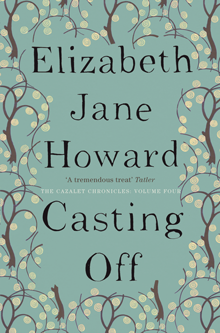
#BookReview ‘Casting Off’ by Elizabeth Jane Howard #historical #WW2

Casting Off by Elizabeth Jane Howard starts in July 1945 as Hugh Cazalet must decide what to do as Miss Pearson, his secretary for 23 years, resigns. But the end of the European war is in sight. When this book ends, war is over and there are more engagements, marriages and divorces, births and deaths in the Cazalet family. This is the fourth book in a five-book series. Elizabeth Jane HowardThe title refers not just to ending relationships, but to letting go of war-time life. This is more complicated than anticipated. Longing for something for so long, does not make it easy to live through when it happens. Change is challenging. Post-war life is not all it is expected to be, in some ways it is harder.  Though the privations of rationing continue, often harsher than during the war itself, possibilities for new life unfold like a flower in bloom. But there are no easy answers.
The three cousins are grown-up. Polly, Louise and Clary now face life as young adults, their idealism tainted by the sadness and disappointments of war. But there are surprises in store for Clary, while the Cazalet brothers must make a business decision which affects the financial future of the whole family. Can they still afford the Sussex home, the anchor for the family throughout the war, and home to The Duchy and The Brig? And where will this extended war-time family now live, separated from one another?
Expecting happiness after the end of the war, ordinary life disappoints as the trials and disappointments continue. Louise’s friend Stella explains: “… when anyone becomes more than a certain amount unhappy they get cut off. They don’t feel any comfort or concern or affection that comes from other people – all of that simply disappears inside some bottomless pit and when people realize that, they stop trying to be affectionate or comforting. Would you like some grey coffee, or some pink-brown tea?”
Howard’s characters are so clearly drawn that they became real people for me, while I read these books. They feel like real friends. That is a huge achievement for any novelist.

Read my reviews of the other books in ‘The Cazalet Chronicles’:-
THE LIGHT YEARS #1CAZALET
MARKING TIME #CAZALET
CONFUSION  #3CAZALET
ALL CHANGE #5CAZALET 

If you like this, try:-
‘Life After Life’ by Kate Atkinson
‘The Heat of the Day’ by Elizabeth Bowen
While Paris Slept’ by Ruth Druart

And if you’d like to tweet a link to THIS post, here’s my suggested tweet:
#BookReview CASTING OFF by Elizabeth Jane Howard http://wp.me/p5gEM4-1CH via @SandraDanby

#BookReview ‘Girl in Hyacinth Blue by Susan Vreeland #historical #art

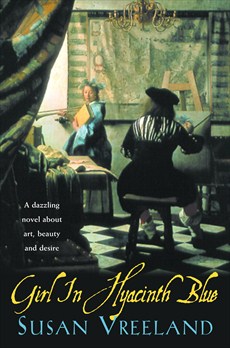
‘The front cover of Girl in Hyacinth Blue by Susan Vreeland features a painting by Dutch master Jan Vermeer called ‘The Painter in his Studio’. In it we see the back of a painter, brush in hand, studying a young girl in blue, holding a book, who stands by a window.  This real painting was the inspiration for Vreeland’s novel. Susan VreelandScene-by-scene  the story takes you back in time, following through the centuries the owners of the painting which author Susan Vreeland imagines Vermeer was painting . First, we meet a maths master who has a secret. A painting, inherited from his father, which came to him in the Second World War. The painting is passed from owner to owner, sometimes as an inheritance or gift, sometimes as payment of a debt, sometimes stolen. Vreeland tells us the story of each owner, what the painting meant to them and how it affected their lives: for some it means quick money, or guilt, or beauty, or a hidden secret. Effectively this is a series of short stories, linked by the painting.
It is a charming tale, set mostly in the Holland of dykes, poverty and farms. The painting illuminates the lives of everyone who owns it, no matter how briefly. A charming story about how a painting is viewed differently by everyone who sees it, starting with the artist’s intentions as he conceives and executes it. Vermeer says: “A man has time for only a certain number of paintings in his lifetime… He’d better choose them prudently.”
If you enjoyed Tracy Chevalier’s Girl with a Pearl Earring or Jessie Burton’s The Miniaturist, you will enjoy this.

If you like this, try:-
‘The Glassmaker’ by Tracy Chevalier
Disobedient’ by Elizabeth Fremantle
The Figurine’ by Victoria Hislop

And if you’d like to tweet a link to THIS post, here’s my suggested tweet:
#BookReview GIRL IN HYACINTH BLUE by Susan Vreeland http://wp.me/p5gEM4-1mi via @SandraDanby

#BookReview ‘Summertime’ by Vanessa Lafaye #Florida #historical

From the first chapter, Summertime by Vanessa Lafaye is steeped in its setting. Florida, 1935. Racial divides, love [extra-marital and long lost], the US mistreatment of its Great War veterans, and the threat of the elements dominate this tale of Heron Key. Vanessa LafayeLafaye is a debut novelist but she handles her explosive material with assurance, taking time to build the story as the town prepares for the annual beach barbeque on Independence Day. With the weather reports showing a hurricane approaching, tensions build between the townsfolk and the war veterans camped nearby in cockroach-infested mouldy conditions.
Lafaye took her inspiration from two real events, the Labor Day Hurricane in 1935, and the appalling way the US Government treated its war veterans. Heron Key is fictional as are the characters, but some of the things which happen during the hurricane are based on real-life reports. This is a wonderful meld of fiction and fact, handled by skilled storyteller. Lafaye handles the suspense as if she has been telling stories like this all her life.

And here’s my review of AT FIRST LIGHT, also by Vanessa Lafaye.

If you like this, try:-
‘The Knife with the Ivory Handle’ by Cynthia Bruchman
‘The Last Runaway’ by Tracy Chevalier
‘The Other Eden’ by Sarah Bryant

And if you’d like to tweet a link to THIS post, here’s my suggested tweet:
#BookReview SUMMERTIME by Vanessa Lafaye‪ via @SandraDanby http://wp.me/p5gEM4-1v2

#BookReview ‘The Knife with the Ivory Handle’ by Cynthia Bruchman #historical

A black man takes shelter in a train carriage amongst the animals. He has been shot and has no tongue. Two children are travelling from a Brooklyn orphanage to Illinois to start a new life on a farm. All three are on the same train. And so begins The Knife with the Ivory Handle, a lyrical tale by Cynthia Bruchman, of Illinois in 1900 which knits together the stories of Annette and Jonathan, Casper and priest Father Kelly. Cynthia BruchmanIt is clear from the first chapter that the author has intimate knowledge of this period in history. The Brooklyn orphanage is a real place on the page – the nuns, daily routine and quiet corridors – as is St Bede’s Abbey later in the book. The Spring Valley Race Riot of 1903 did happen, and the locations from Bureau, LaSalle and Kane Counties are real places. Cynthia Bruchman [below] writes with confidence, placing her story and characters in a setting she researched for her Masters degree. But do not think I mean that the book is full of unnecessary historical detail, the research is not a heavy presence but colours the story of Annette, Jonathan, Casper and Father Kelly. It is the characters I care about. Will Jonathan become an artist? What do the old woman’s cards of fortune mean and what does the future hold for Annette? Does Father Kelly’s destiny lie in the priesthood? And will Casper ever get home to his wife and son Clementine and Petey? There is just enough exposition to help us understand the characters, with enough left unsaid to create intrigue.
The children are particularly well-drawn. Jonathan knows his sister is hungry. “He knew all of her moods by observing her eyes and hands and feet. These parts expressed how she felt inside quite thoroughly, although she was unaware of it.” Annette and her brother were left at the orphanage by their father when she was four, their mother had died during childbirth. Annette tries to remember that day. “Her father rippled in her mind like a gray shirt on a clothes line.”
This is a period of American history of which I know little and I read this novel quickly. It is an intricate tale told with subtlety and enough twists to be surprising.

If you like this, try:-
Summertime’ by Vanessa Lafaye
An Appetite for Violets’ by Martine Bailey
Rush Oh!’ by Shirley Barrett

And if you’d like to tweet a link to THIS post, here’s my suggested tweet:
#BookReview THE KNIFE WITH THE IVORY HANDLE by Cynthia Bruchman http://wp.me/p5gEM4-17s via @SandraDanby 

#BookReview ‘The Miniaturist’ by Jessie Burton #historical #Amsterdam

The Miniaturist by Jessie Burton is an intriguing treasure box of a story. Eighteen-year-old Nella starts her new life as a married woman at her husband’s home in Amsterdam. He is a wealthy merchant and it is an arranged marriage. But Nella finds herself in a world she did not expect: a husband never at home, an abrupt and unwelcoming sister-in-law, two servants who behave as if life on the Herengracht is full of secrets. Nella feels always at a disadvantage. Jessie BurtonJohannes Brandt’s wedding gift to his wife is a cabinet, a kind of empty doll’s house for a young woman, a miniature of their home intended to be used by a young woman to learn how to run a home. “The accuracy of the cabinet is eerie, as if the real house has been shrunk, its body sliced in two and its organs revealed.” It frightens her but she is unable to formulate why. There is other disturbing imagery to suggest life in the house is not as it first appears. On the dark walls there are paintings of dead animals and at Nella’s first public outing as a wife, to the Silver Guild dinner, Nella meets Agnes Meermans. Agnes wears pearls in her hair, “The pearls are the same size as milk teeth.” Odd.
Nella orders her first miniature objects from a craftsman, a miniaturist, and the story burst into life after a slowish start. First, the three objects Nella orders are chosen as symbols of defiance against her new life. Secondly, the package is delivered by the intriguing Jack Philips of Bermondsey. Who is Jack, is he the miniaturist? Or does the title of the book refer to Nella? How else does the miniaturist know what is happening in Nella’s home, and her mind?
One thing is clear, everything in this book – and in the house on the Herengracht – is not as it seems. I raced through this.

Read my review of THE CONFESSION, also by Jessie Burton.

If you like this, try:-
Rush Oh!’ by Shirley Barrett
The Penny Heart’ by Martine Bailey
The Knife with the Ivory Handle’ by Cynthia Bruchman

And if you’d like to tweet a link to THIS post, here’s my suggested tweet:
#BookReview THE MINIATURIST by Jessie Burton via @SandraDanby http://wp.me/p5gEM4-17B

#BookReview ‘An Appetite for Violets’ by Martine Bailey @MartineBailey #historical

The beginning: it is 1773. Kitt, a brother who seeks his disappeared sister, arrives at an Italian villa to find it abandoned, the dinner table laid with forgotten cakes and sweetmeats. You think the story of An Appetite for Violets by Martine Bailey will be about Kitt’s sister Lady Carinna but she is a bit-player. The real story belongs to her under-cook Obedience, Biddy, Leigh, forced to accompany her mistress on a Grand Tour to the Continent. Martine BaileyAfter this first short section at the Villa Ombrosa, the story starts at Mawton Hall in 1772 where the servants are surprised by the arrival of their new mistress, without her elderly husband. Lady Carinna asks Biddy to copy her favourite violet sweets bought from an expensive London store. Although Biddy is an honest cook she is not a craftswoman, and her attempt produces “shocking poor copies of the originals.” She is rescued by the Indonesian footman Mr Loveday who provides a box of original sweets to substitute for Biddy’s home-made variety. Pleased with the sweets Lady Carinna gives Biddy a rose silk gown. Trying on the dress, Biddy gets a glimpse of a life so different from her own.
This experience bonds the two servants, a bond which lasts throughout their journey to Italy. Biddy and Loveday each have their own way of escaping the demands of their mistress, and they vow to support each other no matter what happens. But then they start overhearing secrets, Loveday reads the letters he is bidden to deliver, and Biddy becomes entwined in Carinna’s plan of deception.
Bailey admits to being fascinated by food, and every chapter of Biddy’s is preceded by an excerpt from The Cook’s Jewel, an old household book of recipes, which she takes with her on the journey. As she travels through France and then Italy, Biddy begins to add her own recipes which are linked to the next part of her tale. And it is a tale of excess, guilt and deception, ideally suited to the language of food. As the carriage leaves Mawton Hall at the beginning of the journey, Biddy thinks of her sweetheart Jem left behind, “I pulled down my cap and wept, like a bag of whey that drips without end.”

And here are my reviews of other novels by Martine Bailey:-
THE ALMANACK #1TABITHAHART
THE PROPHET #2TABITHAHART
THE PENNY HEART

If you like this, try:-
The Art of Baking Blind’ by Sarah Vaughan
The Fountains of Silence’ by Ruta Sepetys
The Swift and the Harrier’ by Minette Walters

And if you’d like to tweet a link to THIS post, here’s my suggested tweet:
#BookReview AN APPETITE FOR VIOLETS by Martine Bailey @MartineBailey http://wp.me/p5gEM4-10C via @SandraDanby